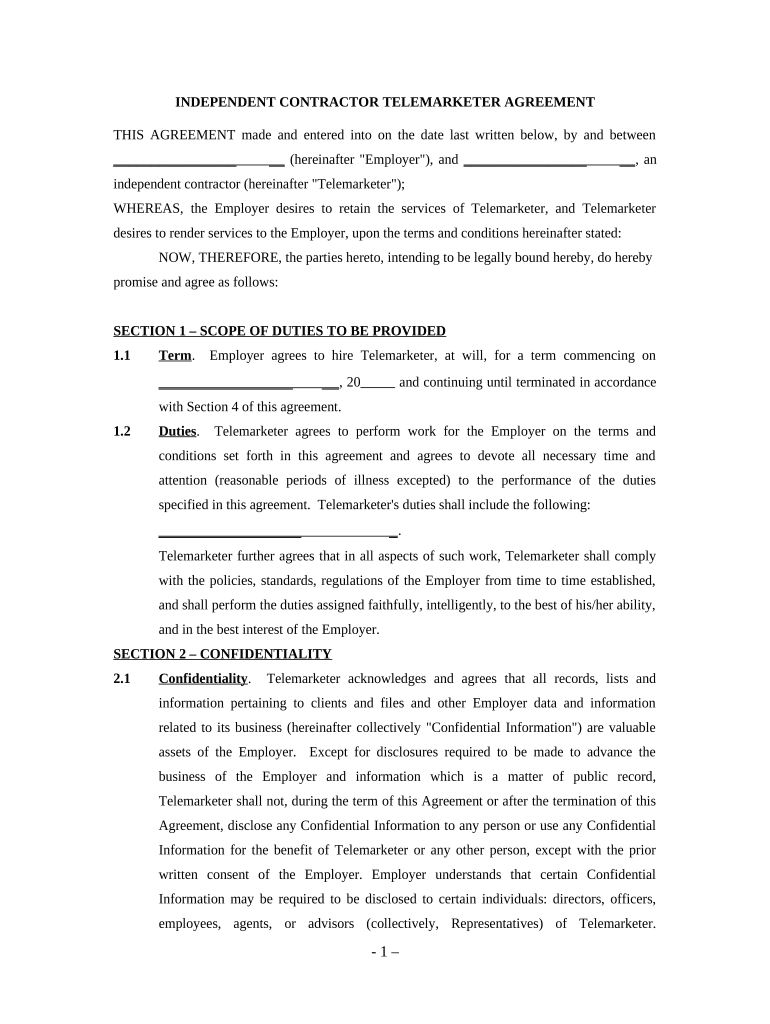
Telemarketing Agreement - Self-Employed Independent Contractor 2026

Get Form
Telemarketing Agreement - Self-Employed Independent Contractor Preview on Page 1

Here's how it works

01. Edit your form online
Type text, add images, blackout confidential details, add comments, highlights and more.
02. Sign it in a few clicks
Draw your signature, type it, upload its image, or use your mobile device as a signature pad.
03. Share your form with others
Send it via email, link, or fax. You can also download it, export it or print it out.

How to use or fill out Telemarketing Agreement - Self-Employed Independent Contractor with Our Platform

Form edit decoration
9.5
Ease of Setup
DocHub User Ratings on G2
9.0
Ease of Use
DocHub User Ratings on G2
  1. Click ‘Get Form’ to open the Telemarketing Agreement in the editor.
  2. Begin by filling in the Employer's name and the Telemarketer's name at the top of the document. This establishes the parties involved in the agreement.
  3. In Section 1, specify the term of employment by entering the start date and any relevant details about duties expected from the Telemarketer.
  4. Proceed to Section 2 to acknowledge confidentiality. Ensure you understand what constitutes Confidential Information and agree not to disclose it without permission.
  5. In Section 3, enter compensation details, including payment amount and frequency (hourly, weekly, etc.).
  6. Review Section 4 for termination conditions. Fill in any required notice periods or mutual agreement terms.
  7. Complete Sections 5 through 7 by confirming independent contractor status and understanding legal obligations. Sign and date at the end of the document.

Start using our platform today to easily complete your Telemarketing Agreement for free!

be ready to get more

Complete this form in 5 minutes or less

Get form

Got questions?

We have answers to the most popular questions from our customers. If you can't find an answer to your question, please contact us.
Contact us
The parties agree that this Agreement is non-exclusive, and each party is free to, and may, enter into similar agreements with other parties. Nothing in this Agreement shall restrict either party from engaging in or providing similar services or products to third parties.
You shall not, directly or indirectly, in any manner, solicit, entice or attempt to persuade any consultant of the Company to leave the Company in order to work for or otherwise engage with a Competing Business or otherwise participate in or facilitate the hire, directly or through another entity, of any person who is
The Use of Non-Solicitation Agreements Non-solicitation agreements are often used in employment contracts to protect an employers business interests. However, California courts have held that these agreements are void and unenforceable because they restrain trade in violation of public policy.
A salesperson is an individual engaged in the selling of merchandise or services. The salesperson can be a common law employee, an independent contractor, an employee by specific statute, or an excluded employee by specific statute.
The general rule is that an individual is an independent contractor if the person for whom the services are performed has the right to control or direct only the result of the work and not what will be done and how it will be done. If you are an independent contractor, then you are self-employed.

Security and compliance

At DocHub, your data security is our priority. We follow HIPAA, SOC2, GDPR, and other standards, so you can work on your documents with confidence.

Learn more
ccpa2
pci-dss
gdpr-compliance
hipaa
soc-compliance

People also ask

In sum, the new federal rule is that a worker is an independent contractor if the worker is, as a matter of economic reality, in business for themselves. In California, most jobs are governed by the so-called ABC Test, which is stricter than the new federal test.
Do NDAs apply to independent contractors? Yes, independent contractors must comply with the terms of non-disclosure agreements. If a contractor shares confidential information with third parties without permission, an indemnification clause is triggered, leading to hefty fines and penalties.
Understanding Non-Solicitation Agreements In most cases, they prevent former employees, independent contractors, or partners from selling a companys clients or customers after leaving the company or ending their association with the business.

Related links