




01. Edit your best interest of the child letter example online
Type text, add images, blackout confidential details, add comments, highlights and more.

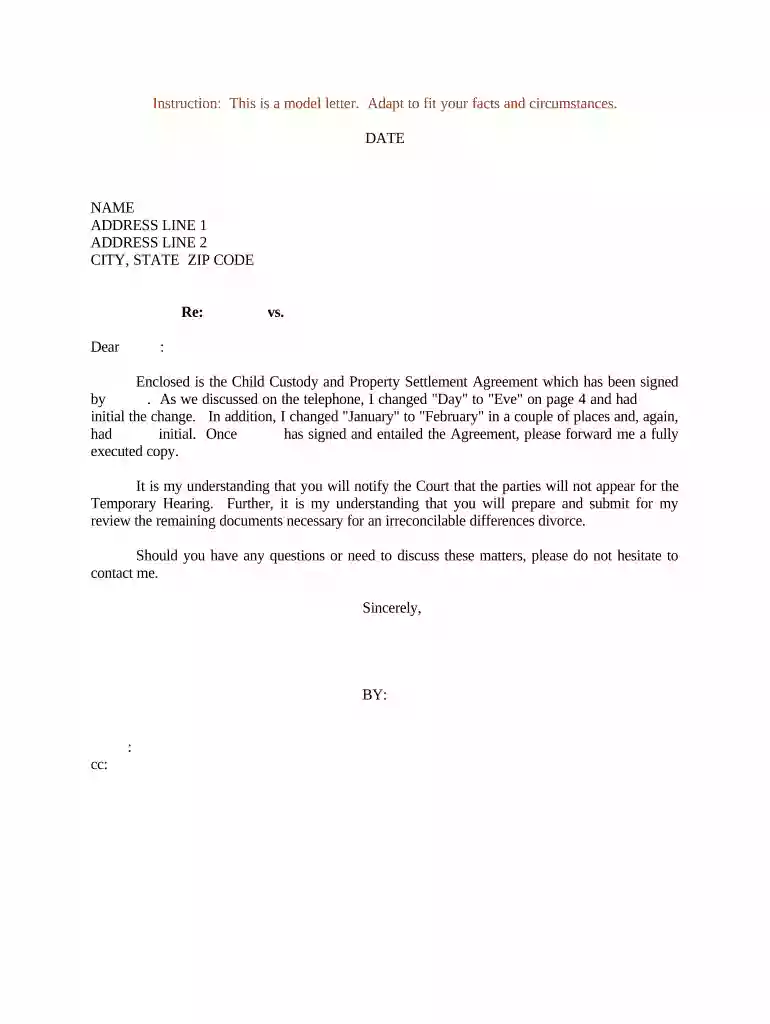
Type text, add images, blackout confidential details, add comments, highlights and more.

Draw your signature, type it, upload its image, or use your mobile device as a signature pad.

Send child custody declaration letter example via email, link, or fax. You can also download it, export it or print it out.
A sample child custody agreement outlines how parents will manage the upbringing and care of their children following a separation or divorce. This document is crucial for ensuring that the best interests of the child are prioritized while providing a clear structure for co-parenting. Here, we explore the essential elements of a child custody agreement, detailing their function, importance, and what to include.
In drafting a sample child custody agreement, one must first understand the different types of custody arrangements available:
Legal Custody: Refers to the right and responsibility to make decisions about a child's upbringing, including education, healthcare, and religious training. Legal custody can be joint or sole, depending on whether both parents share decision-making responsibilities or one parent holds that authority.
Physical Custody: This pertains to where the child lives on a day-to-day basis. Physical custody can also be joint, allowing children to live with both parents at different times, or sole, where the child resides primarily with one parent.
Understanding these terms helps in defining your custody arrangement and establishing a respectful framework for cooperation between parents.
A comprehensive sample child custody agreement should include several key provisions. Here are critical elements to establish clarity and understanding:
Custody Schedule: Detail how time with each parent will be allocated, including regular visitation hours, holidays, and school vacations. For example, one parent might have the child every other weekend, while the other has custody during the week.
Decision-Making Responsibilities: Specify which parent has the authority to make critical decisions about the child's education, health, and welfare. This includes when to seek medical help or which school the child will attend.
Communication Guidelines: Establish how parents will communicate about their child's needs and activities. Clear rules regarding notifications for emergencies, schedule changes, and activities can prevent misunderstandings.
This structured approach benefits both parents and children by providing predictable routines and reducing conflict.
Life circumstances can change, and so might the needs of both parents and children. Including provisions for modifying the agreement is essential to accommodate future changes. Here are important aspects to consider:
Modification Process: Outline how either parent can request changes to the custody agreement and the process involved in making those modifications. For instance, if one parent relocates or there is a significant change in work schedules, a formal review and amendment process should be in place.
Dispute Resolution Mechanisms: Detail the steps to resolve disagreements. Whether through mediation, arbitration, or court intervention, having a clear path to resolve disputes reduces potential conflict and fosters cooperation.
This proactive approach emphasizes the importance of flexibility along with a commitment to keeping the child's best interests at the forefront.
While primarily focused on custody, it is critical to address financial responsibilities in the sample child custody agreement. Here are key components to include:
Child Support Obligations: Clearly delineate the child support payments required by one parent to assist in the child's living and educational expenses. This often includes tuition, healthcare, and extracurricular activities.
Expense Sharing: Specify how costs related to the child, such as medical bills and school fees, will be shared between parents. For example, both parents could agree to split unforeseen medical expenses or extracurricular fees according to their financial capabilities.
Including financial provisions ensures that both parents remain accountable for the financial well-being of their child, which is fundamental in a co-parenting situation.
To ensure that the child custody agreement is legally enforceable, certain formalities must be adhered to. Key steps include:
Signing and Notarizing: The agreement should be signed by both parents, ideally with witnesses and notarized to provide additional legal standing. This adds weight to the agreement and indicates mutual consent.
Filing with the Court: Depending on jurisdiction, the custody agreement may need to be submitted to and approved by a family court. This process helps formalize the agreement and ensures it is legally binding.
Following these steps not only provides security to both parents but also establishes a clear legal framework for the child’s care and upbringing.
Creating a well-structured sample child custody agreement emphasizes the need for clarity and frequent communication between parents. In practice, a collaborative environment allows both parties to navigate the complexities of co-parenting more smoothly. This also benefits the child by ensuring they feel secure and supported, regardless of their parents' relationships.
Establishing a foundation that focuses on cooperation, flexibility, and the child's best interests contributes significantly to effective co-parenting and overall family dynamics.
At DocHub, your data security is our priority. We follow HIPAA, SOC2, GDPR, and other standards, so you can work on your documents with confidence.

A chain of custody should be completed to document the transfer of samples from the field to the laboratory. 5.2.1 Recording Field Conditions. Monitoring ofRead more
This parenting plan is for the following child(ren) born to, or adopted by, the parents: A. Decision-Making Responsibility: (Select one). Post-JudgmentRead more
This template is intended primarily for an initial determination of permanent custody in a pro se dispute between two parents. Although this template is alsoRead more


