




Here's how it works

01. Edit your cost plus construction contract pdf online
Type text, add images, blackout confidential details, add comments, highlights and more.

02. Sign it in a few clicks
Draw your signature, type it, upload its image, or use your mobile device as a signature pad.

03. Share your form with others
Send cost plus fixed fee contract sample via email, link, or fax. You can also download it, export it or print it out.
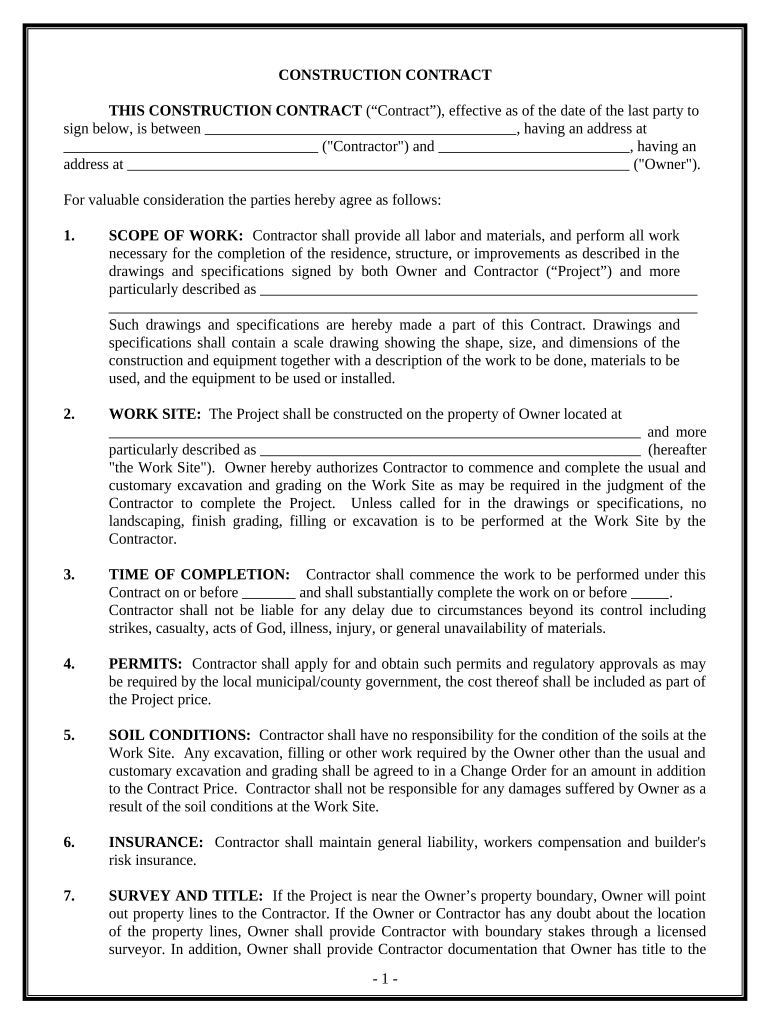
How to use or fill out Construction Contract Cost Plus or Fixed Fee - Arizona with our platform

- Click ‘Get Form’ to open the Construction Contract Cost Plus or Fixed Fee - Arizona in the editor.
- Begin by filling in the Contractor's name and address at the top of the form. This identifies who will be performing the work.
- Next, enter the Owner's name and address. This section is crucial as it specifies who is hiring the Contractor.
- In the 'SCOPE OF WORK' section, provide a detailed description of the project, including drawings and specifications that outline what work will be done.
- Specify the 'WORK SITE' by entering the property address where construction will take place. Ensure this matches any legal documents related to ownership.
- Fill in the 'TIME OF COMPLETION' dates to establish when work will start and when it is expected to be completed.
- Choose between 'COST PLUS' or 'FIXED FEE' payment structures and fill in relevant amounts for each option based on your agreement with the Contractor.
- Review all sections for accuracy before saving your document. Utilize our platform’s features to sign and share your completed contract easily.
Start using our platform today for free to streamline your construction contract process!
Fill out Construction Contract Cost Plus or Fixed Fee - Arizona online
It's free
Got questions?
We have answers to the most popular questions from our customers. If you can't find an answer to your question, please contact us.
Contact us
What is a disadvantage of a cost-plus fixed-fee contract?
Cost plus construction contracts offer advantages like transparency, flexibility, and reduced contractor risk. They also come with drawbacks, including uncertain pricing, a higher administrative workload, and a greater risk of disputes.
When to use cost-plus fixed-fee?
A cost-plus contract reimburses contractors for project costs plus either a percentage or fixed fee, which they take as profit. This type of contract is favored by contractors because of the flexibility they offer. This makes them ideal for projects where the scope is unclear and subject to change.
What percentage do contractors charge for cost-plus?
Most contracts have a cost-plus fee scale of 10-25%. A contractor would use takeoff software to calculate the materials costs, but they wouldnt need to be exact. Some companies use a cost-plus-fixed-fee (CPFF) instead of a percentage.
When to use a cost-plus fixed fee contract?
These contracts are commonly used in research, development, and technical service projects, where precise costs are difficult to estimate in advance.
When would you use a cost-plus contract?
Construction project owners may employ this type of contract when they want to get a project moving quickly or when the scope of work is unclear, making it difficult to estimate the total cost. That said, the total price for a cost-plus contract may ultimately be higher than it would be with other contract types.
Security and compliance
At DocHub, your data security is our priority. We follow HIPAA, SOC2, GDPR, and other standards, so you can work on your documents with confidence.
Learn more


People also ask
What is a standard cost-plus construction contract?
A cost-plus contract is a construction agreement that requires reimbursement for project costs as well as a markup that covers the contractors overhead and profit. In other words, the name is a short-hand way of remembering what the contract covers: project costs plus contractor markup.
What are the disadvantages of a cost-plus fee contract?
Here are some of the disadvantages businesses should consider: Risk of cost overruns: Because the client agrees to reimburse all costs, theres a risk that the project will go over budget. If the contractor isnt managing expenses well, the client will end up paying the bill.
Which is an advantage of the cost-plus fixed-fee contract?
Benefits of a cost-plus fixed-fee contract They allow you to explore and adjust the scope, unlike firm-fixed-price contracts. CPFF contracts foster better communication between clients and contractors, especially when both parties must work closely to guarantee contract performance.