



01. Edit your barring notice template online
Type text, add images, blackout confidential details, add comments, highlights and more.

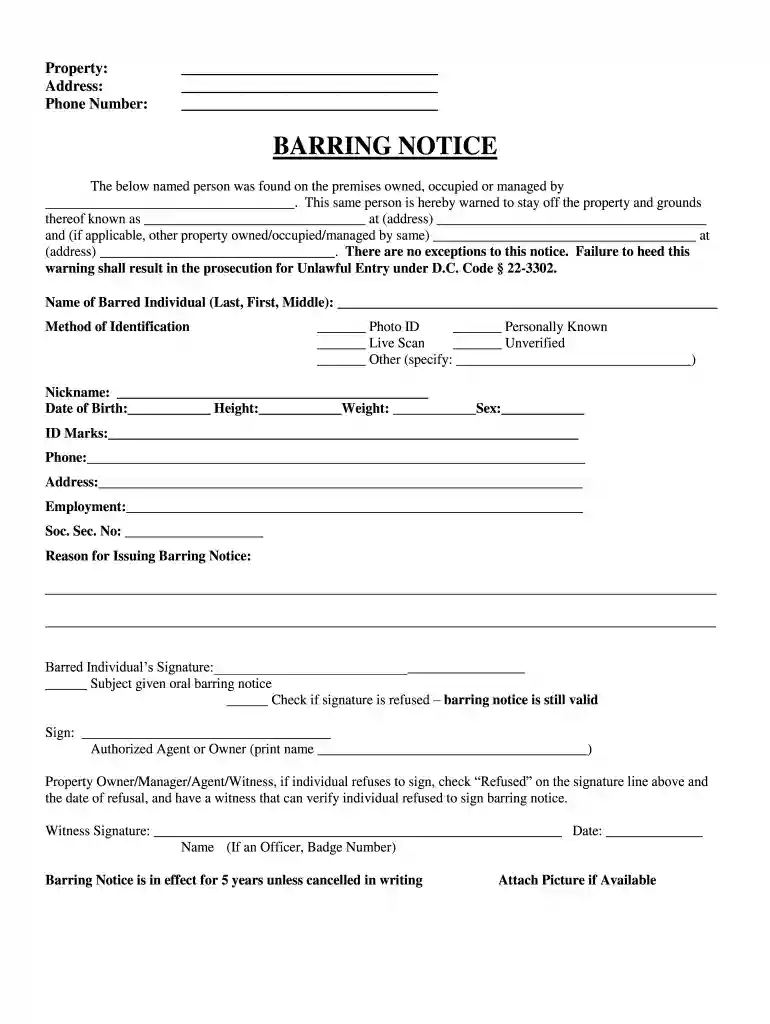
Type text, add images, blackout confidential details, add comments, highlights and more.

Draw your signature, type it, upload its image, or use your mobile device as a signature pad.

Send barring notice via email, link, or fax. You can also download it, export it or print it out.
A barring notice serves as a formal document that prohibits an individual from entering or remaining on a specific property. This notice is critical in maintaining security and enforcing the lawful use of property. It typically contains essential details such as the individual's name, identification method, and the specific reasons for barring them from the premises. The notice serves as a preventative measure against unlawful entry and can lead to legal consequences if disregarded.
A barring notice remains valid for a designated period, often five years, unless formally canceled in writing by the issuing authority. This aspect ensures clarity and accountability, as individuals are notified of the repercussions of failing to comply with the notice. Understanding this form is vital for property owners, law enforcement, and individuals who might receive such notices.
The barring notice includes several key components that provide clarity and enforceability:
Personal Information: This section identifies the individual who is being barred, including their name and any relevant identification information, such as a driver's license number.
Property Details: The notice specifies the property or premises from which the individual is barred, ensuring there is no ambiguity about the location in question.
Duration of the Notice: The barring notice will indicate its effective period, traditionally lasting for five years unless canceled.
Reason for Barring: A clear articulation of the reasons behind the barring, which may include previous incidents, unlawful behavior, or threats, is crucial.
Consequences of Non-Compliance: It typically outlines that failure to adhere to the notice may result in prosecution for unlawful entry, establishing the legal basis for its issuance.
These elements work together to create a comprehensive notice that not only informs the individual but also protects the property owner's rights.
Completing a barring notice involves several structured steps to ensure it is legally binding and effective:
Gather Required Information: Collect all necessary details regarding the individual being barred, including full name, identification specifics, and any relevant history of incidents.
Specify the Property Location: Clearly identify the property by providing its full address and any additional descriptors (e.g., suite number, property type).
Detail the Reasons: Write a concise and accurate description of the reasons for the barring, ensuring it is factual and can stand up to scrutiny if challenged.
Set the Duration: Establish the time frame for the barring notice, commonly five years, and include a statement explaining how it can be lifted if required.
Signature and Date: Ensure the document is appropriately signed and dated by the issuing authority, validating the barring notice to be legally recognized.
Distribution: Serve the notice to the individual in person or via certified mail to ensure there is documented proof of delivery.
Following these steps helps to create a clear and enforceable barring notice while minimizing the risk of legal complications.
The legal implications of a barring notice are significant and must be understood by both issuers and recipients. A barring notice is not merely a suggestion; it is a formal declaration supported by the rule of law. Here are a few important legal considerations:
Adherence to Local Laws: Different states may have specific requirements for issuing a barring notice. Therefore, it is crucial to be familiar with applicable local laws to ensure compliance.
Enforceability: Failure to comply with a barring notice can lead to legal penalties, including the possibility of criminal charges for trespassing. This reinforces the serious nature of the notice.
Documentation: Keeping accurate records of the barring notice issuance and delivery can provide protection against potential legal challenges from the barred individual.
This legal framework emphasizes the critical function of a barring notice in property management and safety.
Real-world scenarios illustrate how barring notices operate effectively in various contexts:
Tenant Issues: In cases where tenants exhibit disruptive behavior or violate lease agreements, landlords may issue a barring notice to prevent them from returning to the property without legal consequences.
Public Spaces: A local park may issue a barring notice to individuals engaged in illegal activities, warning them against future trespassing and preserving community safety.
Commercial Properties: Retail stores often utilize barring notices for individuals caught shoplifting or creating disturbances, discouraging repeat offenses and protecting their business interests.
In these examples, barring notices serve as proactive measures to maintain order, safety, and compliance within specified domains.
We've got more versions of the barring notice template form. Select the right barring notice template version from the list and start editing it straight away!
| Versions | Form popularity | Fillable & printable |
|---|---|---|
| 2011 | 4.8 Satisfied (236 Votes) |
At DocHub, your data security is our priority. We follow HIPAA, SOC2, GDPR, and other standards, so you can work on your documents with confidence.
The GW Police Department (GWPD) may issue a Barring Notice to GW Community Members or Non-University Affiliates verbally or in writing at the time of theRead more
The below named person was found on the premises owned, occupied or managed by . This same person is hereby warned to stay off the property and grounds.Read more
Thanks to call barring you can avoid expensive phone bill surprises by blocking calls to specific numbers, to numbers starting with certain digits (for exampleRead more


