New jersey succession 2026

Get Form
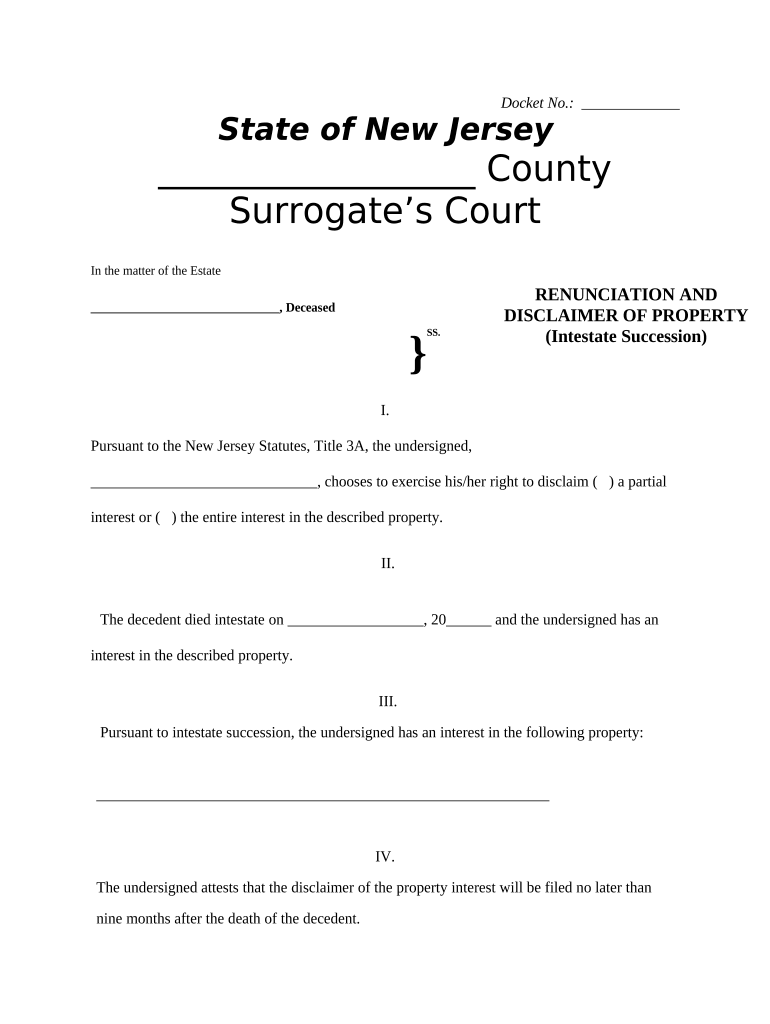
new jersey succession Preview on Page 1

Here's how it works

01. Edit your form online
Type text, add images, blackout confidential details, add comments, highlights and more.
02. Sign it in a few clicks
Draw your signature, type it, upload its image, or use your mobile device as a signature pad.
03. Share your form with others
Send it via email, link, or fax. You can also download it, export it or print it out.

How to use or fill out New Jersey Succession with our platform

Form edit decoration
9.5
Ease of Setup
DocHub User Ratings on G2
9.0
Ease of Use
DocHub User Ratings on G2
  1. Click ‘Get Form’ to open the New Jersey Succession document in the editor.
  2. In Section I, indicate whether you are disclaiming a partial interest or the entire interest in the property by checking the appropriate box.
  3. Fill in the date of death of the decedent in Section II. This is crucial for establishing timelines related to your disclaimer.
  4. In Section III, provide a detailed description of the property you have an interest in. Be as specific as possible to avoid any confusion.
  5. Ensure that you attest in Section IV that your disclaimer will be filed within nine months after the decedent's death.
  6. Review Sections V and VI carefully, as they outline your legal rights and responsibilities regarding the property.
  7. Complete the signature section at the bottom, ensuring all required fields are filled out accurately before submitting.

Start using our platform today to streamline your New Jersey Succession form completion for free!

be ready to get more

Complete this form in 5 minutes or less

Get form

Got questions?

We have answers to the most popular questions from our customers. If you can't find an answer to your question, please contact us.
Contact us
The simplest way to avoid inheritance tax is to leave your estate to Class A or E beneficiaries. Gifts to qualifying charities are fully exempt from inheritance tax. Including charitable donations in your will can reduce the taxable estate.
The Surrogate will issue an Affidavit of Next-of-Kin which will enable the affiant to receive the personal assets of the decedent for the benefit of all next-of-kin and creditors. Only the assets listed on the Affidavit may be transferred.
A spouse and children are typically first in line, but how much each receives depends on whether children are from the current marriage or a previous one. If there is no surviving spouse or children, the estate passes to the decedents parents, then to siblings, nieces, and nephews.
Next of Kin Hierarchy: Surviving spouse or domestic partner: The spouse or legally recognized partner usually has the highest claim. Children or grandchildren: If no spouse exists, the decedents descendants are next. Surviving parent: If there is no spouse or children, the surviving parent is next in line.
New Jersey follows a structured order of inheritance when someone dies without a will. Your spouse and children are first in line, but how your assets are divided depends on your specific family situation. If youre married with children from your current marriage, your spouse inherits most of the estate.

Security and compliance

At DocHub, your data security is our priority. We follow HIPAA, SOC2, GDPR, and other standards, so you can work on your documents with confidence.

Learn more
ccpa2
pci-dss
gdpr-compliance
hipaa
soc-compliance

People also ask

What is the Order of Inheritance Without a Will? If you lack a spouse or children, your parents inherit everything. Without a spouse, children, or parents, your siblings inherit everything. A spouse inherits everything if no children, parents, or siblings are present.

Related links