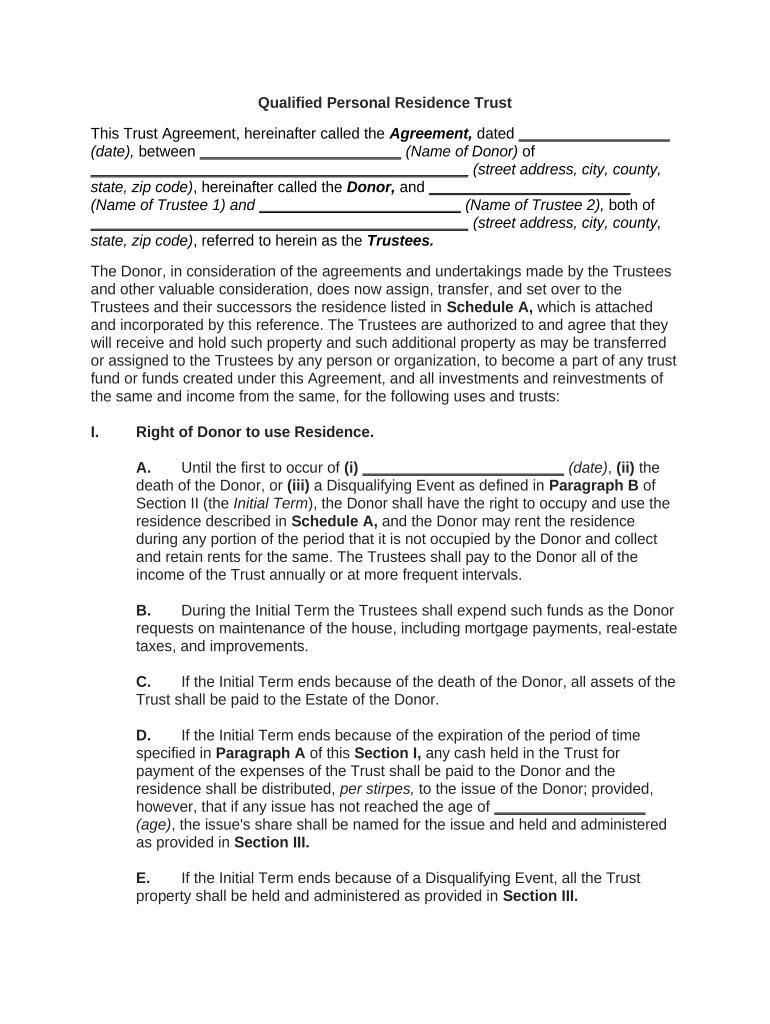
Qualified personal residence trust form 2026

Get Form
qualified personal residence trust example Preview on Page 1

Here's how it works

01. Edit your qualified personal residence trust example online
Type text, add images, blackout confidential details, add comments, highlights and more.
02. Sign it in a few clicks
Draw your signature, type it, upload its image, or use your mobile device as a signature pad.
03. Share your form with others
Send qualified personal residence trust via email, link, or fax. You can also download it, export it or print it out.

How to use or fill out qualified personal residence trust form with our platform

Form edit decoration
9.5
Ease of Setup
DocHub User Ratings on G2
9.0
Ease of Use
DocHub User Ratings on G2
  1. Click ‘Get Form’ to open the qualified personal residence trust form in the editor.
  2. Begin by entering the date of the agreement at the top of the form. This is crucial for establishing the timeline of the trust.
  3. Fill in the name and address of the Donor, ensuring all details are accurate to avoid any legal complications.
  4. Next, input the names and addresses of both Trustees. This section is vital as it designates who will manage the trust.
  5. Complete Schedule A by listing the residence being transferred into the trust. Ensure this information is precise, as it defines what property is included.
  6. In Section I, specify any conditions regarding the Donor's right to use and occupy the residence during the Initial Term. Be clear about dates and terms.
  7. Review Sections II through XII carefully, filling in any required fields related to tax qualifications, distributions, and trustee powers as applicable.

Start using our platform today for free to streamline your document editing and ensure your qualified personal residence trust form is completed accurately!

be ready to get more

Complete this form in 5 minutes or less

Get form

Got questions?

We have answers to the most popular questions from our customers. If you can't find an answer to your question, please contact us.
Contact us
The primary risk of a QPRT is the grantors death before the end of the trust term, which could result in the home being included in the taxable estate. Additionally, changes in the grantors circumstances or real estate market conditions can impact the effectiveness of the QPRT.
A QPRT Example: She retains the right to occupy the home for 10 years, after which the home will pass to her son. Assuming a discount rate of 5.6%, Jills gift can be discounted by $420,090. The gift is valued at $579,910, but Jill owes no gift tax because its offset by her available gift tax exemption.
For example, if you were age 50, created a QPRT with a 15-year term, transferred your $1,000,000 house to the QPRT, and then died 14 years and 11 months later when the residence were valued at $1,800,944, the value of the residence would be included in your estate at $1,800,944 just as it would have been had the QPRT
A PRT is very limited and inflexible, because it must not hold any assets other than the residence and must not allow the sale of the residence. A QPRT can hold limited amounts of cash for expenses or improvements to the residence, and can allow the residence to be sold (but not to the grantor or the grantors spouse).
A QPRT is an irrevocable trust designed to reduce the amount of gift and estate taxes typically incurred when transferring a personal residence to beneficiaries. By transferring your home into a QPRT, you can continue living in it for a specified term while passing it on to your heirs at a reduced transfer tax cost.

Security and compliance

At DocHub, your data security is our priority. We follow HIPAA, SOC2, GDPR, and other standards, so you can work on your documents with confidence.

Learn more
ccpa2
pci-dss
gdpr-compliance
hipaa
soc-compliance

People also ask

For example, if a QTIP trust has a value of $1 million and the surviving spouse receives $100,000 per year in payments from the trust, the value of the surviving spouses gross estate would be $1.1 million. The estate tax would be due on the entire $1.1 million.
How a Qualified Personal Residence Trust (QPRT) Works. A qualified personal residence trust can be useful when the trust expires prior to the death of the grantor. If the grantor dies before the term, the property is included in the estate and is subject to tax.
What are the benefits of setting up a QPRT? When you transfer your home into a QPRT, the value of the gift used for gift tax reporting purposes is calculated based on the current value of your home minus the value of your retained interest in living there for the term of the QPRT.

qualified personal residence trust form