Irrevocable trust death 2026

Get Form
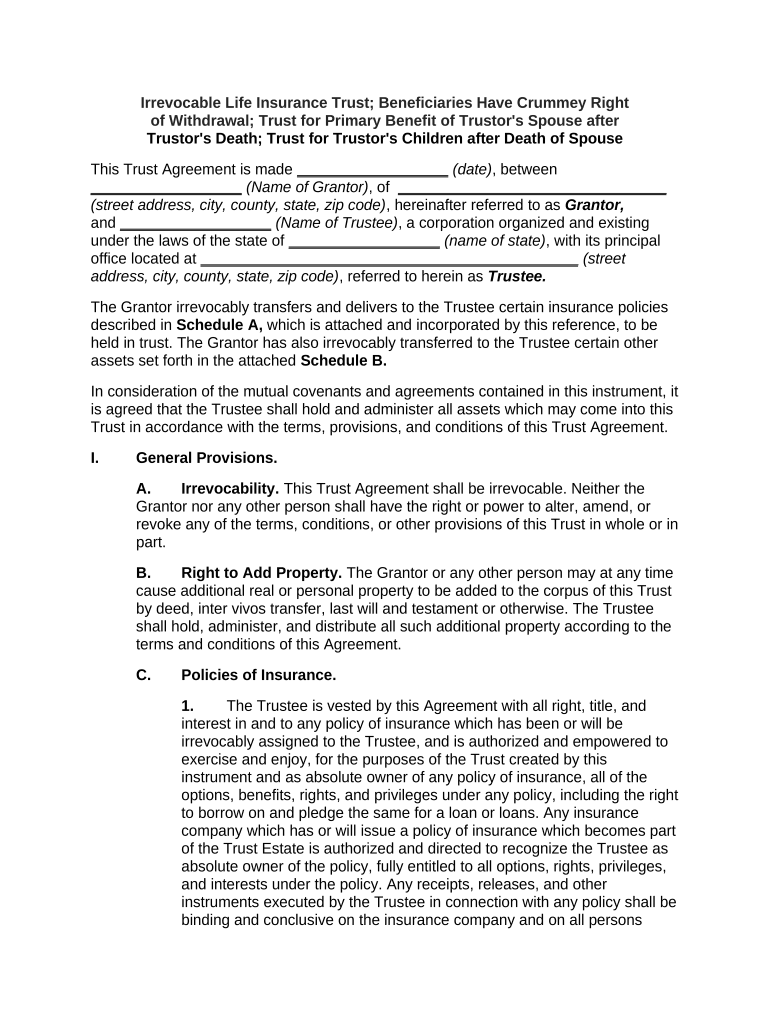
irrevocable trust death Preview on Page 1

Here's how it works

01. Edit your form online
Type text, add images, blackout confidential details, add comments, highlights and more.
02. Sign it in a few clicks
Draw your signature, type it, upload its image, or use your mobile device as a signature pad.
03. Share your form with others
Send it via email, link, or fax. You can also download it, export it or print it out.

How to use or fill out irrevocable trust death with our platform

Form edit decoration
9.5
Ease of Setup
DocHub User Ratings on G2
9.0
Ease of Use
DocHub User Ratings on G2
  1. Click ‘Get Form’ to open the irrevocable trust death document in the editor.
  2. Begin by entering the date of the Trust Agreement and the names and addresses of both the Grantor and Trustee in the designated fields.
  3. In Schedule A, list all insurance policies being transferred to the Trustee. Ensure that each policy is clearly identified for accurate record-keeping.
  4. For Schedule B, include any additional assets being placed into the Trust. This section is crucial for defining what constitutes the Trust Estate.
  5. Review sections on General Provisions, ensuring you understand terms like Irrevocability and Right to Add Property. Fill in any specific details required.
  6. Complete sections regarding Disposition of Trust Estate, specifying how income and principal will be distributed among beneficiaries after the Grantor's death.
  7. Finalize by signing and dating where indicated, ensuring all parties involved have acknowledged their roles within this agreement.

Start using our platform today to streamline your irrevocable trust death form completion for free!

be ready to get more

Complete this form in 5 minutes or less

Get form

Got questions?

We have answers to the most popular questions from our customers. If you can't find an answer to your question, please contact us.
Contact us
The type of trust impacts how the assets are taxed. For instance, assets in an irrevocable trust are typically not subject to estate taxes because they are no longer part of the grantors taxable estate.
The assets in an irrevocable trust are typically distributed according to a predetermined schedule, such as monthly or yearly, or upon specific events, such as when the beneficiary docHubes a certain age, gets married, or achieves another milestone.
If the beneficiary dies first, then it is paid to the estate of the policy owner. If the beneficiary dies after, then the death benefit is paid to the estate of the beneficiary. The best way to ensure that someone you choose gets your policys death benefit is by adding contingent beneficiaries.

Security and compliance

At DocHub, your data security is our priority. We follow HIPAA, SOC2, GDPR, and other standards, so you can work on your documents with confidence.

Learn more
ccpa2
pci-dss
gdpr-compliance
hipaa
soc-compliance