






Definition and Purpose of 2015 Form 1065
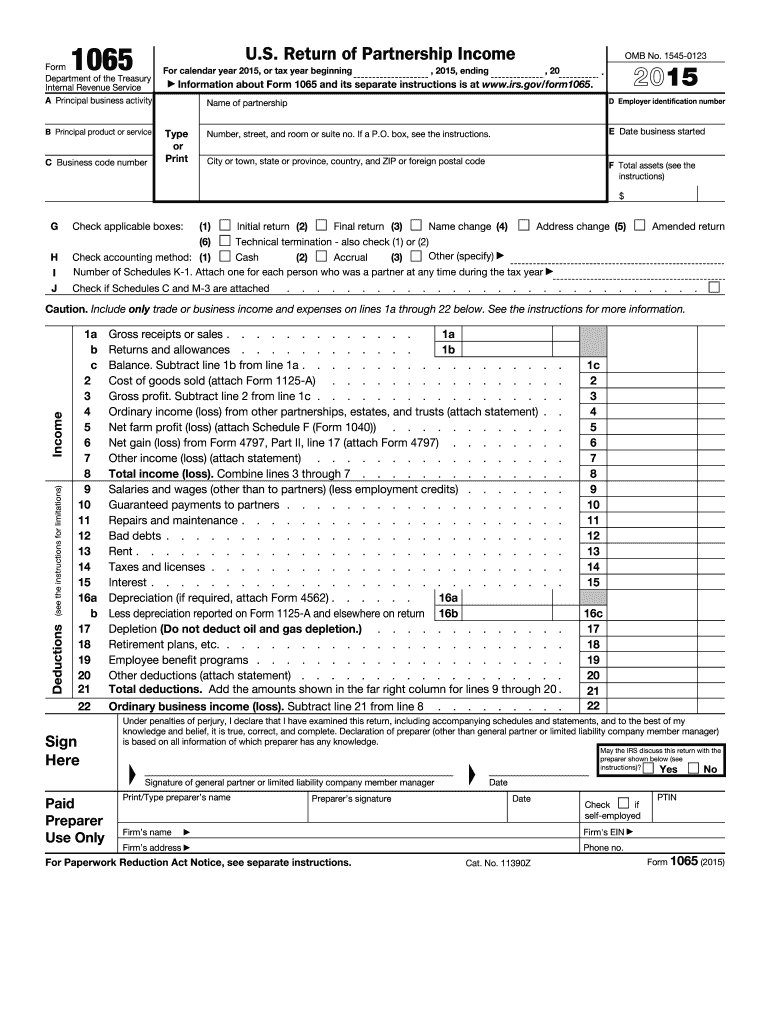
The 2015 Form 1065, officially titled the U.S. Return of Partnership Income, is a key document used by partnerships to report their income, deductions, and tax-related transactions to the IRS. Partnerships, unlike corporations, do not pay income tax directly. Instead, they pass on the financial burden to the partners, who then report their share of income or loss on their personal tax returns. The form serves as a comprehensive record, detailing the financial activities of the partnership for tax purposes.
Key Sections of the Form
- Partnership Identification: Includes essential information such as the partnership's name, employer identification number (EIN), and address.
- Income and Deductions: Details the partnership's total income and any eligible deductions. This section aligns with the gross sales, ordinary income, and various expenses the partnership incurred during the tax year.
- Partner Distributions: Reports any distributions made to partners during the year, ensuring transparency and accurate reporting of partnership profits.
Steps to Complete the 2015 Form 1065
Completing the 2015 Form 1065 requires careful attention to detail, as accurate reporting is crucial for compliance and audit protection.
- Gather Necessary Information: Assemble all financial documents, such as income statements, balance sheets, and receipts for deductible expenses.
- Fill Out the Main Form: Begin with basic partnership information, followed by reporting total income and deductions.
- Complete the Schedules: Utilize Schedule K for partner allocations and Schedule L for the balance sheet details.
- Review for Accuracy: Double-check entries for accuracy to avoid penalties or rejections.
- Sign and Date the Form: Ensure that one of the partners signs and dates the form before submission.
Important Terms Related to 2015 Form 1065
Understanding key terms is vital for accurately completing Form 1065.
- Ordinary Income: Revenue earned from usual business activities minus cost of goods sold, wages, and other ordinary expenses.
- Partner’s Share: The portion of income or loss assigned to each partner based on the partnership agreement.
- Schedule K: A summary section where you report the partners’ shares of income, deductions, credits, etc.
IRS Guidelines for Filing
The IRS provides specific guidelines that partnerships must adhere to when filing Form 1065.
Filing Requirements
- Due Date: The form generally must be filed by March 15 following the close of the tax year.
- Extension Requests: Partnerships can file for a six-month extension using Form 7004, giving until September 15 to submit the final form.
- Electronic Filing: Mandatory for partnerships with more than 100 partners.
Filing Deadlines and Important Dates
Adhering to IRS deadlines is critical to avoid penalties.
- Original Due Date: March 15, 2016, for the 2015 tax year.
- Extended Due Date: September 15, 2016, with an approved extension.
- Important Notice: Ensure timely submission to avoid late fees and interest charges.
Penalties for Non-Compliance
Non-compliance with IRS regulations for Form 1065 can lead to significant penalties.
- Late Filing: A penalty of $210 per month per partner can be imposed for failing to file on time.
- Inaccurate Information: Penalties may apply for incomplete or inaccurate information, emphasizing the importance of precision.
Business Entity Types and Eligibility
Form 1065 is specifically designed for partnerships and other entities treated as partnerships for tax purposes.
Eligible Entities
- General Partnerships: Typically require Form 1065 to report income.
- Limited Partnerships and LLCs: Filing is necessary if the entity has more than one owner.
- Exempt Entities: Single-member LLCs do not file Form 1065; they are generally treated as disregarded entities.
Versions and Alternatives to 2015 Form 1065
While the 2015 Form 1065 is specific to the tax year, understanding its alternatives and related forms can be beneficial.
- Form 1065X: Used to correct errors on a previously filed Form 1065.
- Prior Versions: The 2014 version for late submissions and amendments related to earlier fiscal activities.
- International Versions: Certain forms are relevant for partnerships with overseas operations and might require additional filings such as Form 5471 for foreign entities.
The comprehensive understanding of the 2015 Form 1065 and its requirements ensures accurate reporting and compliance, reducing potential legal and financial risks for partnerships.