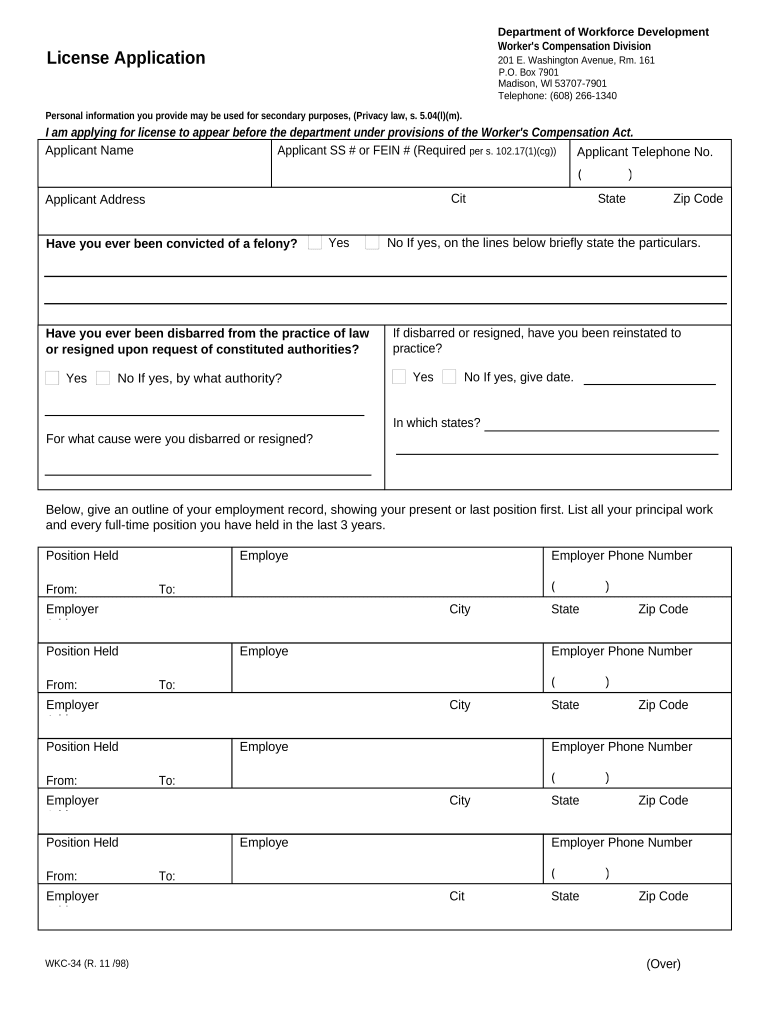
License Application for Workers' Compensation - Wisconsin 2026

Get Form
License Application for Workers' Compensation - Wisconsin Preview on Page 1

Here's how it works

01. Edit your form online
Type text, add images, blackout confidential details, add comments, highlights and more.
02. Sign it in a few clicks
Draw your signature, type it, upload its image, or use your mobile device as a signature pad.
03. Share your form with others
Send it via email, link, or fax. You can also download it, export it or print it out.

How to use or fill out License Application for Workers' Compensation - Wisconsin with DocHub

Form edit decoration
9.5
Ease of Setup
DocHub User Ratings on G2
9.0
Ease of Use
DocHub User Ratings on G2
  1. Click ‘Get Form’ to open the License Application for Workers' Compensation in our editor.
  2. Begin by entering your personal information, including your name, Social Security Number (SS#) or Federal Employer Identification Number (FEIN#), and telephone number. Ensure all required fields are filled accurately.
  3. Indicate whether you have ever been convicted of a felony or disbarred from practicing law. If applicable, provide details in the designated areas.
  4. Outline your employment record by listing your positions held over the last three years, starting with your most recent job. Include employer names, addresses, and phone numbers.
  5. Provide three non-family references along with their contact information. This includes their names, phone numbers, and addresses.
  6. Write a brief statement about your background and experience related to Workers' Compensation matters.
  7. For any hearings attended without a license, list the hearing dates, case names, and parties you represented.
  8. Finally, review all entered information for accuracy before signing and dating the application at the bottom of the form.

Start using our platform today to fill out your License Application for Workers' Compensation quickly and efficiently!

be ready to get more

Complete this form in 5 minutes or less

Get form

Got questions?

We have answers to the most popular questions from our customers. If you can't find an answer to your question, please contact us.
Contact us

Electronic document approval demands a software solution that complies with data security and eSignature standards. DocHub is a perfect tool for that, as it meets all the previously mentioned requirements. Whatever method you like to sign your License Application for Workers' Compensation - Wisconsin in DocHub, your electronic signature will be legally binding and court-admissible.

As a comprehensive document modifying platform, DocHub is available on mobile devices. Open DocHub in your choice of mobile browser and employ our smart mobile-friendly toolset to fill out your License Application for Workers' Compensation - Wisconsin.

Under the Workers Compensation Act (Act), you must carry workers compensation insurance if you do any one of the following: Employ 3 or more full-time or part-time employees. You must have insurance on the day you employ the third person.
To file a claim, an injured worker must: complete an Uninsured Employers Fund Claim Application (by calling (608) 266-3046 and requesting the UEF application form be mailed to them)
While workers cannot be fired in Wisconsin while on workers compensation, there are also protections when it comes to returning to the job. For example, employers need reasonable cause to refuse to rehire a worker from their previous job.

Security and compliance

At DocHub, your data security is our priority. We follow HIPAA, SOC2, GDPR, and other standards, so you can work on your documents with confidence.

Learn more
ccpa2
pci-dss
gdpr-compliance
hipaa
soc-compliance

People also ask

While workers cannot be fired in Wisconsin while on workers compensation, there are also protections when it comes to returning to the job. For example, employers need reasonable cause to refuse to rehire a worker from their previous job.
For temporary disability calculations involving the 3-day waiting period, indemnity is due for the first 3 days after the injury only if temporary disability exists for more than 7 calendar days after the day of injury.
Wisconsin workers compensation law requires many employers to have workers compensation insurance, which covers the medical expenses of a work-related injury and awards an employee 2/3 of their average weekly wage for the time they are not able to work due to the injury, among other coverages.
Intentional acts: When a worker intentionally causes their workplace injuries or illnesses, they are not covered under a workers comp insurance policy. Illegal activities: Employee injuries due to illegal activities at the worksite are not covered by an organizations workers compensation insurance policy.
Workers compensation is protection mandated by Wisconsin law for a worker and his or her dependents against injury and death occurring in the course of employment. It is not health insurance and is not intended to compensate for disability other than disability caused by injury arising out of employment.

Related links