
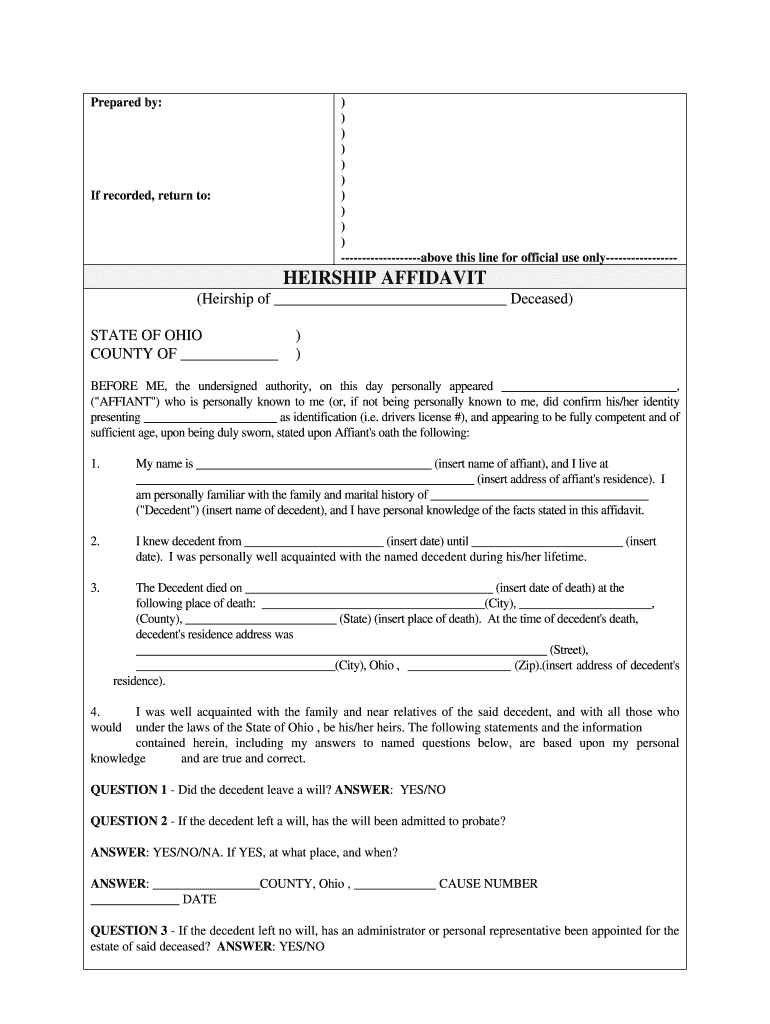







Definition and Meaning of Affidavit of Heirship in Ohio
An affidavit of heirship is a legal document that establishes the heirs of a deceased individual, particularly in the context of probate law in Ohio. This document is essential in situations where a decedent has not left a will or has only arranged for partial distributions of their estate. The affidavit serves as a declaration made by a knowledgeable individual, typically an heir or relative, providing sworn testimony about the decedent's family and marital history.
The affidavit includes critical information about the deceased, such as their full name, date of birth, date of death, and any last known address. It further details the relationships of surviving heirs, including spouses, children, and others who may inherit from the estate. Establishing these connections is crucial because it helps clarify who is entitled to the decedent's assets and ensures a smoother transfer of property ownership, especially when real estate is involved.
Key Components of an Affidavit of Heirship
- Affiant Information: The full name, address, and relationship to the deceased of the individual completing the affidavit.
- Decedent Information: The full name, death date, marital status, and information on children or dependents.
- Family Relationships: A detailed account of surviving heirs, including their names and relationship to the deceased.
- Property Description: Specific mention of any real property or significant assets owned by the decedent, which may need to be transferred to heirs.
Steps to Complete the Affidavit of Heirship in Ohio
When preparing an affidavit of heirship in Ohio, it’s essential to follow a series of organized steps to ensure that the document is completed accurately and effectively.
- Gather Necessary Information: Collect all relevant details concerning the decedent, including their full name, date of death, marital status, and information regarding their children or other potential heirs.
- Complete the Affidavit Form: Obtain the official form, which can often be found at local probate court websites or offices. Fill out the form completely, ensuring all sections are addressed, including information about surviving heirs.
- Affiant Declaration: As the affiant, be prepared to declare your personal knowledge of the decedent’s familial relationships. Clearly express the basis for your knowledge in the document.
- Notarization: After completing the form, sign it in front of a notary public. This step is crucial as it makes the affidavit legally binding and credible.
- File the Affidavit: Submit the completed affidavit to the appropriate Ohio probate court. This filing may be necessary to formalize the legal recognition of heirs, particularly for property transfer purposes.
Important Considerations
- Ensure clarity and accuracy in all provided information to prevent future disputes among heirs.
- Consider consulting with legal counsel to review the document, especially in complex family situations or for substantial estates.
Legal Use of the Affidavit of Heirship in Ohio
The affidavit of heirship is designed to facilitate the transfer of property and clarify inheritance claims when a decedent has passed away without a will, often simplifying the probate process. Legal use of this affidavit is predicated on its acceptance by the probate court and other entities that may require proof of rightful heirship.
For instance, if real estate needs to be transferred to living heirs, the affidavit serves as the primary document supporting that transfer. Title companies typically require such documentation to ensure that the transfer of title is legally protected from future claims.
Benefits of Legal Use
- Cost-Effective: Utilizing an affidavit can be less expensive and quicker than undergoing a full probate process.
- Clarity: It provides a clear statement of heirship, which is helpful to potential buyers or financial institutions concerned with the legitimacy of ownership.
- Prevents Disputes: Establishing heirship through an affidavit can preempt challenges by disclosing relationships transparently and formally.
Important Terms Related to the Affidavit of Heirship in Ohio
Understanding the legal terminology associated with the affidavit of heirship is vital for both clarity and compliance.
- Decedent: The individual who has passed away.
- Affiant: The person who swears to the truth of the information contained in the affidavit.
- Heir: An individual legally entitled to inherit a portion of a deceased person's estate.
- Probate: The legal process of validating a will and administering a deceased person’s estate.
Related Concepts
- Intestate: The condition of dying without a valid will.
- Testate: The condition of dying with a valid will.
- Survivorship: Refers to the heirs who are still living and entitled to inherit from the decedent.
Examples of Using the Affidavit of Heirship in Ohio
The affidavit of heirship can be utilized in various situations, particularly where property transfer is necessary due to the intestate death of an individual. Here are practical scenarios highlighting its application:
- Transferring Real Estate: A family member may need to file an affidavit of heirship to acquire a decedent's home, thereby enabling the heirs to sell or otherwise manage the property.
- Bank Accounts: When a family member passes without a will, surviving heirs may present the affidavit to financial institutions to gain access to bank accounts held solely in the decedent’s name.
- Personal Property: Items such as vehicles or personal belongings may be transferred to heirs without a formal probate process when an affidavit is accepted as proof of heirship.
Case Example
Consider a scenario where an individual passes away without any designated heirs in a will. An adult child, aware that they are the sole surviving family member, can create an affidavit of heirship. Providing details about their parent’s death, alongside verification of their relationship, allows the child to successfully claim ownership of the deceased’s assets through the affidavit without the need for extensive legal proceedings.
Who Typically Uses the Affidavit of Heirship in Ohio?
While the affidavit of heirship can be used by anyone who meets the criteria, it is predominantly utilized by specific relationships and parties connected to the decedent.
- Heirs: These include children, grandchildren, or siblings who may need to establish their eligibility to inherit under Ohio's intestacy laws.
- Legal Representatives: Attorneys may prepare or assist in filing affidavits on behalf of the heirs, particularly when dealing with complex estates or ensuring compliance with legal standards.
- Family Members: Close family members or friends who have personal knowledge of the decedent’s relationships and circumstances can serve as affiants to establish heirship effectively.


Access and Guidance
Families faced with the death of a loved one may find it beneficial to consult legal resources, including estate planning attorneys or probate court officials. Understanding who can rightfully create or sign an affidavit of heirship supports more streamlined management of the decedent’s estate.




