Refunding bond 2026

Get Form
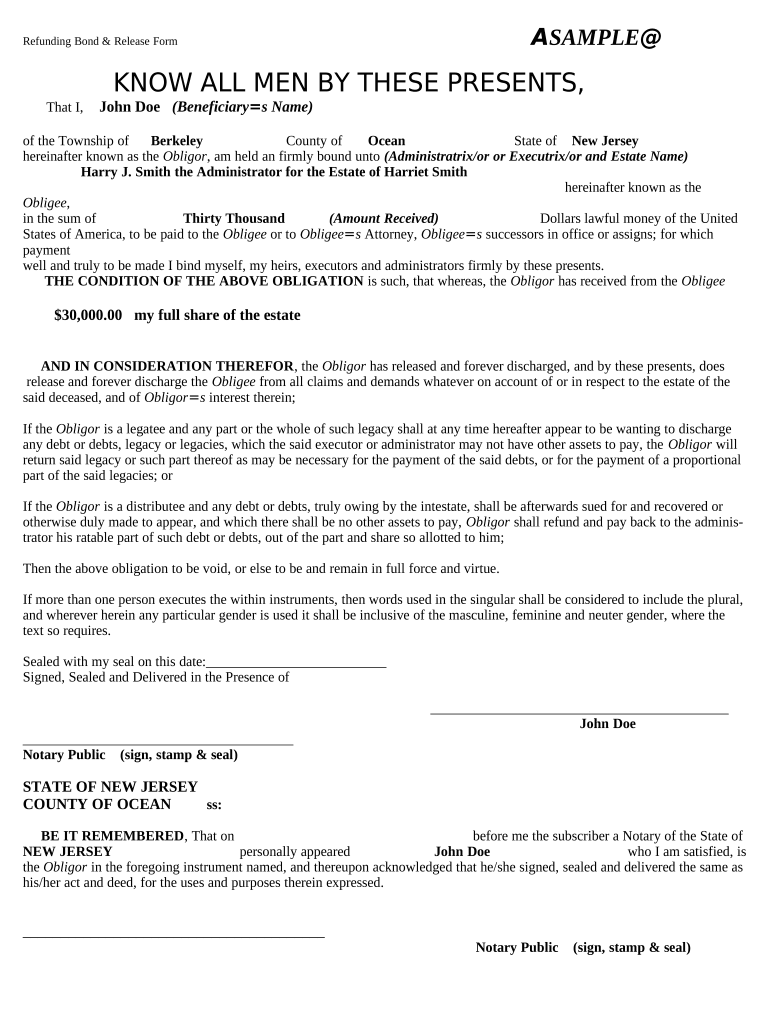
refunding bond Preview on Page 1

Here's how it works

01. Edit your form online
Type text, add images, blackout confidential details, add comments, highlights and more.
02. Sign it in a few clicks
Draw your signature, type it, upload its image, or use your mobile device as a signature pad.
03. Share your form with others
Send it via email, link, or fax. You can also download it, export it or print it out.

How to use or fill out refunding bond with our platform

Form edit decoration
9.5
Ease of Setup
DocHub User Ratings on G2
9.0
Ease of Use
DocHub User Ratings on G2
  1. Click ‘Get Form’ to open the refunding bond in the editor.
  2. Begin by entering your name as the Obligor in the designated field, ensuring accuracy for legal purposes.
  3. Fill in your address details, including Township, County, and State, to provide your location information.
  4. Identify the Obligee by entering their name and title (e.g., Administratrix or Executor) along with the Estate Name.
  5. Specify the amount of money involved in the bond clearly in both words and figures to avoid any confusion.
  6. Review the conditions outlined in the document carefully, ensuring you understand your obligations regarding any debts or legacies.
  7. Sign and date the document where indicated. Ensure that a Notary Public is present to witness your signature and complete their section.

Start using our platform today to easily fill out your refunding bond for free!

be ready to get more

Complete this form in 5 minutes or less

Get form

Got questions?

We have answers to the most popular questions from our customers. If you can't find an answer to your question, please contact us.
Contact us
How long does a bond refund take? Tenants can request their bond back after exiting the property. This is called claiming the bond. If the bond refund is not disputed, a refund can be processed through RBO within 5 working days.
The Refunding Bond and Release has a dual purpose: Refunding To refund to the Executor or Administrator out of his/her share of the estate his ratable part of any unpaid debts, owed by the testator or intestate, if there are no other assets to pay them.
Refunded bonds are frequently used to benefit from favourable interest rate situations. Reduced interest payments and possible interest savings during the bonds lifetime occur from issuers choosing to replace older bonds with new ones at lower rates when interest rates fall. Refunded bond: What is it, Uses, Advantages, Examples, FAQ poems.com.sg glossary bonds refunde poems.com.sg glossary bonds refunde
Answer and Explanation: Calling a bond means the bond can be called in advance than the maturity of the bond and it will be redeemed by the issuer. Bond refunding means retiring the bond at its maturity by using a new debt issue.
Generally unique to municipal securities, a refunding is the process by which an issuer refinances outstanding bonds by issuing new bonds. This may serve either to reduce the issuers interest costs or to remove a restrictive covenant imposed by the terms of the bonds being refinanced.

Security and compliance

At DocHub, your data security is our priority. We follow HIPAA, SOC2, GDPR, and other standards, so you can work on your documents with confidence.

Learn more

People also ask

Understanding Refunded Bond By definition, the term refunding means refinancing another debt obligation. It is not unheard of for municipalities to issue new bonds in order to raise funds to retire existing bonds. The bonds which are issued to refund older bonds are called refunding bonds or pre-refunding bonds.
If youve paid your bail in cash and fulfilled all court obligations, youre eligible for a complete refund, except for the typically non-refundable bond premium. This refund, often referred to as getting your bail money back, is usually processed and disbursed within 30 business days.
Who will get the money refunded? The bail refund will be mailed to the depositor (the person who deposited the money with the Court). The depositor is the person who signed the personal check, money order, or cashiers check to post bail.

Related links