

Domestic violence with children 2026

Get Form
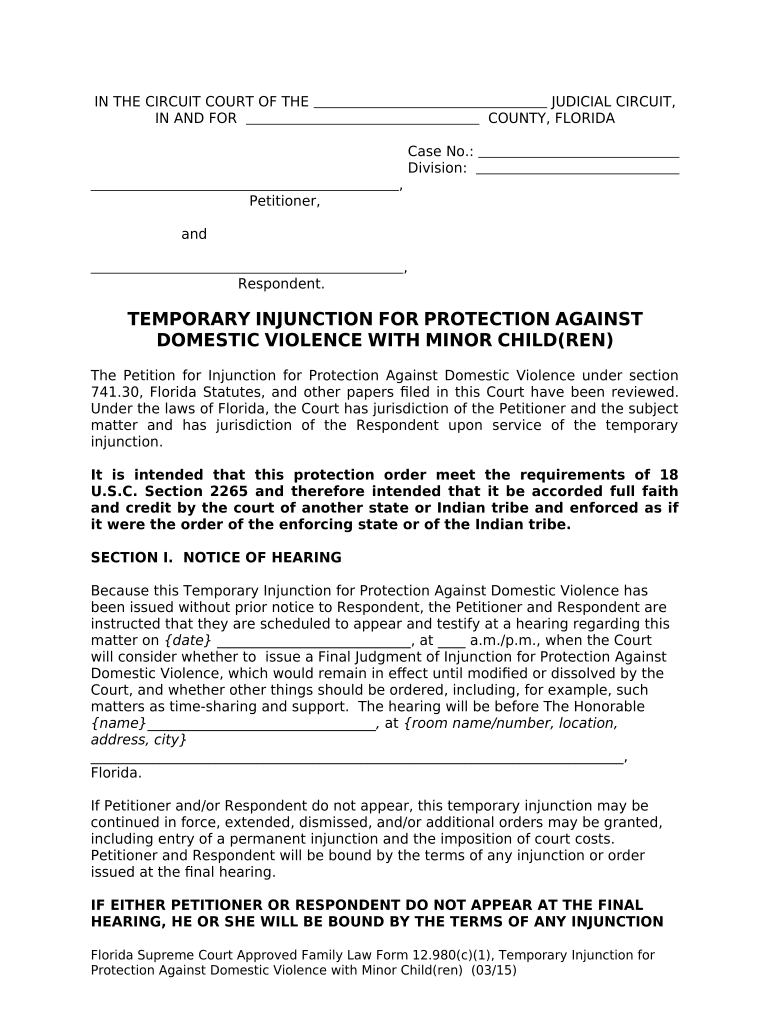
domestic violence with children Preview on Page 1

Here's how it works

01. Edit your form online
Type text, add images, blackout confidential details, add comments, highlights and more.
02. Sign it in a few clicks
Draw your signature, type it, upload its image, or use your mobile device as a signature pad.
03. Share your form with others
Send it via email, link, or fax. You can also download it, export it or print it out.

How to use or fill out domestic violence with children forms

Form edit decoration
9.5
Ease of Setup
DocHub User Ratings on G2
9.0
Ease of Use
DocHub User Ratings on G2
  1. Click ‘Get Form’ to open it in the editor.
  2. Begin by filling in the case number and division at the top of the form. This information is crucial for identifying your case within the court system.
  3. In Section I, provide details about the hearing date and time. Ensure that you accurately list the location and judge's name to avoid any confusion.
  4. Proceed to Section II, where you will affirm your statements under oath regarding domestic violence. Be clear and concise in your descriptions.
  5. In Section III, outline any specific terms of the temporary injunction, including no contact provisions and firearm restrictions. Initial each applicable item to confirm your understanding.
  6. Complete Section IV by adding any special provisions that may apply to your situation, ensuring they are relevant and necessary for your protection.
  7. Finally, review all sections for accuracy before submitting. Utilize our platform’s features to save or print a copy for your records.

Start using our editor today to complete your domestic violence with children form easily and securely!

be ready to get more

Complete this form in 5 minutes or less

Get form

Got questions?

We have answers to the most popular questions from our customers. If you can't find an answer to your question, please contact us.
Contact us
Childhood abuse is commonly associated with becoming a perpetrator of domestic violence as an adult. Perpetrators of domestic violence commonly repeat acts of violence with new partners. Drug and alcohol abuse greatly increases the incidence of domestic violence.
Domestic abuse is any type of controlling, bullying, threatening or violent behaviour between people who are or have been in a relationship. It can also happen between adults related to one another. It can seriously harm children and young people, and experiencing domestic abuse is child abuse.
Domestic abuse is typically manifested as a pattern of abusive behavior toward an intimate partner in a dating or family relationship, where the abuser exerts power and control over the victim. Domestic abuse can be mental, physical, economic or sexual in nature.
# Take the lead and talk to them ask them what they saw or heard or already know about what happened. Expect it to be more than you think, no matter how young they are. It can be difficult but it will help your child to understand rather than fill in the gaps with their imaginations.
Domestic abuse is any incident of controlling, coercive or threatening behaviour, violence or abuse, between people in a domestic setting (such as marriages or cohabitation). Witnessing domestic abuse can seriously harm children and young people.

Security and compliance

At DocHub, your data security is our priority. We follow HIPAA, SOC2, GDPR, and other standards, so you can work on your documents with confidence.

Learn more
ccpa2
pci-dss
gdpr-compliance
hipaa
soc-compliance

People also ask

Children who witness or are victims of emotional, physical, or sexual abuse are at higher risk for health problems as adults. These can include mental health conditions, such as depression and anxiety. They may also include diabetes, obesity, heart disease, poor self-esteem, and other problems.

Related links