Not guilty mental 2026

Get Form
not guilty mental Preview on Page 1

Here's how it works

01. Edit your form online
Type text, add images, blackout confidential details, add comments, highlights and more.
02. Sign it in a few clicks
Draw your signature, type it, upload its image, or use your mobile device as a signature pad.
03. Share your form with others
Send it via email, link, or fax. You can also download it, export it or print it out.

How to use or fill out not guilty mental with our platform

Form edit decoration
9.5
Ease of Setup
DocHub User Ratings on G2
9.0
Ease of Use
DocHub User Ratings on G2
  1. Click ‘Get Form’ to open the not guilty mental document in the editor.
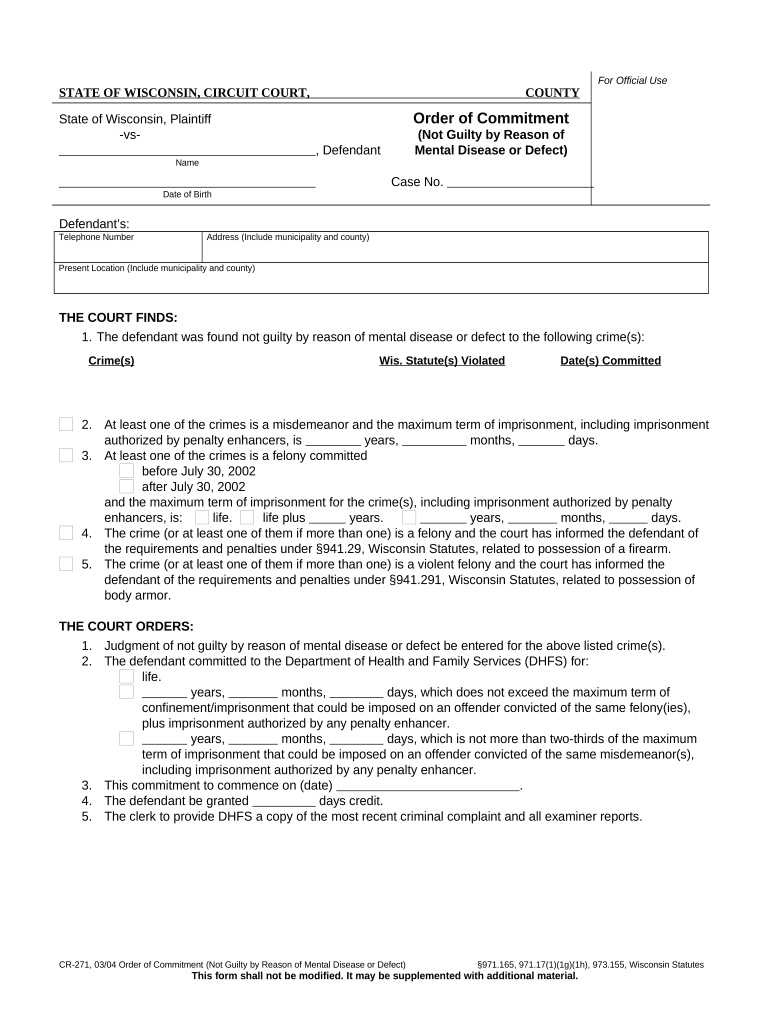
  2. Begin by entering the defendant's name, case number, date of birth, telephone number, and address in the designated fields. Ensure all information is accurate for proper identification.
  3. In the section titled 'THE COURT FINDS', list the crimes for which the defendant was found not guilty by reason of mental disease or defect. Include relevant Wisconsin statutes and dates committed.
  4. Fill out the maximum term of imprisonment for any misdemeanors or felonies as indicated. Be sure to specify if any crimes were committed before or after July 30, 2002.
  5. Complete the 'THE COURT ORDERS' section by indicating the commitment duration to DHFS and any credits granted. This ensures clarity on the terms set by the court.
  6. Finally, review all entries for accuracy before saving your completed form. Utilize our platform’s features to easily share or print your document as needed.

Start using our platform today to fill out your not guilty mental form quickly and efficiently!

be ready to get more

Complete this form in 5 minutes or less

Get form

Got questions?

We have answers to the most popular questions from our customers. If you can't find an answer to your question, please contact us.
Contact us
Acquittal: Judgment that a criminal defendant has not been proved guilty beyond a reasonable doubt. In other words, a verdict of not guilty.
To prove insanity, most jurisdictions require: A professional assessment. Proof that you were not capable of distinguishing between right and wrong. Proof this mindset happened during the time of the offense (see temporary insanity below)