Assignment name change 2026

Get Form
assignment name change Preview on Page 1

Here's how it works

01. Edit your form online
Type text, add images, blackout confidential details, add comments, highlights and more.
02. Sign it in a few clicks
Draw your signature, type it, upload its image, or use your mobile device as a signature pad.
03. Share your form with others
Send it via email, link, or fax. You can also download it, export it or print it out.

How to use or fill out assignment name change with our platform

Form edit decoration
9.5
Ease of Setup
DocHub User Ratings on G2
9.0
Ease of Use
DocHub User Ratings on G2
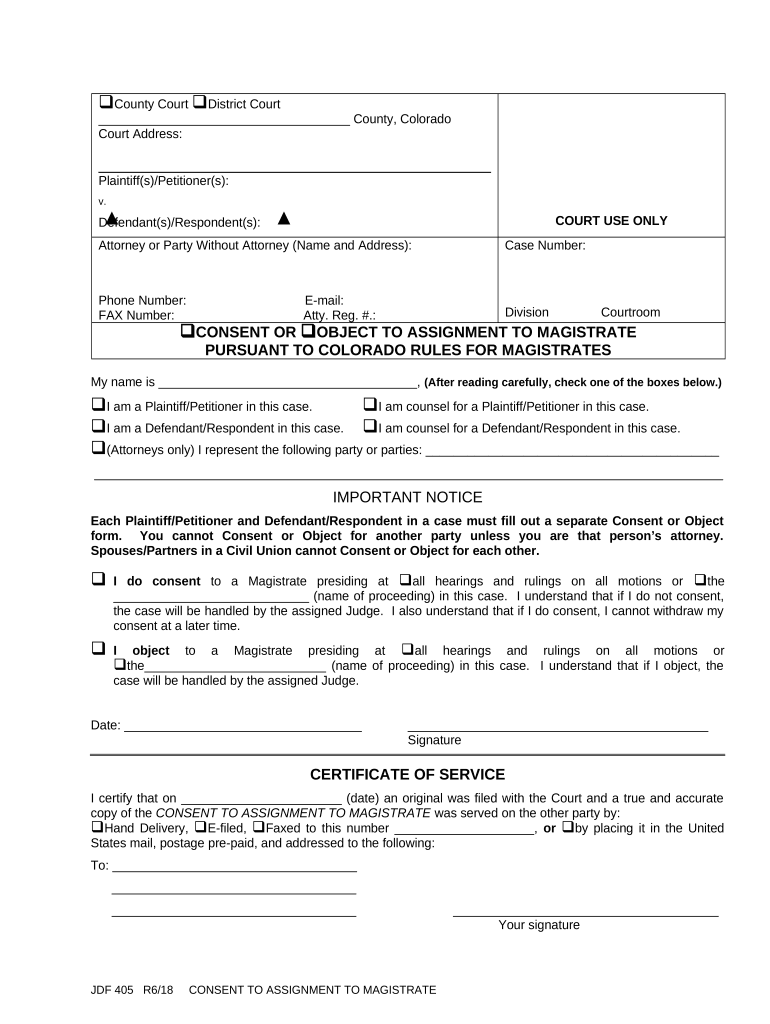
  1. Click ‘Get Form’ to open the assignment name change document in the editor.
  2. Begin by entering the court address and case number in the designated fields. Ensure accuracy as this information is crucial for your case.
  3. Identify yourself by selecting the appropriate option: Plaintiff/Petitioner or Defendant/Respondent. If you are an attorney, specify which party you represent.
  4. Read the important notice carefully. Each party must complete a separate form; ensure you are filling out your own consent or objection.
  5. Indicate your consent or objection regarding a Magistrate presiding over your case by checking the corresponding box and providing any necessary details about the proceedings.
  6. Date and sign the form in the provided sections to validate your submission.
  7. Complete the Certificate of Service section, detailing how you served a copy of this form to other parties involved in your case.

Start using our platform today for free to streamline your document editing and ensure a smooth process!

be ready to get more

Complete this form in 5 minutes or less

Get form

Got questions?

We have answers to the most popular questions from our customers. If you can't find an answer to your question, please contact us.
Contact us
Trademark assignment is the process of transferring ownership of a trademark. It is a docHub legal process that requires careful consideration and adherence to relevant laws and regulations.
Amendments to Names You can alter the names of the patent owners by sending a Recordation Cover Sheet to the Assignment Recordation Branch of the U.S. Patent and Trademark Office (USPTO). The process is the same regardless of whether the patent is under examination or already has been granted.
If you are changing the applicant, you must also submit a request to change the applicant under 37 CFR 1.46(c)(2). Note that 37 CFR 1.46(c)(2) requires compliance with 37 CFR 3.71 and 3.73. Therefore, you must submit a statement under 37 CFR 3.73(c).
The assignment must be in writing. It must be signed by the assignor (the person or entity transferring ownership). The document must identify the patent or application by number. The assignment must be submitted to the USPTO along with the required fee.
Assignment Recordation puts the USPTO on official notice pertaining to ownership of the Intellectual Property. Subject to the provisions set forth in the MPEP, patents shall have the attributes of personal property. A patent for an invention is the grant of a property right to the inventor.

Security and compliance

At DocHub, your data security is our priority. We follow HIPAA, SOC2, GDPR, and other standards, so you can work on your documents with confidence.

Learn more
ccpa2
pci-dss
gdpr-compliance
hipaa
soc-compliance

People also ask

The original owner should record the assignment or name change with the USPTOs Assignment Recordation Branch by going to Assignment Center and filing a Recordation Cover Sheet along with a copy of the actual assignment or proof of name change.
Joint ownership - Multiple parties may together own the entire right, title and interest of the patent property. This occurs when any of the following cases exist: (A) Multiple partial assignees of the patent property; (B) Multiple inventors who have not assigned their right, title and interest; or.
Though the agreement is a legal document, it does not need to be docHubd. However, obtaining notarization for the signatures provides added protection, limiting the risk of a party later claiming a signature was not valid.

Related links