Co successor 2026

Get Form
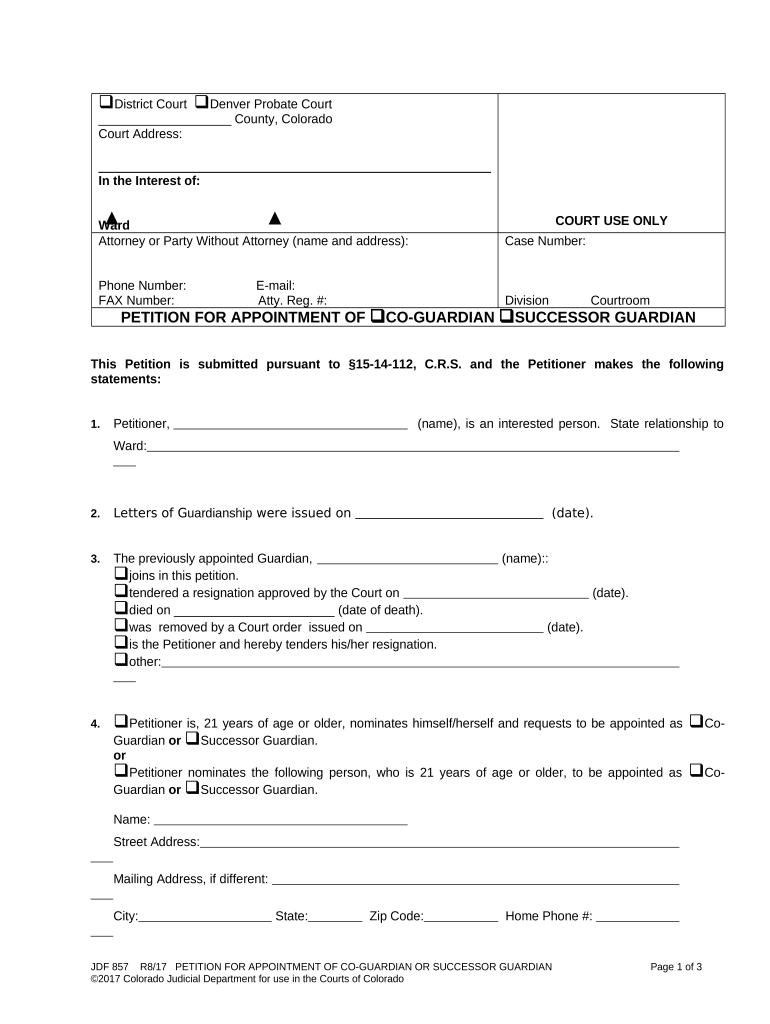
co successor Preview on Page 1

Here's how it works

01. Edit your form online
Type text, add images, blackout confidential details, add comments, highlights and more.
02. Sign it in a few clicks
Draw your signature, type it, upload its image, or use your mobile device as a signature pad.
03. Share your form with others
Send it via email, link, or fax. You can also download it, export it or print it out.

How to use or fill out co successor with our platform

Form edit decoration
9.5
Ease of Setup
DocHub User Ratings on G2
9.0
Ease of Use
DocHub User Ratings on G2
  1. Click ‘Get Form’ to open the co successor document in the editor.
  2. Begin by filling in the court address and case number at the top of the form. Ensure all information is accurate for proper processing.
  3. In section 1, provide your name as the Petitioner and state your relationship to the Ward. This establishes your interest in the case.
  4. Complete section 3 by indicating whether the previously appointed Guardian joins this petition or has resigned, died, or been removed. Fill in relevant dates as necessary.
  5. In section 4, nominate yourself or another individual as Co-Guardian or Successor Guardian. Include their full name, address, and contact information.
  6. Section 5 requires you to specify why the nominated individual has priority for appointment. Check all applicable reasons provided.
  7. If applicable, detail compensation arrangements for the Co-Guardian or Successor Guardian in sections 6 and 7.
  8. Finally, verify all information is correct before signing and dating at the bottom of the form. Ensure you acknowledge any changes made to original content if necessary.

Start using our platform today to streamline your document editing and form completion process for free!

be ready to get more

Complete this form in 5 minutes or less

Get form

Got questions?

We have answers to the most popular questions from our customers. If you can't find an answer to your question, please contact us.
Contact us
A trusteeship is best handled by one person being in charge. A co-trustee would be a drag on the first. Instead of a smooth operation in the hands of one person, a second decision maker (a person probably not as competent as the first person) would always have a say, and could block or delay good decisions.
A co-trustee is one of multiple trustees serving simultaneously, typically with equal powers and duties. They share the responsibility of managing the trusts assets. Sometimes, a co-trustee can temporarily step in if the primary trustee is unavailable, such as during an illness.
With more than one trustee, you ensure that no single individual has unchecked control over your trust. This can be especially valuable if youre concerned about the potential for financial mismanagement or emotional bias.
Successor Trustee. A co-trustee is someone who is actively working with one or more trustees to maintain a trust. Successor trustees, on the other hand, are named responsible for a taking over a revocable living trust after the trustee dies.
Having more than one Trustee can cause delays if all Trustees are required to agree before taking action. If you have an even number of Trustees, decisions can be impossible to make if the Trustees cannot agree. You can inadvertently cause conflict in the family if you appoint siblings or family members as co-Trustees.

Security and compliance

At DocHub, your data security is our priority. We follow HIPAA, SOC2, GDPR, and other standards, so you can work on your documents with confidence.

Learn more
ccpa2
pci-dss
gdpr-compliance
hipaa
soc-compliance

People also ask

The main difference between a successor trustee and a beneficiary is their roles and responsibilities. Beneficiaries are named in the trust and entitled to receive benefits or assets from the trust. Successor trustees execute the trust document on behalf of the grantor and in service of the beneficiaries.
Should You Choose Co-Trustees? One might think of the adage Two brains are better than one. Strength in numbers is a good strategy. After all, co-trustees can divide and conquer duties and responsibilities. Co-trustees combine skills and knowledge to work together to oversee and protect trust assets.

Related links