California objection 2026

Get Form
california deposition objections cheat sheet Preview on Page 1

Here's how it works

01. Edit your california deposition objections cheat sheet online
Type text, add images, blackout confidential details, add comments, highlights and more.

02. Sign it in a few clicks
Draw your signature, type it, upload its image, or use your mobile device as a signature pad.

03. Share your form with others
Send it via email, link, or fax. You can also download it, export it or print it out.

How to use or fill out California Objection with our platform

Form edit decoration
9.5
Ease of Setup
DocHub User Ratings on G2
9.0
Ease of Use
DocHub User Ratings on G2
  1. Click ‘Get Form’ to open the California Objection form in the editor.
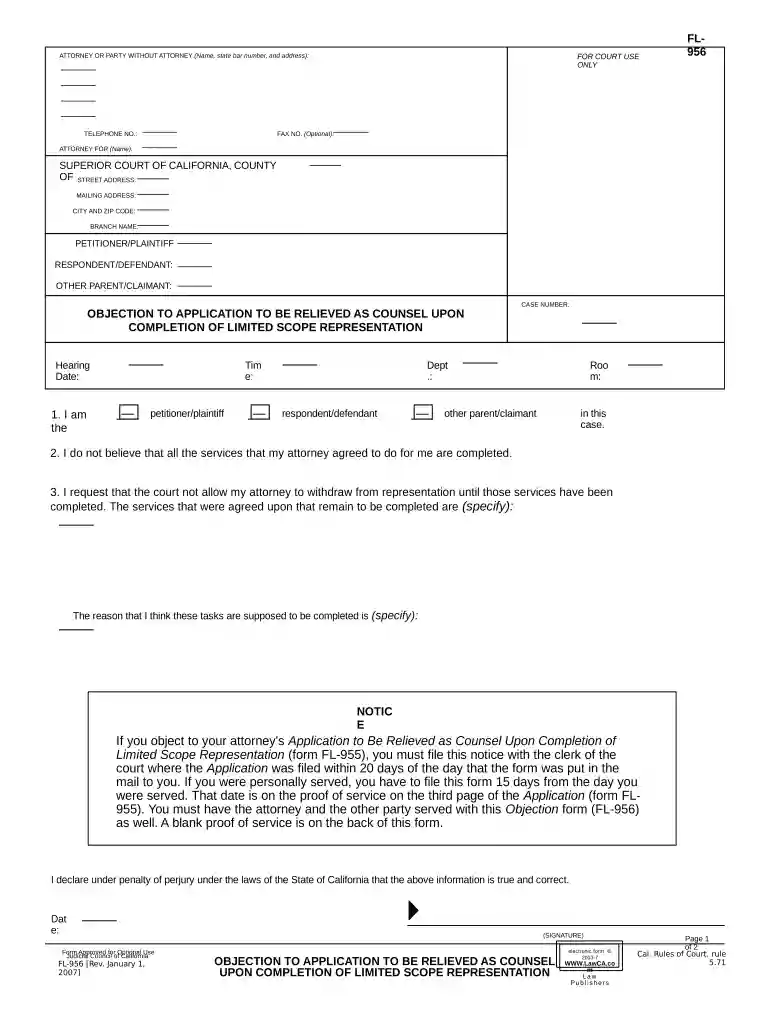
  2. Begin by filling in your attorney's name, state bar number, and address at the top of the form. Ensure that you also include their telephone number and fax number if applicable.
  3. In the 'Petitioner/Plaintiff' section, enter your name as well as the names of the respondent/defendant and any other parent/claimant involved in the case.
  4. Specify the hearing date, time, department, and room where your case will be heard.
  5. Clearly state your objection by indicating that you do not believe all services agreed upon by your attorney have been completed. List these services in detail.
  6. Provide a reason for your objection, explaining why you believe these tasks remain unfinished.
  7. Complete the proof of service section by checking whether you served notice personally or via mail. Fill in all required details accordingly.
  8. Finally, sign and date the form to affirm that all information provided is true and correct under penalty of perjury.

Start using our platform today to easily complete your California Objection form online for free!

be ready to get more

Complete this form in 5 minutes or less

Get form

Got questions?

We have answers to the most popular questions from our customers. If you can't find an answer to your question, please contact us.
Contact us

According to eSignature laws, documents approved electronically have the same validity as traditionally approved ones. You can eSign almost any business and personal paperwork. Four types of paperwork still call for handwritten signatures only - wills and testamentary trusts, court orders and other court papers, state statutes governing divorce, adoption, or other family law, and notice of cancellation of utility services. If you follow the regulations and use a reliable and compliant software solution, like DocHub, you can eSign your california objection without printing it.

Using a swift editing system like DocHub, you do not require anything but a web browser and connection to the internet to modify your california objection online swiftly. Upload your file or get the appropriate form in DocHub’s catalog, open our editor with one click, and complete it electronically. To edit your forms at any time, register a free profile with DocHub.

Argumentative objections are often made when the questions directed to the witness attempt to influence the witness testimony by inserting the attorneys (or self-represented partys) interpretation of the evidence into the question.
The Three Most Common Objections Made During Trial Testimony Hearsay. A common, if not the most common trial objection to a trial testimony objection is hearsay. Leading. A close second objection is to leading questions. Relevancy. The last of the three (3) of the most common objections is relevancy.
Evidentiary Objections. At every trial or hearing requiring the admission of evidence, attorneys have the duty to object to evidence that the rules of court deem inadmissible. Objections must be made in a timely fashion, as soon as the witness or opposing party attempts to improperly introduce evidence.

Security and compliance

At DocHub, your data security is our priority. We follow HIPAA, SOC2, GDPR, and other standards, so you can work on your documents with confidence.
Learn more
ccpa2
pci-dss
gdpr-compliance
hipaa
soc-compliance

People also ask

The Three Most Common Objections Made During Trial Testimony Hearsay. A common, if not the most common trial objection to a trial testimony objection is hearsay. Leading. A close second objection is to leading questions. Relevancy. The last of the three (3) of the most common objections is relevancy.
State your responses succinctly, being as specific as possible about the legal grounds for admissibility. Give a one-sentence non-legal explanation for the benefit of the jury. Accept the judges ruling gracefully. Make an offer of proof if you lose the objection.
(c) Objections to declarations (1) If a party thinks that a declaration does not meet the requirements of (b)(2) the party must file their objections in writing at least 2 court days before the time of the hearing, or any objection will be considered waived, and the declaration may be considered as evidence.
A foundation objection means that the witness does not have firsthand knowledge about the subject matter of their testimony. A hearsay objection means that the witness is attempting to introduce the out-of-court statements of a third party for the truth of the statement.
The basis for admitting testimony or evidence into evidence. For example, an attorney must lay a foundation in order to admit an expert witness testimony or a companys business records into evidence. Laying a foundation establishes the qualifications of a witness or the authenticity of evidence.

Related links