Type text, add images, blackout confidential details, add comments, highlights and more.
02. Sign it in a few clicks
Draw your signature, type it, upload its image, or use your mobile device as a signature pad.
03. Share your form with others
Send it via email, link, or fax. You can also download it, export it or print it out.
How to use or fill out Quitclaim Deed from Husband and Wife to Corporation - Arkansas with our platform
Ease of Setup
DocHub User Ratings on G2
Ease of Use
DocHub User Ratings on G2
Click ‘Get Form’ to open the Quitclaim Deed in the editor.
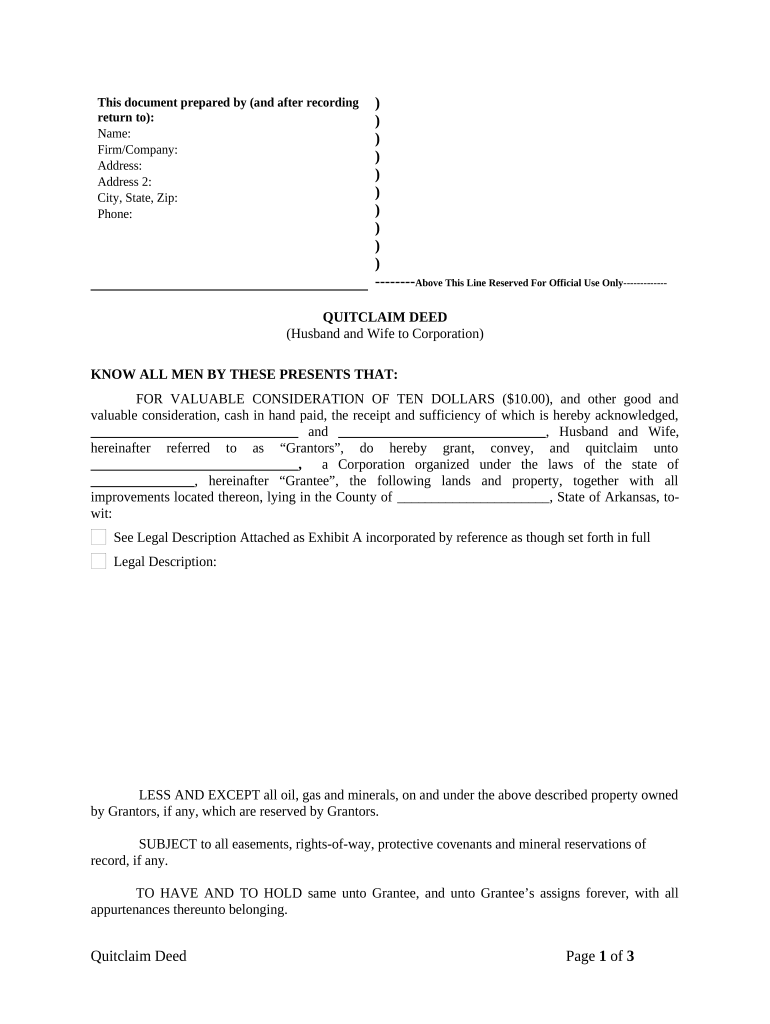
Begin by filling in the names of the Grantors (Husband and Wife) at the top of the form, along with their firm/company name, address, and contact information.
In the section that states 'KNOW ALL MEN BY THESE PRESENTS THAT', enter the names of both Grantors and the Grantee (the Corporation) along with its state of incorporation.
Provide a detailed legal description of the property being conveyed. If you have an attachment (Exhibit A), ensure it is included as instructed.
Indicate whether the property is part of the homestead by checking the appropriate box and filling in any necessary details regarding tax proration.
Both Grantors must sign and print their names at the designated signature lines, ensuring all signatures are dated correctly.
Complete the notary section by having a notary public witness and sign, confirming that both parties executed this deed voluntarily.
Start using our platform today to easily complete your Quitclaim Deed for free!
Fill out Quitclaim Deed from Husband and Wife to Corporation - Arkansas online It's free
When Is Homestead Title Marketable? - Digital Commons @ DU
by MC Lankton 1951 Cited by 1 She alone conveyed by quitclaim deed to the husband. When the heirs of the wife sued for partition and the heirs of the husband de- fended on the basis ofRead more
Sep 1, 2016 Quitclaim Deedto G./. A. Hendrix and Eula Hendrix, husband and wife, for a parcel of land near Johnson Road occupied by the abandonedRead more
Cookie consent notice
This site uses cookies to enhance site navigation and personalize your experience.
By using this site you agree to our use of cookies as described in our Privacy Notice.
You can modify your selections by visiting our Cookie and Advertising Notice.