Application civil form 2026

Get Form
application civil form Preview on Page 1

Here's how it works

01. Edit your form online
Type text, add images, blackout confidential details, add comments, highlights and more.
02. Sign it in a few clicks
Draw your signature, type it, upload its image, or use your mobile device as a signature pad.
03. Share your form with others
Send it via email, link, or fax. You can also download it, export it or print it out.

How to use or fill out application civil form with our platform

Form edit decoration
9.5
Ease of Setup
DocHub User Ratings on G2
9.0
Ease of Use
DocHub User Ratings on G2
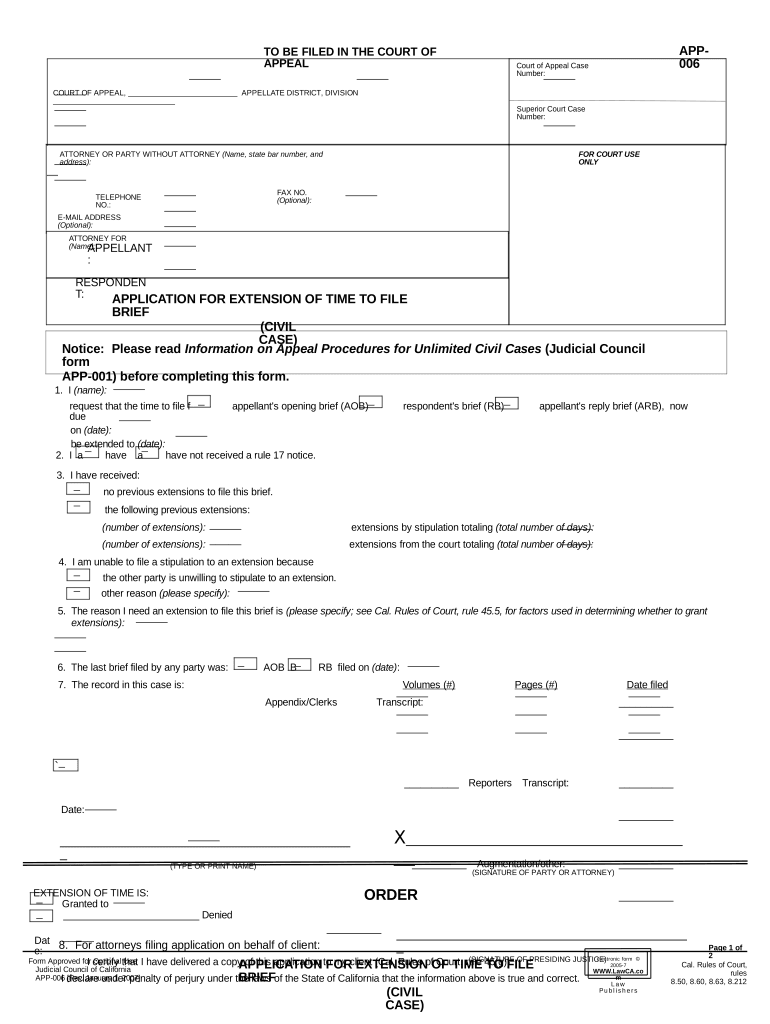
  1. Click ‘Get Form’ to open the application civil form in the editor.
  2. Begin by entering the Court of Appeal Case Number at the top of the form. This is essential for identifying your case.
  3. Fill in your name, state bar number, and address in the 'Attorney or Party Without Attorney' section. If applicable, include your email address and fax number.
  4. In Section 1, specify whether you are requesting an extension for the appellant's opening brief, respondent's brief, or appellant's reply brief. Clearly indicate the due date and the new requested date.
  5. Complete Section 2 by indicating if you have received a rule 17 notice. In Section 3, provide details about any previous extensions you may have received.
  6. In Section 4, explain why you cannot file a stipulation for an extension. Use Section 5 to describe your reasons for needing an extension.
  7. Finally, ensure all required signatures are completed before submitting your application as per court guidelines.

Start using our platform today to streamline your document editing and submission process for free!

be ready to get more

Complete this form in 5 minutes or less

Get form

Got questions?

We have answers to the most popular questions from our customers. If you can't find an answer to your question, please contact us.
Contact us
Civil Lawsuits: The 8-Step Process From Start to Finish Step 1: Pre-suit negotiations. Often, a legal issue is first addressed in the form of a demand letter. PLEADINGS. Step 2: File a complaint. Step 3: Respond to the complaint. Step 4: The court issues a schedule for the case. DISCOVERY. PRE-TRIAL. TRIAL. APPEAL.
The first document filed in a lawsuit is usually a pleading called a complaint or a petition. Its essential in various types of cases. The complaint is a detailed document laying the groundwork for a civil action.
Typical civil causes of action include bdocHub of contract, battery, or defamation and violations of federal statutes and constitutional rights. To establish a prima facie civil case, a plaintiff must describe his or her damages or injury, explain how the defendant caused the harm, and ask the court for relief.
Before you start your small claim its a good idea to write a formal letter to the person or business you disagree with - theyre called the defendant. This is called a letter before claim or a letter before action. Youll need to do this even if youve already written to them to complain.
You have to go to the police, the FBI, or the government prosecutor - the District Attorney (local or state law) or the States Attorney (federal law) - and ask that a case be filed. The prosecutor then decides whether the case is strong enough and/or important enough to pursue.

Security and compliance

At DocHub, your data security is our priority. We follow HIPAA, SOC2, GDPR, and other standards, so you can work on your documents with confidence.

Learn more
ccpa2
pci-dss
gdpr-compliance
hipaa
soc-compliance