Summons - Joinder - California 2026

Get Form
joining a third party to family law proceedings california Preview on Page 1

Here's how it works

01. Edit your joining a third party to family law proceedings california online
Type text, add images, blackout confidential details, add comments, highlights and more.
02. Sign it in a few clicks
Draw your signature, type it, upload its image, or use your mobile device as a signature pad.
03. Share your form with others
Send how to file a joinder in california via email, link, or fax. You can also download it, export it or print it out.

How to use or fill out Summons - Joinder - California with our platform

Form edit decoration
9.5
Ease of Setup
DocHub User Ratings on G2
9.0
Ease of Use
DocHub User Ratings on G2
  1. Click ‘Get Form’ to open the Summons - Joinder - California in the editor.
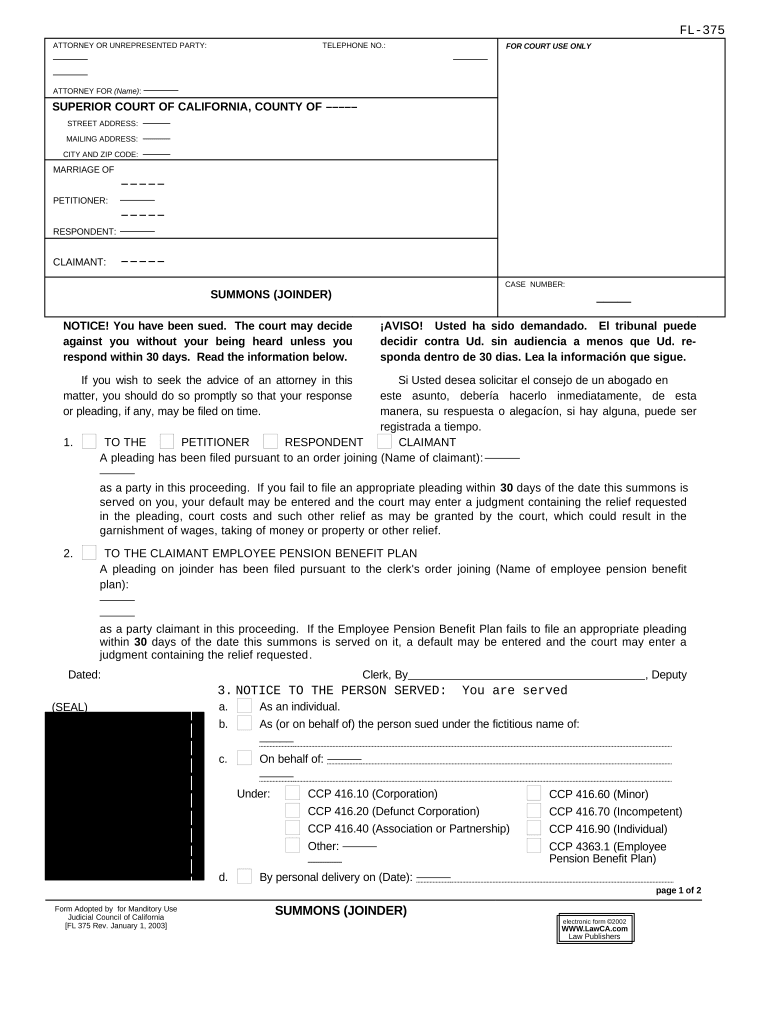
  2. Begin by entering your contact information in the 'ATTORNEY OR UNREPRESENTED PARTY' section, including your name and telephone number.
  3. Fill in the details for the petitioner and respondent under the 'MARRIAGE OF' section, ensuring accuracy as this information is crucial for court records.
  4. In the 'CLAIMANT' field, specify the name of the claimant involved in this proceeding. This is essential for identifying all parties involved.
  5. Review the notice section carefully. It informs you about your rights and obligations regarding responding to this summons within 30 days.
  6. Complete any additional sections as required, such as proof of service, ensuring that all necessary fields are filled out correctly before submission.

Start using our platform today to easily fill out and manage your legal documents for free!

be ready to get more

Complete this form in 5 minutes or less

Get form

Got questions?

We have answers to the most popular questions from our customers. If you can't find an answer to your question, please contact us.
Contact us
A summons may be served by personal delivery of a copy of the summons and of the complaint to the person to be served. Service of a summons in this manner is deemed complete at the time of such delivery.
Summary: You dont need an attorney to respond to a Summons, but you have to respond with a written Answer or you run the risk of losing automatically. In your Answer, you should address all the claims against you and list your defenses, but dont give too much detail or you could hurt your case.
Joginder Singh Rohilla Carefully read the contents of the summons. Note the date and time of appearance. Consult a lawyer immediately. Gather all relevant documents. Prepare and file your written statement. Appear before the court on the given date. Apply for exemption if you cannot appear personally.
You must fill out an Answer, serve the plaintiff, and file your Answer form with the court. Generally, this is due within 30 days after you were served. If you dont, the plaintiff can ask for a default. If theres a default, the court wont let you file an Answer and can decide the case without you.
Your answer should include the court name, case name, case number, and your affirmative defenses. Print three copies of your answer. File one with the clerks office and mail (or serve) one to the plaintiff or plaintiffs attorney. The plaintiff is the debt collector, creditor, or law firm suing you.

Security and compliance

At DocHub, your data security is our priority. We follow HIPAA, SOC2, GDPR, and other standards, so you can work on your documents with confidence.

Learn more
ccpa2
pci-dss
gdpr-compliance
hipaa
soc-compliance

People also ask

The Role of Service in Legal Proceedings The rules for serving summonses vary by jurisdiction, but in California, they are strictly regulated to protect the integrity of the process. Failing to serve a summons means the defendant is not officially informed of the case, which can lead to delays or even case dismissal.
Proof of Service of Summons (POS-010) Tells the court that you had a summons or other legal papers delivered to (served on) the other party in a case. Lists the papers that were served and tells who they were served on, where, when, and how they were served, and who served them.

Related links