





Definition and Meaning
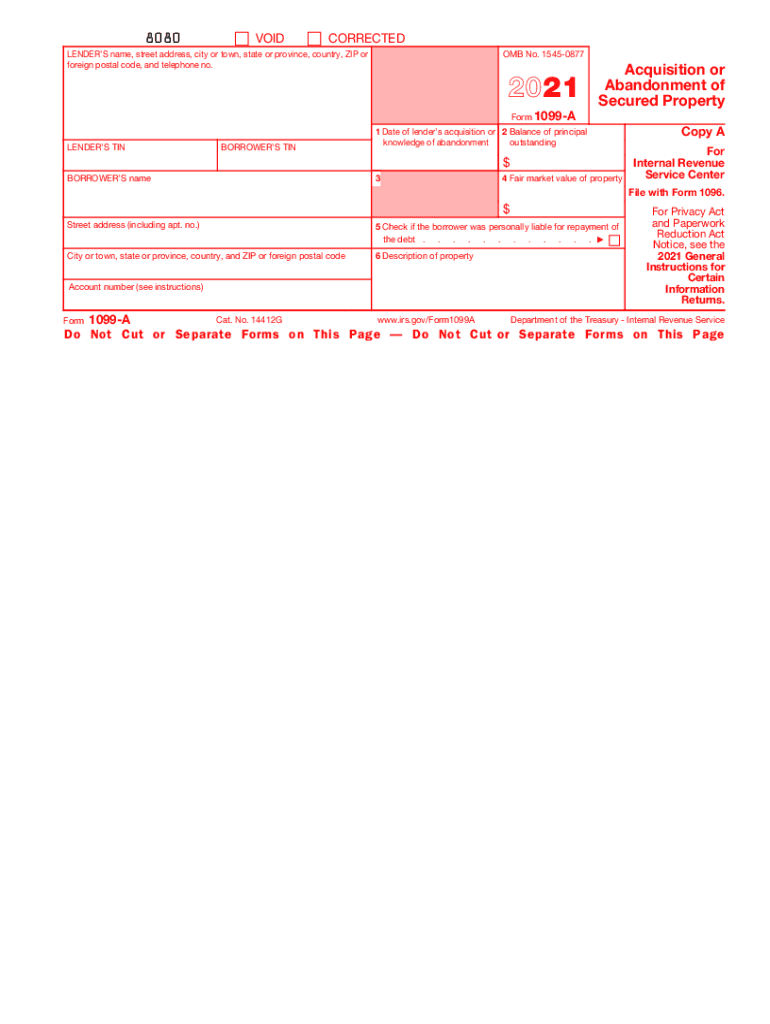
Form 1099-A is utilized by lenders to report the acquisition or abandonment of secured property. This document plays a critical role in the realm of tax filing since it delineates situations where individuals might experience a gain or loss related to the foreclosure of a property. Primarily, the form identifies when a loan secured by a property is either canceled or when the borrower surrenders their property to the lender. Such events must be reported accurately to guard against erroneous tax outcomes for both lenders and borrowers.
Why It's Important
When a property is foreclosed, the IRS treats this as a disposition of property. This could result in income that must be reported on the tax return. Properly filing Form 1099-A will ensure all parties involved effectively manage their fiscal responsibilities, thereby preventing potential audits or penalties.
How to Use the 1099-A Form
Lenders must fill out Form 1099-A when a borrower's property has been acquired or abandoned. Key data includes the date of acquisition or abandonment, the fair market value of the property, and the balance of principal outstanding on the loan. Borrowers, in turn, use this information to determine any taxable gain or loss from the transaction, which they report on their own tax filings.
Borrower Responsibilities
- Confirm the accuracy of data provided, as any mistakes could lead to undesired tax consequences.
- Use this form to ascertain the amount of gain or loss for the purposes of tax calculation. An incorrect determination could result in an unfavorable audit.
Steps to Complete the 1099-A Form
- Gather Required Information: Collect details about the foreclosed property, including the date of abandonment or acquisition, fair market value, and outstanding loan balance.
- Complete Lender Information: Enter the name, address, and tax identification number (TIN) of the lender.
- Populate Borrower Details: Fill in the borrower's name, address, and social security number (SSN).
- Financial Details: Accurately report the property's fair market value and outstanding principal balance.
- Submit the Form: Distribute copies to the borrower and the IRS, maintaining one for the lender’s records.
Specific Considerations
- Accuracy: Ensure all information is precise to avoid penalties.
- Timeliness: Adhere to IRS submission deadlines to prevent late penalties.
Key Elements of the 1099-A Form
Form 1099-A is comprised of several essential components that require meticulous attention:
- Box 1: Date the lender acquired or foreclosed on the property.
- Box 2: Balance of principal outstanding.
- Box 3: Reserved for lender’s own use.
- Box 4: Fair market value of the foreclosed property.
- Box 5: Checkbox indicates whether the borrower was personally liable for repayment.
- Box 6: Description of the property, providing context for the transaction.
These elements collectively ensure accurate capture of all required details for both reporting parties and the IRS.
IRS Guidelines
The IRS provides specific instructions for the completion and submission of Form 1099-A. Compliance with these guidelines ensures proper processing and avoidance of tax complications. The form must be issued to both the borrower and the IRS to fulfill reporting obligations.
Submission Requirements
- Electronically: While the paper form is acceptable, electronic filing is preferred by the IRS for its efficiency and ease of access.
- Deadline: Filed by January 31st for paper submissions, allowing time for taxpayer processing.
Who Typically Uses the 1099-A Form
The users of this form are generally lenders and borrowers involved in secured property transactions.


Lenders
- Responsible for filing the form to report transactions where property has been abandoned or acquired.
- Must ensure accuracy to prevent penalties.
Borrowers
- Utilize the form to determine the taxable implications of a foreclosure or abandonment occurrence.
- Are obliged to report any resulting gain or loss on their personal tax filings.
Penalties for Non-Compliance
Failing to comply with IRS requirements associated with Form 1099-A may lead to monetary penalties.
Potential Consequences
- Fines: For each overlooked form, there may be tiered fines which increase based on the duration of non-compliance.
- Legal Action: Persistent non-compliance can escalate to legal scrutiny and further financial repercussions.
Required Documents and Information
Assembling all necessary documentation is vital for accurate filing. The burden of proof lies with both lenders and borrowers to maintain corroborating details:
- Property Records: Official documents that substantiate the transaction.
- Loan Statements: Provide context for outstanding principal calculations.
- Market Evaluations: Justify the fair market valuation reported on the form.
Additional Tips
- Consistent Review: Regularly auditing this data helps in maintaining the integrity of tax submissions.
- Consultation: Professional guidance may be beneficial to confirm that all requirements are adequately addressed.