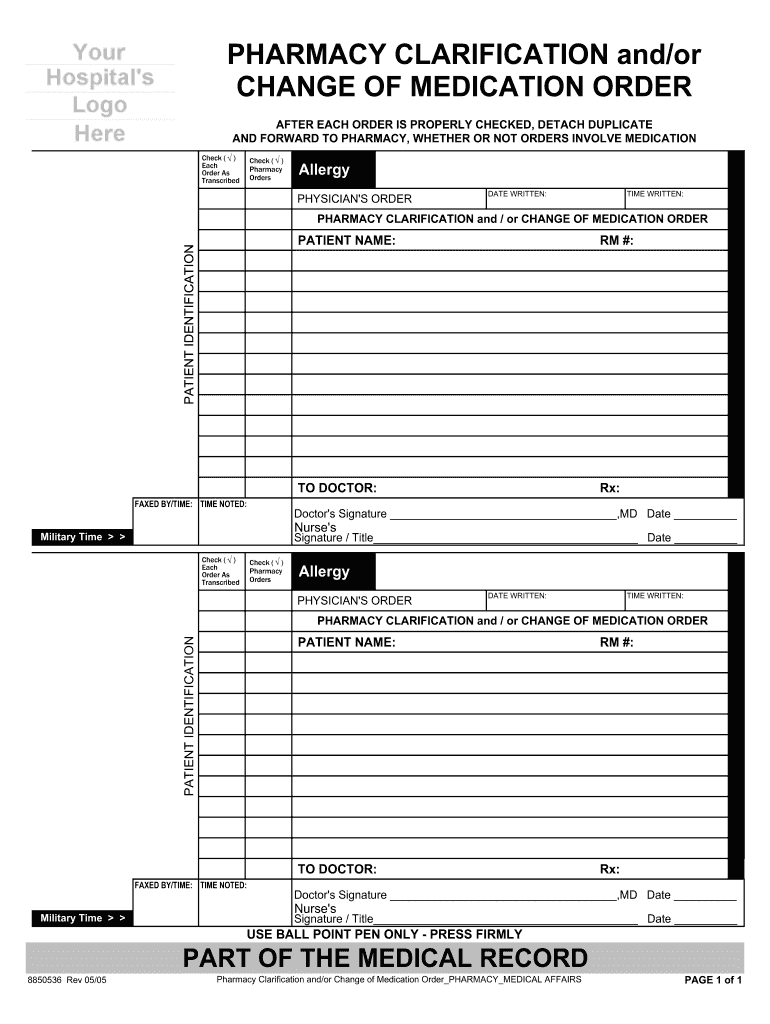
PHARMACY CLARIFICATION andor CHANGE OF MEDICATION ORDER 2026

Get Form
order clarification Preview on Page 1

Here's how it works

01. Edit your order clarification online
Type text, add images, blackout confidential details, add comments, highlights and more.
02. Sign it in a few clicks
Draw your signature, type it, upload its image, or use your mobile device as a signature pad.
03. Share your form with others
Send andor online via email, link, or fax. You can also download it, export it or print it out.

How to use or fill out PHARMACY CLARIFICATION and/or CHANGE OF MEDICATION ORDER with our platform

Form edit decoration
9.5
Ease of Setup
DocHub User Ratings on G2
9.0
Ease of Use
DocHub User Ratings on G2
  1. Click ‘Get Form’ to open the PHARMACY CLARIFICATION and/or CHANGE OF MEDICATION ORDER in the editor.
  2. Begin by entering the 'DATE WRITTEN' and 'TIME WRITTEN' in the designated fields to document when the order was created.
  3. Fill in the 'PATIENT NAME' and 'RM #' (Room Number) to ensure accurate identification of the patient associated with this order.
  4. In the 'TO DOCTOR' section, specify the physician responsible for this order, followed by entering the prescribed medication in the 'Rx' field.
  5. Ensure that both the doctor’s signature and date are provided at the bottom of the form, along with a nurse's signature and title for verification.
  6. Finally, check each order as transcribed and pharmacy orders to confirm accuracy before detaching duplicates for forwarding.

Start using our platform today to streamline your pharmacy orders for free!

See more PHARMACY CLARIFICATION andor CHANGE OF MEDICATION ORDER versions

We've got more versions of the PHARMACY CLARIFICATION andor CHANGE OF MEDICATION ORDER form. Select the right PHARMACY CLARIFICATION andor CHANGE OF MEDICATION ORDER version from the list and start editing it straight away!
Versions Form popularity Fillable & printable
2005 4 Satisfied (57 Votes)
be ready to get more

Complete this form in 5 minutes or less

Get form

Got questions?

We have answers to the most popular questions from our customers. If you can't find an answer to your question, please contact us.
Contact us
Why can several medication orders be written on a single medication order form? Medication order forms are an all-purpose communication tool used by the various members of the healthcare team. Orders for various procedures, laboratory tests, and x-rays may be written on the form in addition to medication orders.
Nurses must administer medications via the route indicated in the order. If a nurse discovers an error in the order or believes the route is unsafe for a particular patient, the route must be clarified with the prescribing provider before administration.
Prescriptions are often referred to as orders in clinical practice. There are several types of orders, such as routine orders, PRN orders, standing orders, one-time orders, STAT orders, and titration orders. A routine order is a prescription that is followed until another order cancels it.
One of the recommendations to reduce medication errors and harm is to use the five rights: the right patient, the right drug, the right dose, the right route, and the right time.
What are the 5 rights of medication administration? The right patient. The right drug. The right time. The right dose. The right route.

Security and compliance

At DocHub, your data security is our priority. We follow HIPAA, SOC2, GDPR, and other standards, so you can work on your documents with confidence.

Learn more
ccpa2
pci-dss
gdpr-compliance
hipaa
soc-compliance
be ready to get more

Complete this form in 5 minutes or less

Get form

People also ask

This process comprises five steps: (1) develop a list of current medications; (2) develop a list of medications to be prescribed; (3) compare the medications on the two lists; (4) make clinical decisions based on the comparison; and (5) communicate the new list to appropriate caregivers and to the patient.
There are five stages of the medication process: (a) ordering/prescribing, (b) transcribing and verifying, (c) dispensing and delivering, (d) administering, and (e) monitoring and reporting. Monitoring and reporting is a newly identified stage about which there is little research.

Related links