Hand Hygiene Forms - part 2doc 2026

Get Form
Hand Hygiene Forms - part 2doc Preview on Page 1

Here's how it works

01. Edit your form online
Type text, add images, blackout confidential details, add comments, highlights and more.

02. Sign it in a few clicks
Draw your signature, type it, upload its image, or use your mobile device as a signature pad.

03. Share your form with others
Send it via email, link, or fax. You can also download it, export it or print it out.

How to use or fill out Hand Hygiene Forms - part 2doc with our platform

Form edit decoration
9.5
Ease of Setup
DocHub User Ratings on G2
9.0
Ease of Use
DocHub User Ratings on G2
  1. Click ‘Get Form’ to open it in the editor.
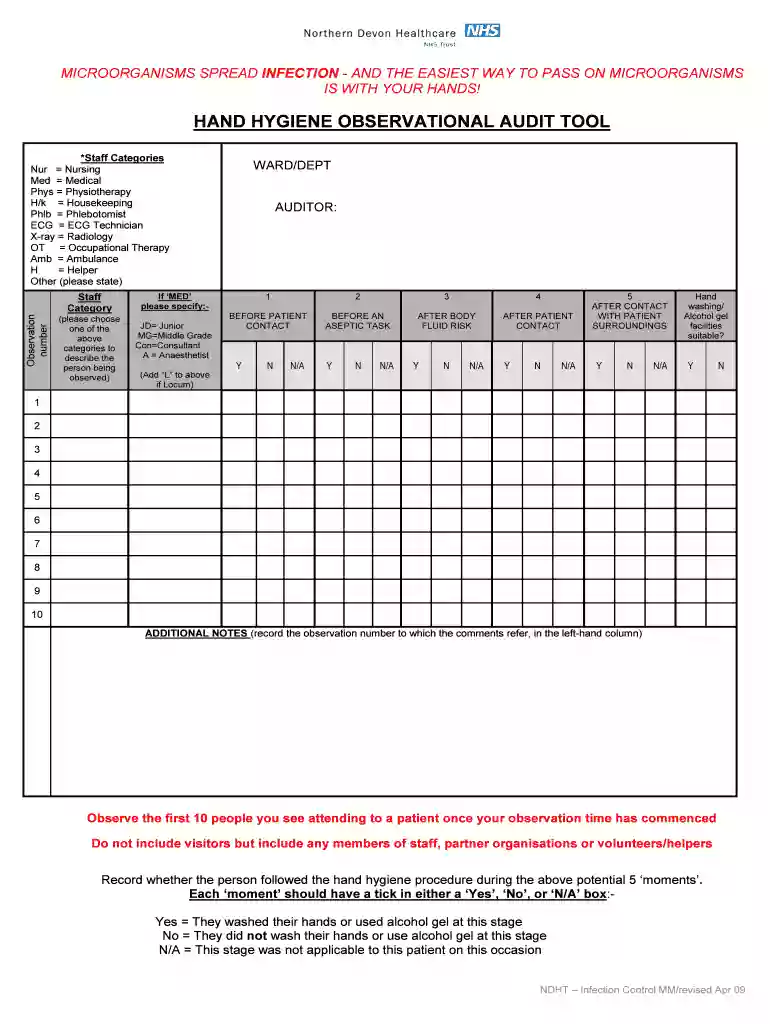
  2. Begin by selecting the appropriate staff category from the provided list. This will help categorize the observation accurately.
  3. Enter the observation number and specify the ward or department where the observation is taking place.
  4. As you observe, record whether each staff member followed hand hygiene procedures during the five key moments by ticking 'Yes', 'No', or 'N/A' for each moment.
  5. For additional notes, reference the observation number in the left-hand column and provide any relevant comments regarding your observations.
  6. Once completed, save your document and send it to NDHT – Infection Control as instructed.

Start using our platform today to streamline your form completion process for free!

be ready to get more

Complete this form in 5 minutes or less

Get form

Got questions?

We have answers to the most popular questions from our customers. If you can't find an answer to your question, please contact us.
Contact us
As soon as you detect an indication for hand hygiene, count an opportunity in the appropriate column and cross the square corresponding to the indication(s) you detected. Then complete all the indications that apply and the related hand hygiene actions observed or missed.
Different Levels of Hand Hygiene (A) Social Hand Hygiene- Routine Hand Washing. The aim of social (routine) hand washing with soap and warm water is to remove dirt and organic material, dead skin and most transient organisms. (B) Antiseptic Hand Hygiene. (C) Surgical Hand Hygiene.
Hand hygiene means cleaning your hands with: Handwashing with water and soap (e.g., plain soap or with an antiseptic). Antiseptic hand rub (alcohol-based foam or gel hand sanitizer). Surgical hand antisepsis.
Applying an alcohol-based hand rub to the surface of hands (including liquids, gels and foams) Washing hands with water and either antimicrobial or non-antimicrobial soap or soap solution.
Many diseases and conditions can be prevented through proper hygiene practices, such as covering your coughs and sneezes, washing hands after handling animals, and showering before you swim.

People also ask

Washing hands with soap and water is the best way to get rid of germs in most situations. If soap and water are not readily available, you can use an alcohol-based hand sanitizer that contains at least 60% alcohol.
According to the Centers for Disease Control and Prevention (CDC), hand hygiene is the single most important practice in the reduction of the transmission of infection in healthcare settings.

Related links