01. Edit your ms dr's biology 621 answer key online
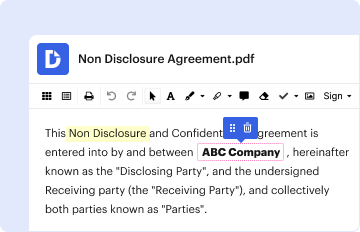
Type text, add images, blackout confidential details, add comments, highlights and more.
02. Sign it in a few clicks
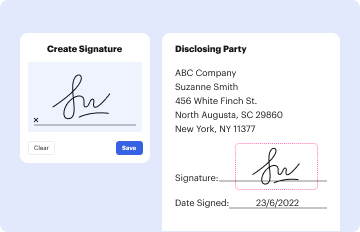
Draw your signature, type it, upload its image, or use your mobile device as a signature pad.
03. Share your form with others
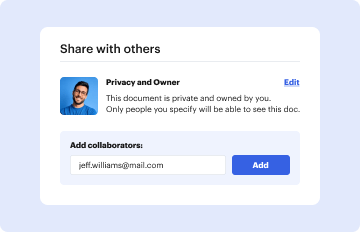
Send ms dr's biology 621 via email, link, or fax. You can also download it, export it or print it out.
How to use or fill out mutations practice with our platform
Ease of Setup
DocHub User Ratings on G2
Ease of Use
DocHub User Ratings on G2
Click ‘Get Form’ to open the mutations practice worksheet in the editor.
Begin by entering your name, block, and date at the top of the form. This personal information is essential for identifying your work.
Review the three types of DNA alterations: substitution, insertion, and deletion. Use the provided examples to understand how each mutation affects DNA sequences.
In section one, transcribe and translate the normal and sickle cell DNA sequences as instructed. Ensure you clearly indicate any changes made during transcription.
For questions regarding types of mutations, list two examples and explain their similarities and differences based on your understanding from the previous sections.
Complete all remaining questions by carefully analyzing each mutated DNA sequence provided. Circle changes in mRNA sequences and determine potential effects on amino acid sequences.
Start using our platform today to easily complete your mutations practice for free!
There are four types of chromosomal mutations: deletion, duplication, inversion, and translocation. Deletion involves the loss of all or part of a chromosome.
What are the 5 examples of mutation?
Five examples of mutations are point substitutions, insertions, deletions, chromosomal inversions, and chromosomal translocations. Point substitutions, insertions, and deletions are small-scale mutations.
How to study mutations?
Two groups of tests, molecular and cytogenetic, are used in genetic syndromes. In general, single base pair mutations are identified by direct sequencing, DNA hybridization and/or restriction enzyme digestion methods.
What is the mutation testing strategy?
Mutation testing is a fault based technique used for producing high quality test cases. It injects specific faults into the software under test and requires from the tester to produce test cases able to reveal them.
How to do mutation testing?
Performing mutation testing involves several steps: Choose the section of the source code that you want to test. Create mutants by making small, controlled changes to the code. Run your existing test suite against both the original, unmutated code and the mutants.
mutations practice
Mutations practice questionsMutation questions and answers PDFGenetic mutations practiceMutations practice freeWorksheet mutations practiceDNA Mutations Practice Worksheet pdf
Security and compliance
At DocHub, your data security is our priority. We follow HIPAA, SOC2, GDPR, and other standards, so you can work on your documents with confidence.
Exome sequencing looks at all the genes in the DNA (whole exome) or just the genes that are related to medical conditions (clinical exome). Whole genome sequencing is the largest genetic test and looks at all of a persons DNA, not just the genes.
What is the best practice for mutation testing?
Best Practices for Mutation Testing Focus on Critical and Complex Code: Run mutation testing on the most critical and complex parts of your code first. Running mutation testing on the entire codebase is slow and unnecessary for trivial code.
What are the principles of mutation testing?
Mutation testing is a powerful testing technique for achieving correct, or close to correct, programs. It rests on two fundamental principles. One principle is commonly known as the competent programmer hypothesis (CPH), or the competent programmer assumption. The other is known as the coupling effect.
worksheet mutations
Dna Mutations Worksheet
Dna Mutations Worksheet. Dna Mutations Worksheet - Which type of mutation results in abnormal amino acid sequence? Transcribe and translate the original dnaRead more
Mutations are a type of crop created in the Greenhouse. They are created by arranging crops in specific patterns around an empty soil plot and grant special
Cookie consent notice
This site uses cookies to enhance site navigation and personalize your experience.
By using this site you agree to our use of cookies as described in our Privacy Notice.
You can modify your selections by visiting our Cookie and Advertising Notice.