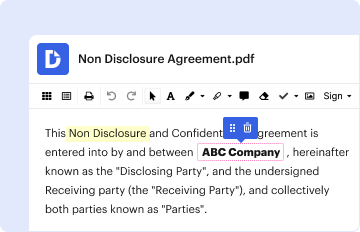
Type text, add images, blackout confidential details, add comments, highlights and more.
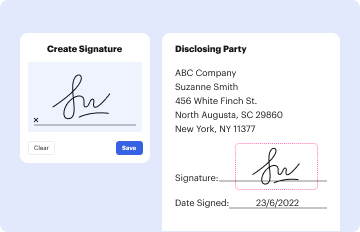
02. Sign it in a few clicks
Draw your signature, type it, upload its image, or use your mobile device as a signature pad.
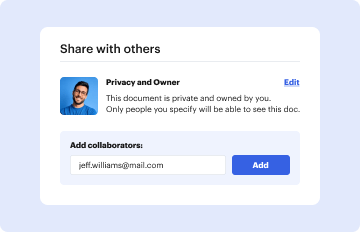
03. Share your form with others
Send tuckman questionnaire via email, link, or fax. You can also download it, export it or print it out.
How to use or fill out the Tuckman Questionnaire with our platform
Ease of Setup
DocHub User Ratings on G2
Ease of Use
DocHub User Ratings on G2
Click ‘Get Form’ to open the Tuckman Questionnaire in the editor.
Begin by reviewing the introductory section that outlines the purpose of the questionnaire. This will help you understand how to assess your team's maturity stage.
Proceed to fill out each of the 32 questions. For each statement, select a score from 1 (Almost never) to 5 (Almost always) based on your team's behavior.
Once all questions are answered, transfer your scores to the scoring sheet provided at the end of the questionnaire. Ensure accuracy to avoid data entry errors.
Calculate totals for each category: Forming, Storming, Norming, and Performing. This will indicate which stage your team predominantly operates in.
Start using our platform today for free and streamline your Tuckman Questionnaire process!
Preparing your Dissertation at a Distance: A Research Guide
Tuckman (1994: 36-47) discusses five variables, namely: Independent completed a survey questionnaire that addressed their perceptions regarding the.Read more
Psychometric properties of the Tuckman Academic - PMC
by JVQ Calle 2025 Cited by 2 These measures are commonly used to assess the reliability and consistency of psychological scales and questionnaires. The results revealed thatRead more
Believing the Results: Validation of the Tuckman Team
The Tuckman framework contains four stages of team development: Forming, Storming, Norming, and Performing. Although engineering educators have used thisRead more
Cookie consent notice
This site uses cookies to enhance site navigation and personalize your experience.
By using this site you agree to our use of cookies as described in our Privacy Notice.
You can modify your selections by visiting our Cookie and Advertising Notice.