






Definition and Meaning of the 2016 Form 5498
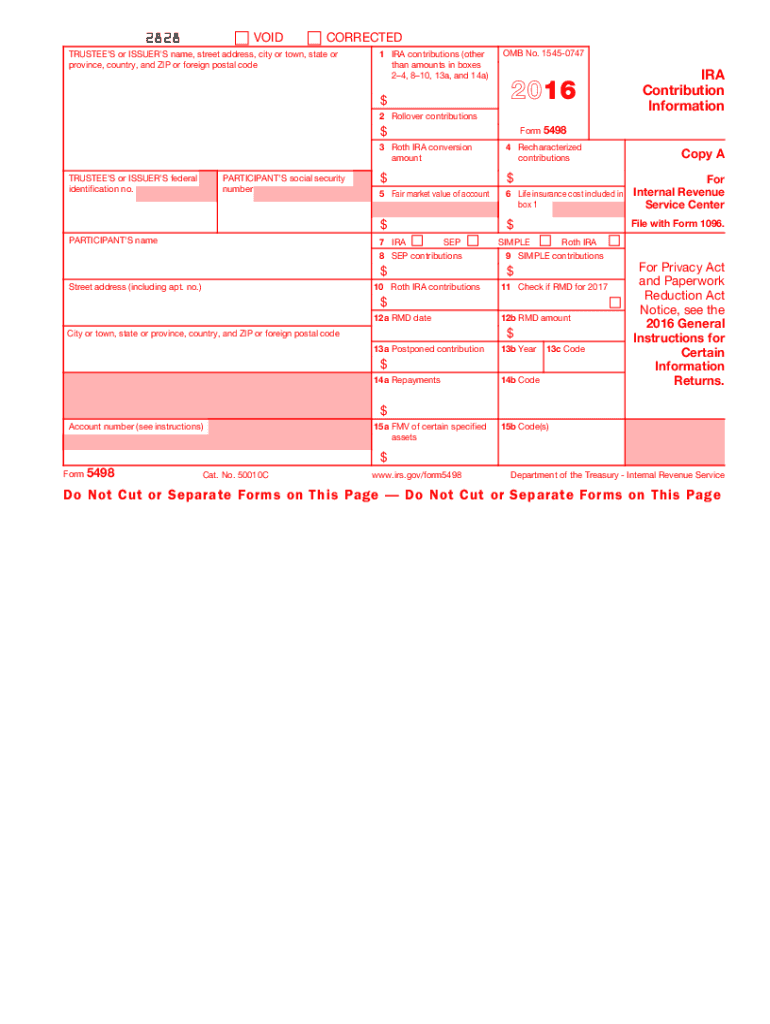
The 2016 Form 5498 is a document used by financial institutions to report contributions made to individual retirement arrangements (IRAs) to the IRS. The form provides detailed information about various types of contributions, including those made to traditional IRAs, Roth IRAs, and other specific retirement accounts. This form assists in ensuring compliance with tax regulations by accurately reporting the amounts contributed to each individual's retirement account. Additionally, the form serves to communicate required minimum distributions (RMDs) and fair market value information for account holders aged 70½ and above.
Key Elements of the 2016 Form 5498
- Contributor Information: Includes the name, address, and taxpayer identification number of the IRA contributor.
- Trustee Information: Identifies the financial institution serving as the IRA trustee or issuer.
- Contribution Types: Details on different types of contributions reported, such as rollovers, conversions, and annual contributions.
- Fair Market Value of IRA: Reports the fair market value of the IRA at year-end, crucial for tracking investment growth.
- RMD Information: Indicates whether the account holder is required to take minimum distributions, including the total amount.
Understanding these elements is critical for both the account holder's tax reporting and for maintaining accurate financial records.
Steps to Complete the 2016 Form 5498
- Gather Required Information: Collect all necessary personal and financial details for accurate reporting.
- Identify Contribution Types: Document all types of contributions made throughout the year.
- Calculate Fair Market Value: Work with financial advisors or institutions to determine the IRA's fair market value as of December 31, 2016.
- Review RMD Requirements: Ensure the correct RMD information is presented, particularly for those over 70½.
- Verify Trustee Details: Confirm that the financial institution's information is up-to-date and accurately reflected.
- Submit by the Deadline: Ensure the completed form is submitted to both the IRS and the account holder by May 31, 2017.
These steps ensure compliance and accurate representation of retirement contributions.
How to Obtain the 2016 Form 5498
IRAs trustees or custodians are responsible for generating and providing the 2016 Form 5498 to account holders. Account holders typically receive this form automatically if there have been any reportable contributions or distributions during the year. Institutions often provide this document via mail, but some might offer digital copies accessible through online accounts or secure emails. If missing a form, contact the financial institution directly to request a copy.
Why You Should Retain the 2016 Form 5498
- Documentation: Provides a record of all contributions for the tax year 2016.
- Verification: Useful for confirming reported amounts against personal records.
- Future Planning: Important for planning subsequent contributions and understanding required distribution obligations.
- IRS Communication: Essential for addressing any discrepancies with tax filings related to retirement accounts.
Retaining this form ensures that you have comprehensive documentation for your retirement contributions.
IRS Guidelines on Form 5498
The IRS requires financial institutions to report contributions to traditional, Roth, SEP, and SIMPLE IRAs using Form 5498. Specific guidelines stipulate the types of contributions that need to be reported and the deadline for submission. The IRS also provides instructions for correcting any errors found on submitted forms, ensuring the accuracy of official records. Institutions must adhere to these guidelines to avoid penalties and to ensure that taxpayer accounts are reported correctly.
Filing Deadlines for the 2016 Form 5498
The IRS mandates that Form 5498 for tax year 2016 be submitted to the recipient and the IRS by May 31, 2017. This timeline ensures that both the account holder and the IRS receive accurate information about all retirement contributions before the deadline for filing taxes. Timely submission is essential to prevent any issues with tax filings that include IRA contributions.
Important Terms Related to the 2016 Form 5498
- Traditional IRA: A tax-deferred retirement account option reporting contributions on Form 5498.
- Roth IRA: Features post-tax contributions, also included on Form 5498 for transparency.
- RMDs: Required distributions for individuals over a certain age, information commonly included in the form.
- Trustee or Custodian: Financial institution responsible for managing the IRA and reporting contributions via Form 5498.
These terms are crucial for understanding the scope and purpose of Form 5498.
Penalties for Non-Compliance with Form 5498 Requirements
Failure to properly report contributions using Form 5498 or to meet the specified IRS deadlines can lead to significant penalties for the financial institutions involved. Penalties vary based on the nature and timing of the non-compliance. Individuals may also face complications in accurately filing their tax returns if their contributions are not reported in accordance with IRS requirements. Addressing issues promptly and ensuring submissions adhere to guidelines help mitigate these risks.