Rubric for instructional materials 2026

Get Form
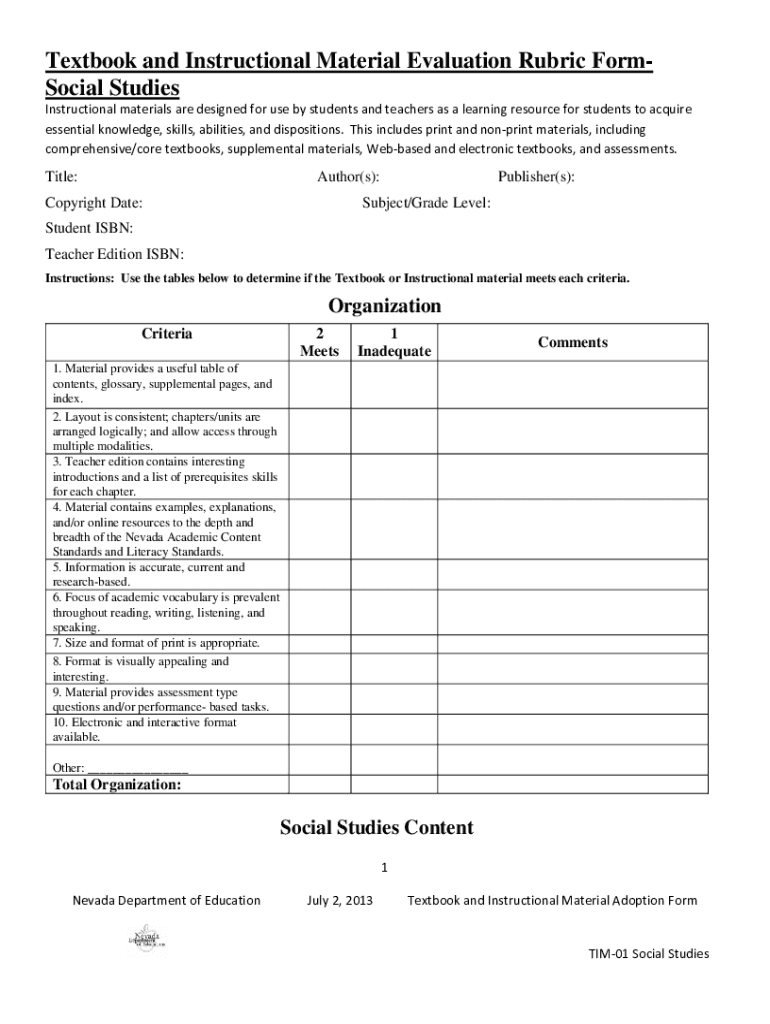
rubrics for instructional materials Preview on Page 1

Here's how it works

01. Edit your rubrics for instructional materials online
Type text, add images, blackout confidential details, add comments, highlights and more.
02. Sign it in a few clicks
Draw your signature, type it, upload its image, or use your mobile device as a signature pad.
03. Share your form with others
Send criteria for evaluating instructional materials via email, link, or fax. You can also download it, export it or print it out.

How to use or fill out rubric for instructional materials

Form edit decoration
9.5
Ease of Setup
DocHub User Ratings on G2
9.0
Ease of Use
DocHub User Ratings on G2
  1. Click ‘Get Form’ to open the rubric for instructional materials in our editor.
  2. Begin by filling in the title, author(s), copyright date, and publisher(s) at the top of the form. This information is essential for identifying the material being evaluated.
  3. Next, specify the subject and grade level, along with both student and teacher edition ISBNs. Accurate details here ensure proper alignment with educational standards.
  4. Proceed to evaluate each criterion under 'Organization' by selecting either 'Meets' or 'Inadequate' and providing comments where necessary. This section assesses the overall structure and accessibility of the material.
  5. Continue with the 'Social Studies Content' section, ensuring that you assess how well the material aligns with grade-level knowledge and skills. Again, mark your evaluation and add comments as needed.
  6. Move on to 'Inclusion' criteria, focusing on how well the material supports diverse learners. Document your evaluations clearly.
  7. Finally, complete the 'Alignment' section to confirm that content meets district curriculum standards. Sum up your scores for a total evaluation at the end of the form.

Start using our platform today to streamline your document editing and evaluation process for free!

be ready to get more

Complete this form in 5 minutes or less

Get form

Got questions?

We have answers to the most popular questions from our customers. If you can't find an answer to your question, please contact us.
Contact us
Different Types of Instructional Materials and When to Use Them Textbooks and Reference Books. Digital Resources. Audiovisual Materials. Worksheets and Workbooks. Manipulatives. Educational Games and Simulations. Charts, Graphs, and Diagrams. Case Studies and Real-World Examples.
Techniques of Evaluation consist of test and other items for measuring growth in particular outcomes of learning. Tools are the instruments used for measuring the learning outcome such as question papers, observation- schedules, rating scale, checklists etc.
Criteria for Evaluating Instructional Materials History-social science content and alignment with standards. Program organization. Assessment. Universal access. Instructional planning and support.
Qualities of effective instructional materials Clearly stated. Appropriate to the level of the course. Relevant to the content of the course. Appropriate to the role of the course in the major, concentration, and/or General Education curriculum. Appropriately sequenced.
A rubric is a type of scoring guide that assesses and articulates specific components and expectations for an assignment.

Security and compliance

At DocHub, your data security is our priority. We follow HIPAA, SOC2, GDPR, and other standards, so you can work on your documents with confidence.

Learn more
ccpa2
pci-dss
gdpr-compliance
hipaa
soc-compliance

People also ask

Evaluations can be carried out pre-use, in-use or post-use. The main aim of evaluating materials pre-use, according to Rubdy (2003, p. 42), is to measure the potential of what teachers and learners can do with them in the classroom.
When evaluating instructional materials, consider the extent to which each is interesting, approachable, and engaging. This isnt about materials being entertaining. Its about whether it can spark curiosity and promote deeper thinking about the content.

criteria for instructional materials