






Definition & Meaning
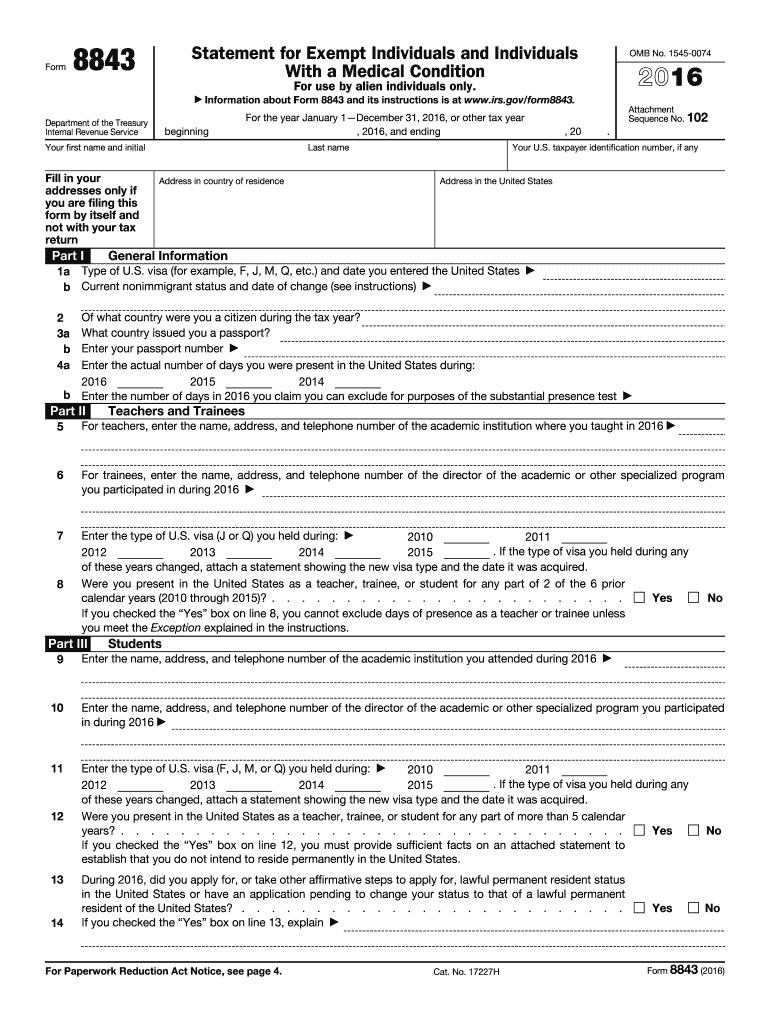
Form 8843 is a statement required by certain alien individuals to explain their claim for excluding days of presence in the U.S. for tax purposes. Specifically, it serves those who may be exempt from the substantial presence test, including teachers, trainees, students, and professional athletes. For the 2016 version, the form offers sections dedicated to each of these categories, clearly outlining the eligibility and requirements for each type of individual.
How to Use Form 8843 (2016)
Using Form 8843 involves a thorough understanding of which sections apply to your personal circumstances. The form is predominantly used to declare your claim as an exempt individual to the IRS. Each section—whether for students or professional athletes—requires detailed information to substantiate your claim for exemption from being taxed as a U.S. resident. Filling out this form correctly aligns with declaring which specific days you were present in the U.S. but should not be counted towards the substantial presence threshold.
Steps to Complete Form 8843 (2016)
-
Gather Personal Information: Start by providing your full name, identification number (such as a passport or taxpayer identification number), and information about your U.S. visa and residency status.
-
Determine Your Status: Identify which category of alien status you fall under—such as a student on an F-1 visa. This will determine the specific sections of the form you need to complete.
-
Complete Relevant Sections: Fill out the sections relevant to your status. For students, Section II must be completed. Teachers and trainees will fill out Section III, while professional athletes complete Section IV.
-
Review and Submit: Carefully review the form for accuracy. Once completed, it should be attached to your annual tax return or mailed separately if a tax return is not required.
Filing Deadlines / Important Dates
Form 8843 must typically be filed by the deadline for your annual tax return, which is usually April 15. If you are not required to file a tax return, it is advisory to still submit Form 8843 by the same date to ensure compliance with IRS regulations. Being aware of this deadline helps avoid potential oversight and penalties.
Important Terms Related to Form 8843 (2016)
- Substantial Presence Test: A key IRS test that determines if a nonresident alien is subject to U.S. taxation as a resident alien.
- Exempt Individuals: Categories of aliens who may disregard certain days of presence in the U.S. for tax purposes, typically including students, teachers, and specific athletes.
- F-1/J-1 Visas: Common visa types issued for students and exchange visitors, indicating nonresident status for tax purposes under certain conditions.
IRS Guidelines
The IRS provides specific guidelines on who must file Form 8843, detailing the process for both resident and nonresident aliens. This guidance includes definitions, eligibility criteria, and detailed instructions for each category of exempt individual. Following these guidelines is crucial in ensuring that the form is completed accurately and submitted on time.
Penalties for Non-Compliance
Failure to file Form 8843 can result in penalties, including jeopardizing your nonresident alien status and potentially owing taxes as if you were a U.S. resident. Successfully claiming exemption from the substantial presence test hinges upon timely and accurate form submission. Avoiding these penalties requires adherence to all IRS filing instructions.
Required Documents
To complete Form 8843, you need:
- A copy of your passport and visa documentation
- Previous travel records (such as entry and exit stamps)
- Any relevant tax identification numbers (Social Security Number or Individual Taxpayer Identification Number)
These documents support the claims made within the form and help ensure that all sections are filled accurately.
Achieving Tax Compliance with Form 8843
Achieving tax compliance with Form 8843 hinges on understanding its importance in the context of U.S. taxation for nonresident aliens. The form's primary role is to document your eligibility for exemption from the substantial presence test due to specific conditions or classifications, ensuring that you're only taxed on applicable income. The process highlights the responsibility of the filer to disclose necessary information, which ultimately aids in maintaining the integrity of tax filings for both the individual and the IRS.