




01. Edit your fda form 1571 online
Type text, add images, blackout confidential details, add comments, highlights and more.

Type text, add images, blackout confidential details, add comments, highlights and more.

Draw your signature, type it, upload its image, or use your mobile device as a signature pad.

Send fda 1571 via email, link, or fax. You can also download it, export it or print it out.
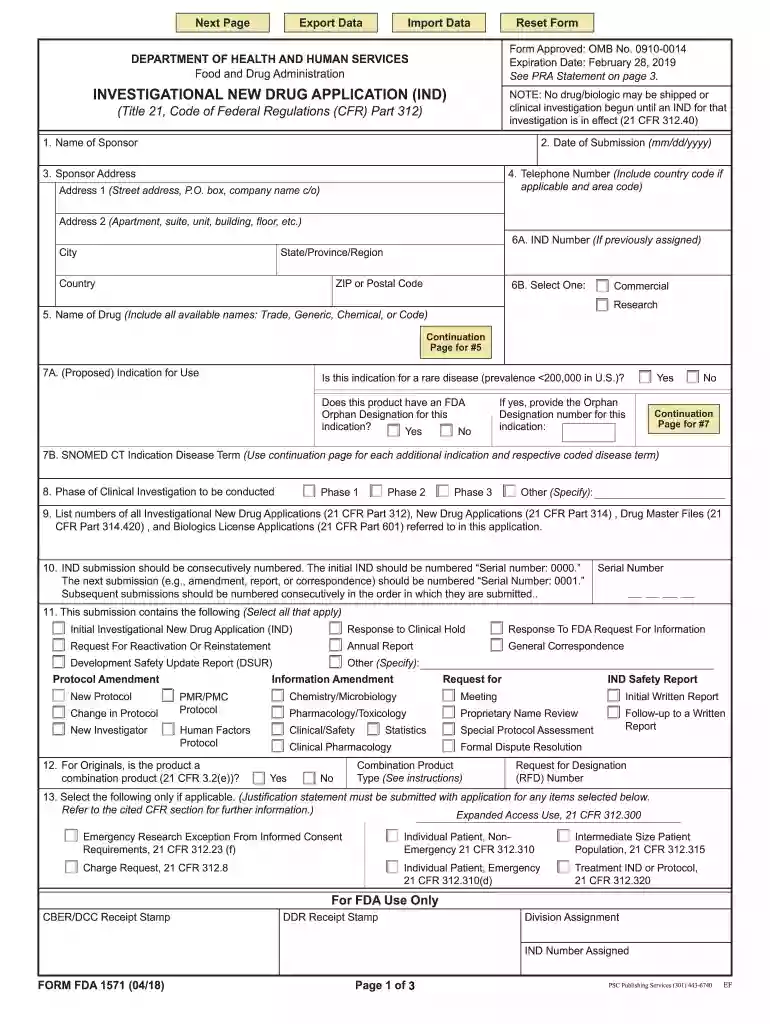
FORM FDA 1571, known formally as the Investigational New Drug Application (IND), is a crucial document that sponsors must submit to the U.S. Food and Drug Administration (FDA) to legally initiate clinical investigations of a new drug. This form serves as a formal request for permission to start clinical trials, providing substantial information about the investigational drug, the proposed clinical protocol, and the planned investigations. The FDA uses the information provided in this form to assess safety and efficacy before allowing human trials to begin. Specifically, the form includes various sections, such as the drug's chemical structure, pharmacological properties, and proposed uses, ensuring a comprehensive overview to facilitate FDA review.
Section Completion: Each section of FORM FDA 1571 requires detailed information about the investigational drug and its development. Important sections include:
Compliance Statements: The form requires a commitment from the sponsor to adhere to FDA regulations, including adherence to Good Clinical Practice (GCP) guidelines. This underscores the sponsor’s responsibility for the ethical conduct of the research.
Preclinical and Chemistry Information: Sponsors must include preclinical data supporting the drug's safety, as well as details about manufacturing processes and quality control measures. This helps establish confidence in the drug’s safety for early human testing.
Submission Method: Submit the completed form electronically or via traditional mail according to FDA guidelines. Electronic submissions must adhere to specific formatting standards.
Tracking and Waivers: Once submitted, sponsors can track the status of their IND application. If necessary, they may request waivers for certain data requirements, though thorough justification is essential.
Clinical Investigation Phases: The form delineates between different clinical phases (I, II, and III) and requires information specific to each phase. Phase I trials typically focus on safety, while Phase II and III trials investigate efficacy and side effects.
Risks and Benefits: Sponsors must articulate the potential risks associated with the investigational use of the drug, juxtaposed with its expected benefits. This is vital for ethical approvals and participant safety.
Monitoring Plan: An integrated plan for monitoring the trials, including data collection methods and adverse event reporting strategies, must be addressed in the application.
Data Retention: The form outlines required strategies for data retention, ensuring that research findings and participant information are maintained throughout the study duration and beyond, in accordance with FDA regulations.
Submitting FORM FDA 1571 is not just administrative; it is a legally binding process. Thus, failure to comply with the information requirements can lead to legal repercussions, including penalties, rejection of the application, or delays in the investigational process. This emphasizes the necessity for accuracy and completeness throughout the form completion.
Timeliness is crucial when submitting FORM FDA 1571. While the FDA does not impose a strict deadline for submission, it is advisable to file the application well ahead of the intended start date for any clinical trials. This allows for sufficient review time, addressing potential FDA queries, and making necessary adjustments to the proposed study design.
In addition to FORM FDA 1571, other related forms, such as FORM FDA 1572, exist to provide supplementary information, particularly regarding clinical investigators and study sites. Understanding the distinctions between these forms is essential for comprehensive IND submission.
For practical understanding, consider a case study where a biopharmaceutical company filed FORM FDA 1571 for a new cancer treatment. They provided exhaustive data on preclinical studies demonstrating significant tumor reduction in animal models, coupled with extensive toxicity reports. This thoroughness allowed them to proceed without delay into Phase I trials, showcasing the importance of careful documentation and preparedness when completing the application.
Failure to adequately complete and submit FORM FDA 1571 can result in severe penalties, including clinical holds and potential fines. Moreover, non-compliance can damage a sponsor's credibility and future applications for INDs, leading to long-term impacts on research opportunities and collaborations. Hence, understanding the implications of every section of the form is vital for ensuring that compliance is maintained, contributing to successful drug development.
We've got more versions of the fda form 1571 form. Select the right fda form 1571 version from the list and start editing it straight away!
At DocHub, your data security is our priority. We follow HIPAA, SOC2, GDPR, and other standards, so you can work on your documents with confidence.
IND submission should be consecutively numbered. The initial IND should be numbered Serial number: 0000. The next submission (e.g., amendment, report,Read more
MALE HYPOGONADISM. 11. 3.1. Epidemiology and prevalence of male hypogonadism. 11. 3.1.1 Body Composition and Metabolic Profile.Read more


