




01. Edit your ssa 823 online
Type text, add images, blackout confidential details, add comments, highlights and more.

Type text, add images, blackout confidential details, add comments, highlights and more.

Draw your signature, type it, upload its image, or use your mobile device as a signature pad.

Send ssa form 823 via email, link, or fax. You can also download it, export it or print it out.
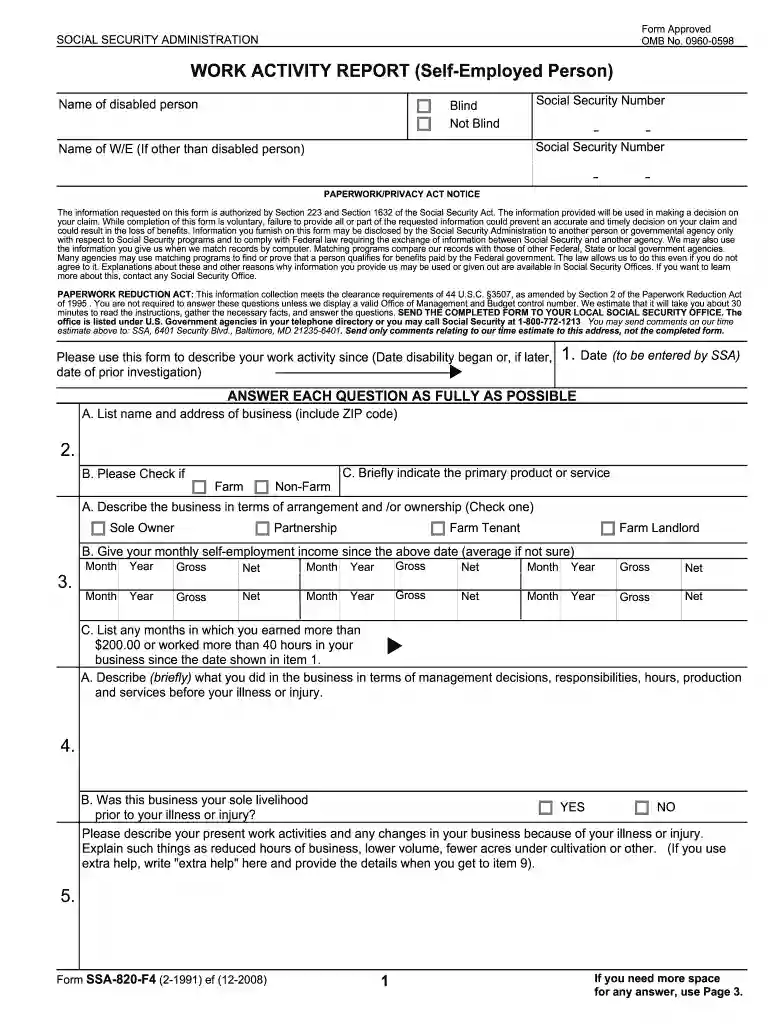
Form SSA 820, also known as the Work Activity Report, is a critical document issued by the Social Security Administration (SSA) for individuals who are self-employed and receiving disability benefits. This form is designed to collect comprehensive information regarding the business activities of individuals with disabilities, including details about their income and any modifications in their work due to their disability.
Understanding the components of Form SSA 820 can enhance accuracy and completeness in filling it out. The form consists of several sections, each designed to capture specific information relevant to the individual's work activities.
Filling out Form SSA 820 accurately requires several steps to ensure that all necessary information is provided. The process can be broken down into manageable stages.
Accurate income reporting is crucial when filling out Form SSA 820, as it directly impacts disability benefit calculations. Understanding the guidelines for reporting income can prevent miscalculations and potential penalties.
Misreporting information on Form SSA 820 can have serious legal ramifications for recipients of Social Security benefits. Understanding these risks can encourage compliance and diligence when filling out the form.
Several resources are available for individuals needing assistance with completing Form SSA 820 to ensure accurate submissions and compliance.
Being aware of common pitfalls when filling out Form SSA 820 can help individuals avoid unnecessary errors that may lead to issues with their disability benefits.
By understanding the detailed requirements, potential implications, and available resources concerning Form SSA 820, individuals can navigate the process more effectively and maintain compliance with Social Security regulations.
We've got more versions of the ssa 823 form. Select the right ssa 823 version from the list and start editing it straight away!
| Versions | Form popularity | Fillable & printable |
|---|---|---|
| 1991 | 4.9 Satisfied (350 Votes) |
Yes, you can use DocHub for signing any business and private documentation, including your ssa 823 form. All electronic signatures you create with our service are legally binding and court-admissible, as DocHub complies with standards required by ESIGN and UETA. Save your accomplished form with a detailed Audit Trail if needed.
With a swift editing platform like DocHub, you do not need anything but a web browser and internet connection to edit your form 823 online swiftly. Add your file or get the relevant form in DocHub’s catalog, open our editor with a single click, and finish it electronically. To revise your forms anytime, register a free account with DocHub.
At DocHub, your data security is our priority. We follow HIPAA, SOC2, GDPR, and other standards, so you can work on your documents with confidence.
In time series analysis, singular spectrum analysis (SSA) is a nonparametric spectral estimation method. It combines elements of classical time series ...
Social Security Announces Electronic Self-Reporting Forms ... Work Activity Report for Wage Employment (Form SSA-821) and Self-Employment (Form SSA-820).
Social Security uses the Work Activity Report form to learn more about the work activity of a disability applicant or beneficiary.


