




01. Edit your sworn application for tax clearance online
Type text, add images, blackout confidential details, add comments, highlights and more.

Type text, add images, blackout confidential details, add comments, highlights and more.

Draw your signature, type it, upload its image, or use your mobile device as a signature pad.

Send sworn application for tax clearance annex j 3 via email, link, or fax. You can also download it, export it or print it out.
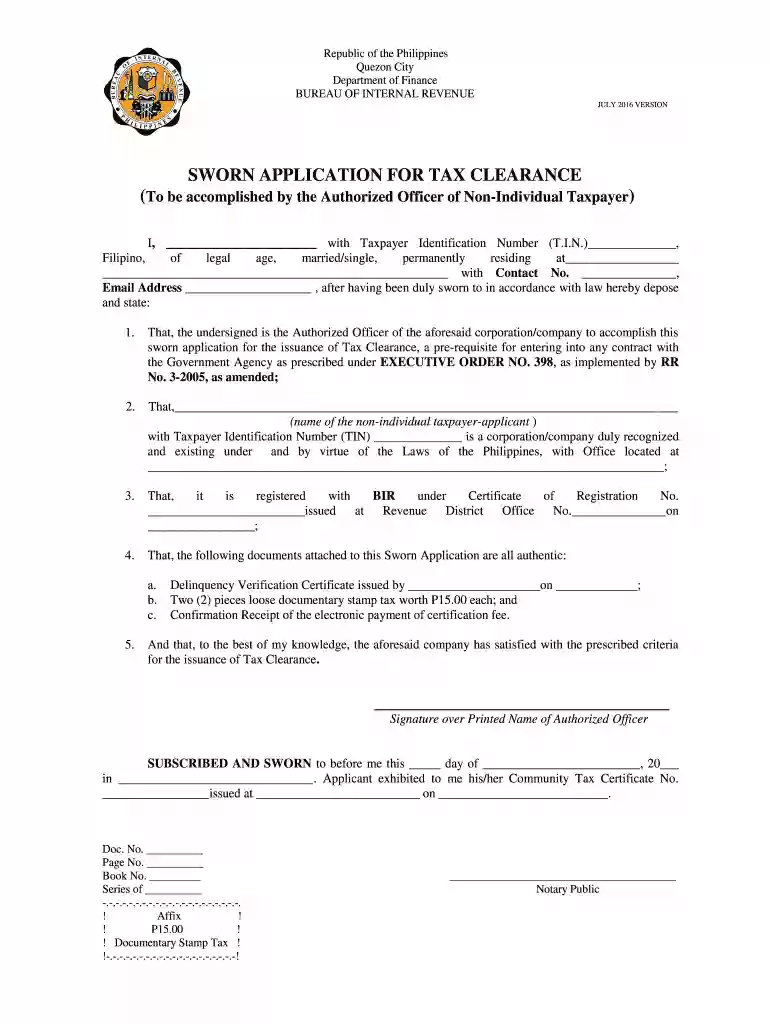
The sworn application for tax clearance serves as a formal document that non-individual taxpayers must complete to obtain a tax clearance certificate. This certificate is essential for various legal and business transactions, particularly when entering contracts with government entities. The application requires detailed information about the entity, including its registration details with the Bureau of Internal Revenue (BIR) and any necessary supporting documents to verify tax compliance.
Key aspects of the sworn application for tax clearance include:
Gather Necessary Documents:
Complete the Application Form:
File Supporting Documentation:
Submit the Application:
Await Clearance Processing:
When preparing a sworn application for tax clearance, there are several important considerations to keep in mind to ensure a smooth process:
Understanding potential pitfalls can aid in the successful submission of your sworn application for tax clearance. Common reasons for denial include:
For entities that encounter denial, reviewing the application, rectifying inaccuracies, and reapplying can enhance chances of securing tax clearance.
To ensure comprehensive preparation, specific documentation is frequently required along with the sworn application for tax clearance. Documents may include:
Proper attachment of these documents can facilitate faster processing and approval.
Entities must be aware of the various submission methods available for the sworn application for tax clearance:
The method chosen for submission can have implications on the speed of application approval and the overall efficiency of the process.
Tax compliance verification is central to the tax clearance application process. The clearance certificate acts as a verification tool, affirming that a taxpayer has fulfilled all obligations. This verification is crucial in contexts such as:
Ensuring compliance not only facilitates smoother transactions but also fosters a trustworthy reputation in the business realm.
The sworn application for tax clearance is a critical document for entities looking to engage in governmental transactions. Understanding its components, submission methods, and required documentation can aid in a seamless application process. By proactively ensuring tax compliance, organizations can establish a sturdy foundation for future business activities.
We've got more versions of the sworn application for tax clearance form. Select the right sworn application for tax clearance version from the list and start editing it straight away!
At DocHub, your data security is our priority. We follow HIPAA, SOC2, GDPR, and other standards, so you can work on your documents with confidence.
This form is required for state income tax withholding. □ CalPERS Beneficiary Designation. You are eligible for membership into CalPERS Retirement. For more.Read more
Apr 24, 2013 TITLE IHAZARDOUS SUBSTANCES RELEASES, LIABILITY,. COMPENSATION. Sec. 101. Definitions. Sec. 102. Reportable quantities and additionalRead more
Apr 14, 2026 A tax compliance report (Letter 6201) shows whether you have filed tax returns and paid taxes on time. Find out what it includes and how to


