




01. Edit your dha form 229 online
Type text, add images, blackout confidential details, add comments, highlights and more.

Type text, add images, blackout confidential details, add comments, highlights and more.

Draw your signature, type it, upload its image, or use your mobile device as a signature pad.

Send dha form 229 pdf via email, link, or fax. You can also download it, export it or print it out.
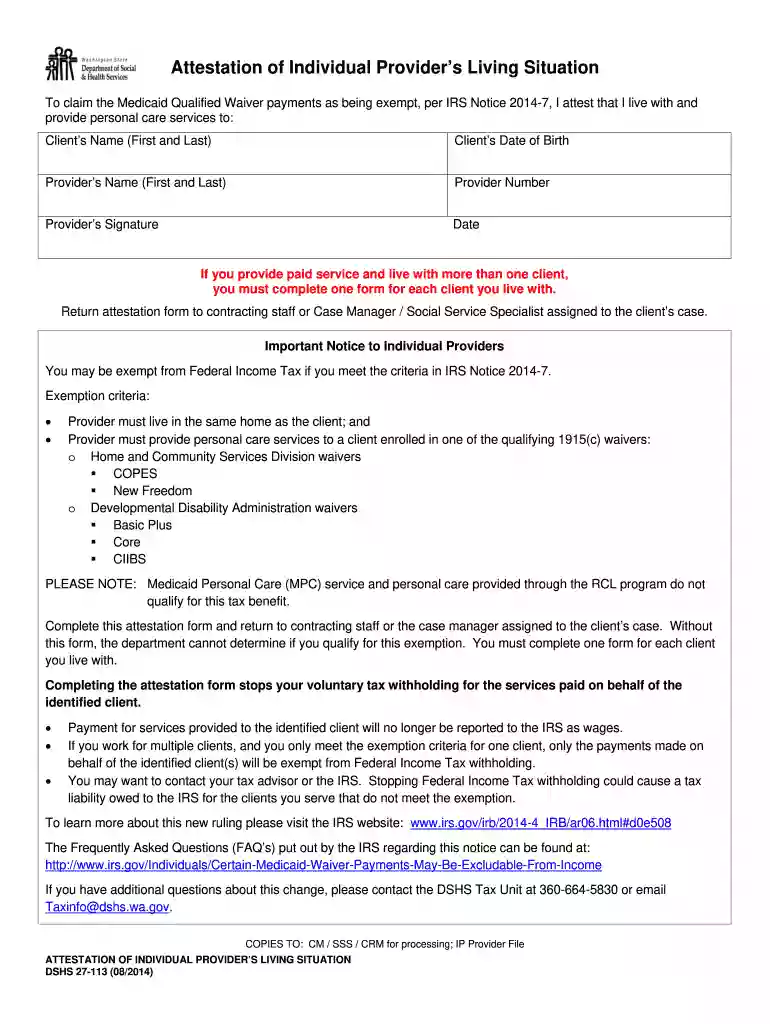
The DSHS attestation form is a crucial document for individual providers who claim Medicaid Qualified Waiver payments. This form certifies that providers live with and provide personal care services to specific clients, thereby confirming eligibility for tax-exempt status under IRS Notice 2014-7. The completion of this form necessitates detailed information about the provider, the client, and the nature of the services provided.
Key elements of the DSHS attestation form include:
This document serves to uphold accountability in the Medicaid system by ensuring that providers meet the necessary conditions for claiming exemptions.
Utilizing the DSHS attestation form involves a series of clear steps to ensure compliance with Medicaid policies and IRS regulations.
Gather Necessary Information: Before completing the form, collect all essential information from both the client and the provider. This includes names, addresses, social security numbers, and details about the services rendered.
Complete the Form Accurately: Fill out the form meticulously, ensuring that all fields are populated correctly. Pay special attention to the sections requiring signatures and dates, as incomplete forms may lead to delays or rejections.
Submit the Form: After completing the attestation form, it can be submitted either digitally or via traditional mail. Adherence to submission guidelines is crucial to ensure timely processing.
Maintain Copies: It is wise to keep copies of the completed form and any supporting documents for personal records. This is important in case of audits or discrepancies in the future.
Follow Up: After submission, follow up to ensure that the form has been received and is being processed. Keeping in touch with the relevant department can help address any unforeseen issues promptly.
The completion of the DSHS attestation form requires adherence to several clear, systematic steps to ensure accuracy and compliance.
Obtain the Form: Start by accessing the DSHS attestation form, which can typically be found on the official DSHS website or through your case manager.
Fill Out Key Sections:
Sign and Date the Form: After verifying everything is correct, sign the form and include the date to validate your attestation.
Compile Supporting Documents: Gather any necessary documentation that supports your claims—this may include care plans, eligibility letters, or any prior correspondence with Medicaid.
Submit the Form: Choose your submission method based on what is allowed—this could be electronic submission through an online portal or via mail to the designated address.
Confirm Submission: Keep documentation that verifies your submission date and method, which can be helpful in case of follow-ups.
Understanding the terminology associated with the DSHS attestation form is vital for ensuring compliance and clarity throughout the process.
This vocabulary assists in understanding the broader context and implications of the DSHS attestation form within the Medicaid framework.
The legal aspects of the DSHS attestation form are significant for compliance with both Medicaid requirements and IRS regulations.
Fulfilling these legal obligations not only protects the provider's interests but also maintains integrity within the Medicaid system.
Different states may have varying requirements and regulations regarding the DSHS attestation form, necessitating awareness of local guidelines.
Understanding these state-specific nuances is essential for ensuring that the DSHS attestation form is accurately completed and accepted by relevant authorities.
Practical examples can elucidate the utility and application of the DSHS attestation form in real-world situations.
Case Study 1: A family caregiver living with an elderly parent may need to submit the DSHS attestation form to claim Medicaid benefits for providing daily assistance. They accurately complete the form, detailing their living situation and the services offered, and securely submit it.
Case Study 2: An individual provider may assist a disabled client and must fill out an attestation form to maintain their Medicaid reimbursement eligibility. They gather supporting documentation, including care logs and personal identification, to accompany their submitted form.
These examples illustrate the practical implications and essential role of the DSHS attestation form in facilitating access to necessary care for clients while ensuring that providers maintain compliance.
We've got more versions of the dha form 229 form. Select the right dha form 229 version from the list and start editing it straight away!
| Versions | Form popularity | Fillable & printable |
|---|---|---|
| 2014 | 4.8 Satisfied (282 Votes) |
At DocHub, your data security is our priority. We follow HIPAA, SOC2, GDPR, and other standards, so you can work on your documents with confidence.
Jan 1, 2021 The form is intended for any individual with a serious illness. It attestation must be signed within 120 days. Application mustRead more
A completed CEA Form, with a DocHubd signature, is the only acceptable documentation that meets this requirement. The department may request additionalRead more
After the individual provider signs the attestation form, the individual provider must mail the attestation form to the address identified on the form.


