




01. Edit your 1125 form online
Type text, add images, blackout confidential details, add comments, highlights and more.

Type text, add images, blackout confidential details, add comments, highlights and more.

Draw your signature, type it, upload its image, or use your mobile device as a signature pad.

Send form 1125 e via email, link, or fax. You can also download it, export it or print it out.
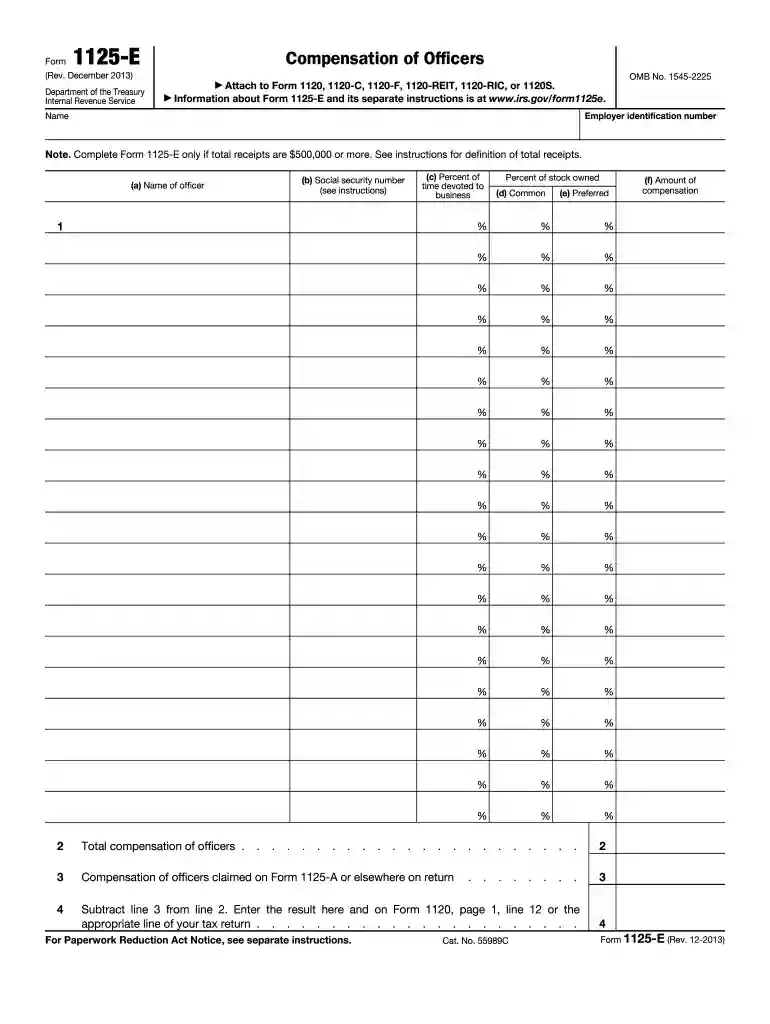
Form 1125-E, titled "Compensation of Officers," is a document required by the Internal Revenue Service (IRS) primarily used by corporations. It is specifically designed for reporting compensation details of officers in corporations with total receipts of $500,000 or more. This form includes essential information such as officer names, social security numbers, stock ownership percentages, and the compensation amounts. Attaching this form to corporate tax returns ensures accurate reporting of officer compensations and assists in determining compliance with federal tax obligations.
Gather Necessary Information: Before filling out Form 1125-E, collect required data, including officer names, social security numbers, and details about stock ownership.
Calculate Total Compensation: Determine the total compensation paid to each officer, including salaries, bonuses, and other benefits.
Complete the Form Sections: Fill out each section of the form, ensuring that details about compensation and stock ownership percentages are accurate and complete.
Review for Accuracy: Double-check all entries for accuracy to prevent potential issues with the IRS.
Submit with Tax Returns: Attach the completed Form 1125-E to the corresponding corporate tax return before submission by the filing deadline.
Corporations requiring the 2013 Form 1125-E can obtain it directly from the IRS website. Typically, the form is available for download as a PDF, ensuring it can be filed in both digital and paper formats. Additionally, tax preparation software often includes an option to generate Form 1125-E, streamlining the process for businesses using these systems.
The IRS provides specific instructions accompanying the 1125-E form to guide corporations on completing it accurately. This includes directives on what constitutes reportable compensation and how to handle discrepancies in reporting. Compliance with these guidelines is crucial to avoid penalties and ensure proper tax filings.
Corporations failing to file Form 1125-E when required may incur penalties from the IRS. These penalties typically involve fines and potential interest on late tax payments resulting from inaccurate reporting. Ensuring timely and accurate submission of this form is vital for maintaining compliance and avoiding financial repercussions.
Consider a corporation with annual receipts exceeding $500,000. The company must report compensation for its CEO and CFO, including salaries and bonuses. This corporation would use Form 1125-E to declare officer compensation in detail, ensuring each officer's total payments are accurately communicated to the IRS, thereby upholding legal and tax obligations.
Primarily, corporations structured as C-corporations are the typical users of Form 1125-E. These businesses, especially those with significant revenue streams, are legally obliged to disclose officer compensation to meet federal tax documentation requirements. The form is less common among small businesses and partnerships not meeting the revenue threshold.


We've got more versions of the 1125 form form. Select the right 1125 form version from the list and start editing it straight away!
At DocHub, your data security is our priority. We follow HIPAA, SOC2, GDPR, and other standards, so you can work on your documents with confidence.
File this form to request a six month extension of time to file your 2012 West Virginia Personal Income Tax Return (October 15, 2013). NOTE: This form andRead more
Complete Form 1125-E only if total receipts are $500,000 or more. See instructions for definition of total receipts. (a) Name of officer. (b) Social securityRead more
Mar 23, 2023 Contents Introduction Text of Exemption 2 History of the High 2/Low 2 Distinction Scope of Exemption 2 Strategies for challenging ExemptionRead more


