
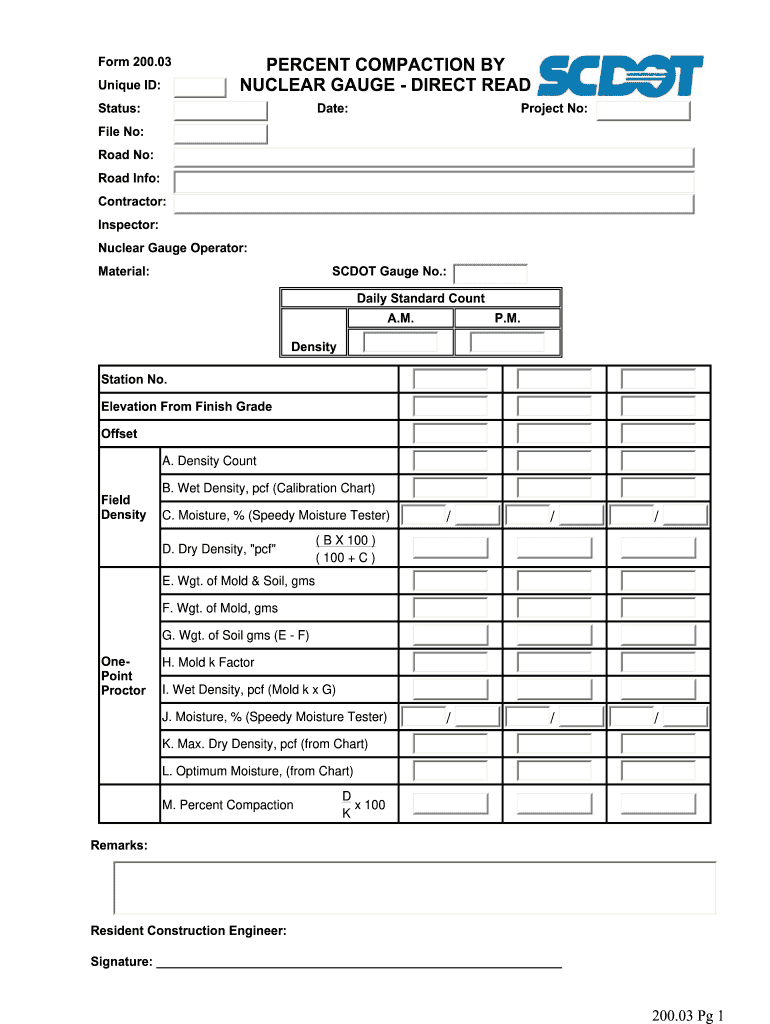





Scdot compaction tests form 2026

Get Form
fdot speedy moisture chart Preview on Page 1

Here's how it works

01. Edit your fdot speedy moisture chart online
Type text, add images, blackout confidential details, add comments, highlights and more.
02. Sign it in a few clicks
Draw your signature, type it, upload its image, or use your mobile device as a signature pad.
03. Share your form with others
Send fdot speedy conversion chart via email, link, or fax. You can also download it, export it or print it out.

How to use or fill out scdot compaction tests form with our platform

Form edit decoration
9.5
Ease of Setup
DocHub User Ratings on G2
9.0
Ease of Use
DocHub User Ratings on G2
  1. Click ‘Get Form’ to open the scdot compaction tests form in the editor.
  2. Begin by entering the Project No., Date, and File No. in the designated fields at the top of the form. This information is crucial for tracking and referencing your test results.
  3. Fill in the Road No. and Road Info sections to specify where the compaction test is being conducted. Accurate details here ensure proper documentation.
  4. Complete the Contractor and Inspector fields with relevant personnel information, followed by entering details about the Nuclear Gauge Operator and Material used for testing.
  5. In the Daily Standard Count section, input A.M. and P.M. density counts as required. Ensure these values are accurate for reliable results.
  6. Proceed to fill out Density Station No., Elevation From Finish Grade, and Offset fields, which are essential for precise measurements.
  7. For calculations involving density, moisture, and weight, follow the provided formulas carefully to derive values such as Wet Density, Moisture %, and Percent Compaction.
  8. Finally, add any remarks in the designated section before signing off with your name as Resident Construction Engineer.

Start using our platform today to streamline your document editing and form completion process for free!

be ready to get more

Complete this form in 5 minutes or less

Get form

Got questions?

We have answers to the most popular questions from our customers. If you can't find an answer to your question, please contact us.
Contact us

With DocHub, you can rapidly approve your scdot forms or any other document on iOS, even without installing extra applications. You can access your DocHub account from any internet-connected browser and complete and sign your form in any preferred method with just a couple of clicks.

If you are searching for a state-specific speedy moisture chart sample, you will find it in our DocHub Forms & Templates catalog. Use the search field, key in your form’s name, and search through the results for your state. You may also filter out irrelevant results while exploring our catalog by groups.

Proctor tests are soil moisture-density relationship tests that establish maximum dry density (the unit weight of the soil minus the weight of water) and the optimum water content for soil samples. For each soil type, the dry density and optimum water content values are different.
The dry density increases as the added moisture lubricate the soil particles and enable greater compaction from the same applied energy. Once the optimum moisture content is exceeded, the water starts to displace the soil in a given volume, and the dry density decreases.
What is the purpose of the compaction test? The test aims to establish the maximum dry density that may be attained for a given soil with a standard amount of compaction effort. When a series of soil samples are compacted at different water content, the plot usually shows a peak.

Security and compliance

At DocHub, your data security is our priority. We follow HIPAA, SOC2, GDPR, and other standards, so you can work on your documents with confidence.

Learn more
ccpa2
pci-dss
gdpr-compliance
hipaa
soc-compliance
be ready to get more

Complete this form in 5 minutes or less

Get form

People also ask

The Proctor test measures soil compaction to determine the point at which soils can most efficiently be compacted using construction equipment, based on their optimal moisture content and maximum dry weight.
A quantity of soil or soil and aggregate mixture is prepared at a determinable moisture content and compacted in a standard mold using a manual or mechanical rammer. The wet mass of this compacted sample is divided by the volume of the mold to determine the wet density.
0:54 7:17 Proctor Test, Method A - YouTube YouTube Start of suggested clip End of suggested clip Using a manual compaction rammer or a similar device with a two inch face lightly tamp the soilMoreUsing a manual compaction rammer or a similar device with a two inch face lightly tamp the soil until it is no longer loose or fluffy. Release the hammer and set it down on the soil in the mold.
The maximum dry unit weight (\u03b3dmax) is approximately 106.0lb/ft3....Solution. Moisture Content (%)Unit Weight for Zero Air Voids Curve (kN/m3)1817.872017.242216.662515.853 more rows
Calculate the dry density using the following equation: Dry Density (pcf) = Wet Density (pcf) \u2013 Moisture Content (pcf). 9.1. Report the moisture content of the soil to the nearest 0.1 percent and the moisture content of aggregate base materials to the nearest 0.1 pound per cubic foot.

Related links