Understanding the Habitat for Humanity Community Service Hours Form
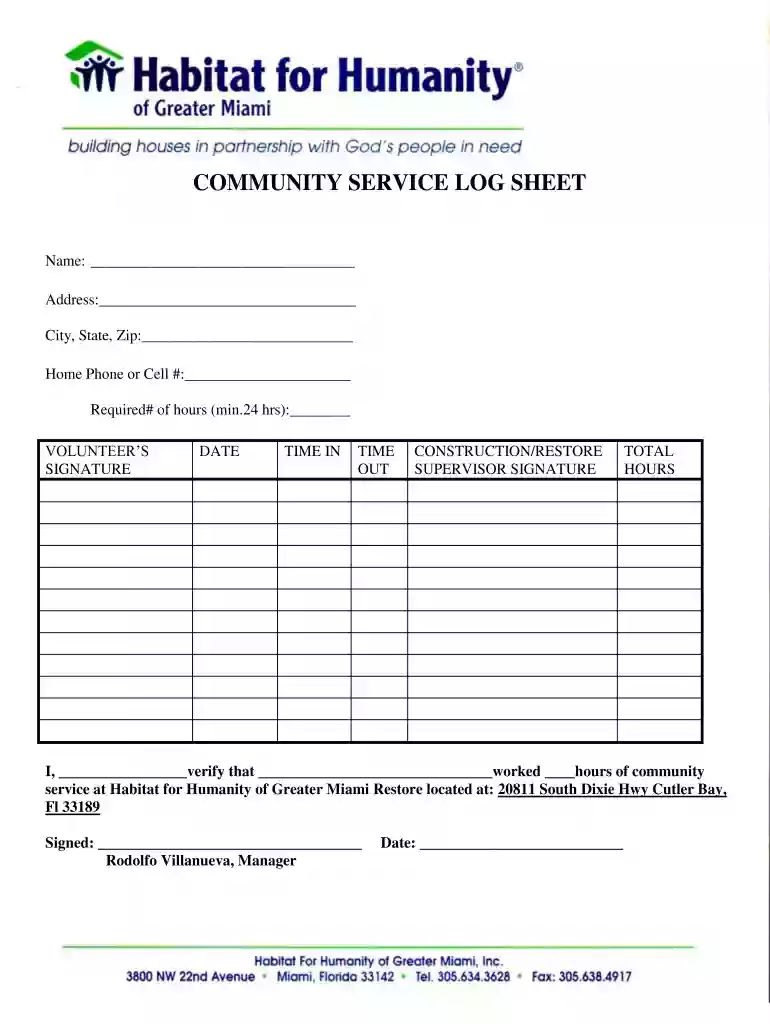
The Habitat for Humanity community service hours form is designed to document volunteer hours contributed by individuals participating in Habitat for Humanity projects. This form plays a crucial role in verifying hours worked, satisfying community service requirements, and fostering accountability among volunteers.
Key Components of the Community Service Hours Form
-
Personal Information Section
- This section typically requires the volunteer's name, contact details, and possibly their affiliation with a specific organization, if applicable. Accurate entry is essential to ensure proper recognition for the hours completed.
-
Hours Requirement
- Volunteers may need to indicate the total number of hours they are required to complete for their community service obligation. Understanding this figure helps in tracking progress and ensures volunteers meet their commitments.
-
Time In and Time Out
- This part of the form enables individuals to log the start and end times of their service. This function is critical for calculating total hours spent volunteering, which is then verified by a supervisor.
Supervisor Verification Process
-
Signature Requirement
- A supervisor’s signature is mandatory to validate the reported hours. This signature ensures accountability and confirms that the volunteer participated in the designated activities.
-
Comments for Quality Assurance
- Supervisors may also provide feedback or comments about the volunteer’s performance, which can be used for future reference or assessments.
Total Hours Worked Calculation
-
Summary of Service Hours
- At the end of the form, a section summarizes the total hours worked. This allows volunteers to see at a glance how much time they have contributed and ensures they have met any outlined community service obligations.
-
Importance of Accurate Reporting
- Accurate reporting of hours is critical for the community service process, as discrepancies can lead to issues in fulfilling service requirements.
Benefits of Using the Community Service Hours Form
-
Facilitates Tracking and Management
- Using this form simplifies the tracking of individual hours worked, making it easier for both volunteers and Habitat for Humanity coordinators to manage service commitments.
-
Promotes Transparency
- The form encourages honesty in reporting and helps maintain the integrity of community service efforts, which is essential for fostering trust within volunteer organizations.
Accessibility of the Form
-
Digital Availability
- The Habitat for Humanity community service hours form can often be found in digital formats, making it easier to fill out and submit online. This accessibility ensures that more individuals can participate without the hassle of paperwork.
-
Integration with Organizational Systems
- Some organizations may implement these forms as part of their broader volunteer management systems, which helps in streamlining processes and ensuring all records are maintained in one centralized location.
Variants and Alternatives to the Standard Form
-
Customizable Templates
- Organizations may create customized versions of the community service hours form to suit their specific needs, incorporating branding or additional data fields relevant to their programs.
-
Related Documentation
- Alongside the community service hours form, other related documents might include volunteer agreements or liability waivers, which together contribute to a comprehensive volunteer management system.
Ensuring accurate completion and submission of the Habitat for Humanity community service hours form not only enhances the volunteer experience but also strengthens the overall impact of community service initiatives.