
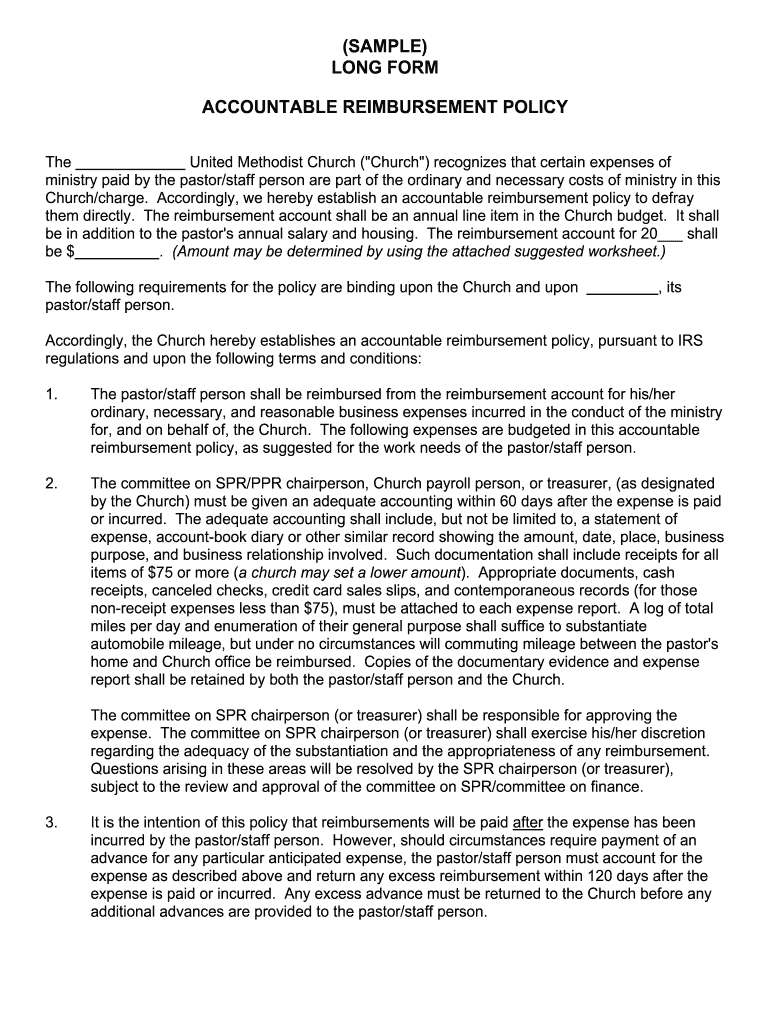







Definition & Meaning of the Long Form Accountable Reimbursement Policy
The (SAMPLE) Long Form Accountable Reimbursement Policy defines a structured approach for reimbursing employees for business-related expenses, ensuring compliance with Internal Revenue Service (IRS) guidelines. This policy is designed to document the reimbursement process, specify allowable expenses, and outline procedures for how employees may request reimbursement. In essence, it establishes a clear framework to support employees in recovering costs incurred while performing duties related to their roles without creating tax liabilities for the organization or the individual.
Key Features of the Policy
- Accountability: The policy mandates that employees maintain detailed records, including original receipts, to substantiate claims for reimbursement. This requirement ensures transparency and accountability in the reimbursement process.
- Eligibility Criteria: Only specific types of expenses, such as travel, meals, and supplies directly related to business operations, are reimbursable under this policy. This distinction helps prevent personal expenses from being incorrectly categorized as business-related.
- Approval Process: Employees must submit reimbursement requests for approval. This process typically involves completion of a standardized form that includes expense details, amounts, and evidence of why the costs were necessary for business functions.
How to Use the Long Form Accountable Reimbursement Policy
Employers and employees alike benefit from understanding the proper use of the (SAMPLE) Long Form Accountable Reimbursement Policy. The document serves as a guide for both the submission and approval of reimbursement requests.
Steps for Employees
- Expense Tracking: Employees should maintain meticulous records of incurred expenses aligned with business activities. This includes saving invoices, receipts, and any other supporting documents.
- Completion of Reimbursement Form: Employees must fill out a reimbursement form, which should include:
- Date of the expense
- Description of the item or service
- Amount spent
- Purpose of the expense
- Submission for Approval: Once completed, the form and associated documents should be submitted to the designated supervisor or finance department for review.
- Await Approval: Employees should monitor the status of their requests to ensure timely processing. If additional information is needed, they must be responsive to requests from the approving party.
Important Terms Related to Accountability in Reimbursement
Understanding key terms associated with the (SAMPLE) Long Form Accountable Reimbursement Policy can help users navigate its requirements effectively.
- Accountable Plan: A reimbursement arrangement that complies with IRS guidelines, allowing employees to avoid income tax implications on reimbursed amounts.
- Unaccountable Plan: A reimbursement plan that does not require substantiation of expenses and may be subject to taxation.
- Documentation: Original receipts, invoices, and detailed entries that justify the expenses claimed.
- Business Expenses: Costs incurred directly in pursuit of business goals, such as travel, meals, and supplies.
Legal Use of the Long Form Accountable Reimbursement Policy
The (SAMPLE) Long Form Accountable Reimbursement Policy serves not just operational purposes but also adheres to legal standards set forth by the IRS. This policy is crucial for ensuring that reimbursements qualify as non-taxable if they meet specific guidelines.
IRS Compliance Considerations
- Substantiation Requirement: Employees must provide documentation for their expenses to demonstrate that funds were spent in accordance with business needs.
- Timely Submission: The policy typically stipulates deadlines for submitting reimbursement requests, which must be adhered to in order to maintain compliance.
- Expense Categories: Clear definitions of what qualifies as a reimbursable expense help organizations avoid misclassification that could lead to legal issues or penalties.
Key Elements of an Effective Long Form Accountable Reimbursement Policy
Creating a comprehensive (SAMPLE) Long Form Accountable Reimbursement Policy involves including key components that ensure clarity and usability.
- Scope of Policy: Definition of who is eligible for reimbursement, such as employees, contractors, or part-time workers.
- Permitted Expenses: Detailed lists of what expenses can and cannot be reimbursed, including examples to guide users.
- Procedures for Reimbursement: Clearly outlined steps for submitting requests, along with the timeframe for processing claims and disbursing funds.
- Review and Appeal Process: Guidelines on what to do if a reimbursement request is denied, including how to appeal decisions and seek additional clarity.
Examples of Using the Long Form Accountable Reimbursement Policy
Understanding practical applications of the (SAMPLE) Long Form Accountable Reimbursement Policy can clarify how it functions in real-world scenarios.
Scenario 1: Employee Travel Expenses
An employee traveling for business purposes incurs costs for flights, hotel stays, and meals. Following the policy, the employee:
- Collects all relevant receipts.
- Completes the reimbursement form specifying travel dates, locations, and purpose.
- Submits this documentation to their supervisor for review and approval.
Scenario 2: Office Supply Purchases
A staff member buys office supplies necessary for a project:
- They keep receipts and detail items purchased on the reimbursement form.
- The supplies are deemed essential for project completion, justifying their reimbursement.
These examples illustrate the function of the policy in normal operations, enhancing ethical financial practices and organizational efficiency.




