




01. Edit your hundredths grid online
Type text, add images, blackout confidential details, add comments, highlights and more.

Type text, add images, blackout confidential details, add comments, highlights and more.

Draw your signature, type it, upload its image, or use your mobile device as a signature pad.

Send hundredths via email, link, or fax. You can also download it, export it or print it out.
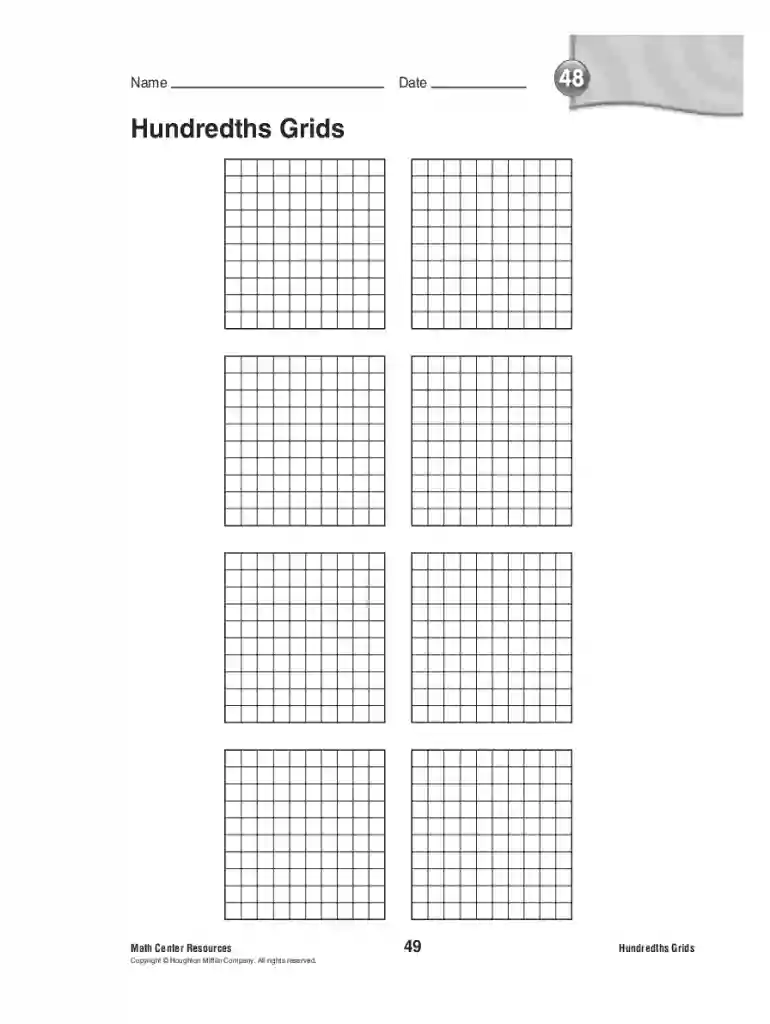
Hundredths grids, also referred to as hundredths models, are visual representations that help individuals understand decimal values, specifically those that extend to the hundredths place. These grids are divided into one hundred small squares, where each square represents one hundredth of a whole. The use of these grids is crucial in education, particularly in teaching mathematical concepts related to decimals and percentages, as they provide a tangible way to visualize relationships between whole numbers and their decimal equivalents.
The grids serve multiple educational purposes:
Using hundredths grids effectively involves practical exercises that engage students in visualizing and manipulating decimal values. Here's how to leverage these grids in educational settings:
Introduce Decimal Concepts:
Shading Activities:
Comparative Analysis Exercises:
Interactive Learning:
Real-Life Applications:
Accessing hundredths grids can be done through various channels, ensuring a flexible approach to obtaining these educational resources:
When solving problems using hundredths grids, it can be helpful to follow a structured approach:
Identify the Decimal: Start by determining the decimal value that needs representation. For example, if you are illustrating 0.75, recognize this value corresponds to seventy-five hundredths.
Shade the Grid: Using a blank hundredths grid, shade in the number of squares that represent the decimal value. For 0.75, you would shade 75 out of the 100 squares.
Analytical Observation: Reflect on the shaded area; analyze what this visual representation signifies in terms of proportions and comparisons with other decimals.
Problem-solving Application: Use the shaded grid to solve additional problems. For instance, you might ask how many more squares are needed to reach 100, or what the decimal representation would be if only 60 squares were shaded.
Validation and Review: After completing the problem, revisit the grid, ensuring proper representation and correctness of the decimal concepts.
Several practical examples demonstrate how hundredths grids can be utilized effectively in various scenarios:
Understanding Percentages: A teacher presents a problem focusing on achieving a passing score of 80%. Students can use a hundredths grid to shade in 80 squares, linking the visual representation of the decimal 0.80 to the concept of a percentage.
Shopping Discounts: In a real-world math problem, students may calculate the final price of an item after a 25% discount. They can visualize the discount using a hundredths grid, shading 25 of the 100 squares to represent the portion of the cost that is deducted.
Measurement Conversion: When teaching students how to convert measurements, such as inches to centimeters, hundredths grids may aid in visualizing the decimal equivalents of their calculations, helping them understand how decimal points shift during these conversions.
By applying these examples, educators can create engaging and informative lessons around decimal literacy, promoting proficiency in mathematical concepts related to hundredths.
At DocHub, your data security is our priority. We follow HIPAA, SOC2, GDPR, and other standards, so you can work on your documents with confidence.
Blank Decimal Squares for Hundredths. Page 4. Blank Decimal Squares for Thousandths. Page 5. Decimal Squares Grid. Page 6. Decimal Squares Number Lines. 0 1 2 3Read more
EXAMPLE: The grid shows how tenths, hundredths, and thousandths work together to make a decimal. EXAMPLE: Number line used to compare decimals. ImagesRead more
This article presents a dissection of the current Java Edition protocol for 1.21.10, protocol 773.


