Insurance group beneficiary designation form 2026

Get Form
fegli beneficiary form Preview on Page 1

Here's how it works

01. Edit your fegli beneficiary form online
Type text, add images, blackout confidential details, add comments, highlights and more.

02. Sign it in a few clicks
Draw your signature, type it, upload its image, or use your mobile device as a signature pad.

03. Share your form with others
Send printable tb test form for employment via email, link, or fax. You can also download it, export it or print it out.

How to use or fill out insurance group beneficiary designation form with our platform

Form edit decoration
9.5
Ease of Setup
DocHub User Ratings on G2
9.0
Ease of Use
DocHub User Ratings on G2
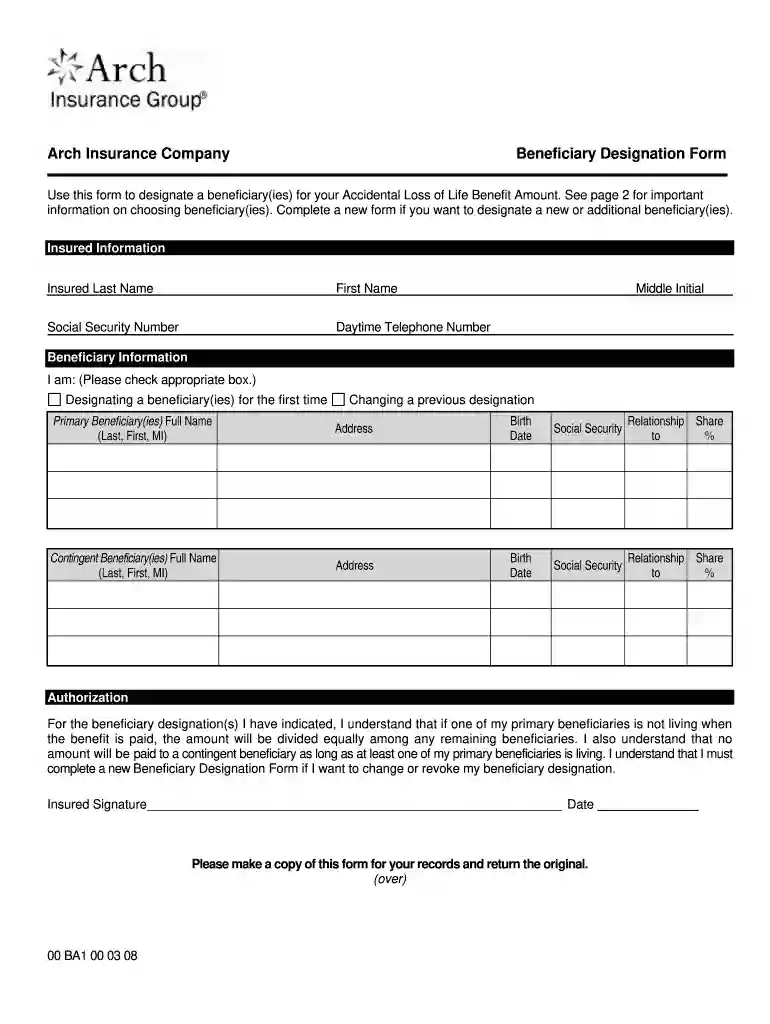
  1. Click ‘Get Form’ to open the insurance group beneficiary designation form in the editor.
  2. Begin by filling out the 'Insured Information' section. Enter your last name, first name, middle initial, social security number, and daytime telephone number.
  3. In the 'Beneficiary Information' section, indicate whether you are designating a beneficiary for the first time or changing a previous designation by checking the appropriate box.
  4. For primary beneficiaries, provide their full names (last, first, MI), addresses, birth dates, social security numbers, relationships to you, and the percentage share of benefits they will receive. Ensure that all percentages add up to 100%.
  5. Repeat step 4 for contingent beneficiaries if applicable. Remember that contingent beneficiaries only receive benefits if no primary beneficiaries are living.
  6. Review your entries for accuracy and completeness. Sign and date the form in the authorization section before submitting it.

Start using our platform today to easily complete your insurance group beneficiary designation form for free!

be ready to get more

Complete this form in 5 minutes or less

Get form

Got questions?

We have answers to the most popular questions from our customers. If you can't find an answer to your question, please contact us.
Contact us
4 Types of beneficiaries Primary beneficiaries. Contingent beneficiaries. Revocable beneficiaries. Irrevocable beneficiaries.
The beneficiary designation form is an estate planning tool that ensures assets are passed to the correct person(s) or organization(s) after a persons death. Beneficiary designations are not only important, but essential for individual legacies and business entities that act as plan sponsors for their employees.
Below, we have broken the process down into manageable steps. Step 1: Start with a Proper Salutation. Step 2: Introduce Yourself and Your Relationship to the Deceased. Step 3: Clearly State the Purpose of the Letter. Step 4: Provide Detailed Information about the Inheritance.
Most beneficiary designations will require you to provide a persons full legal name and their relationship to you (spouse, child, mother, etc.). Some beneficiary designations also include information like mailing address, email, phone number, date of birth and Social Security number.
Any of the following individuals are considered an eligible designated beneficiary (EDB): a surviving spouse, a disabled or chronically ill individual, an individual who is not more than 10 years younger than the IRA owner, or a child of the IRA owner who has not docHubed the age of majority.

Security and compliance

At DocHub, your data security is our priority. We follow HIPAA, SOC2, GDPR, and other standards, so you can work on your documents with confidence.

Learn more
ccpa2
pci-dss
gdpr-compliance
hipaa
soc-compliance
be ready to get more

Complete this form in 5 minutes or less

Get form

People also ask

Three or More Beneficiaries in Succession If the primary and secondary beneficiaries die, the third person named will receive the proceeds. Sample: Martha Doe, wife, or, in the event of her death, Richard Doe, cousin, or in the event of his death, Jane Doe, niece.

Related links