Gravel Pit Inspection Form - North American Invasive Species ... 2025

Get Form
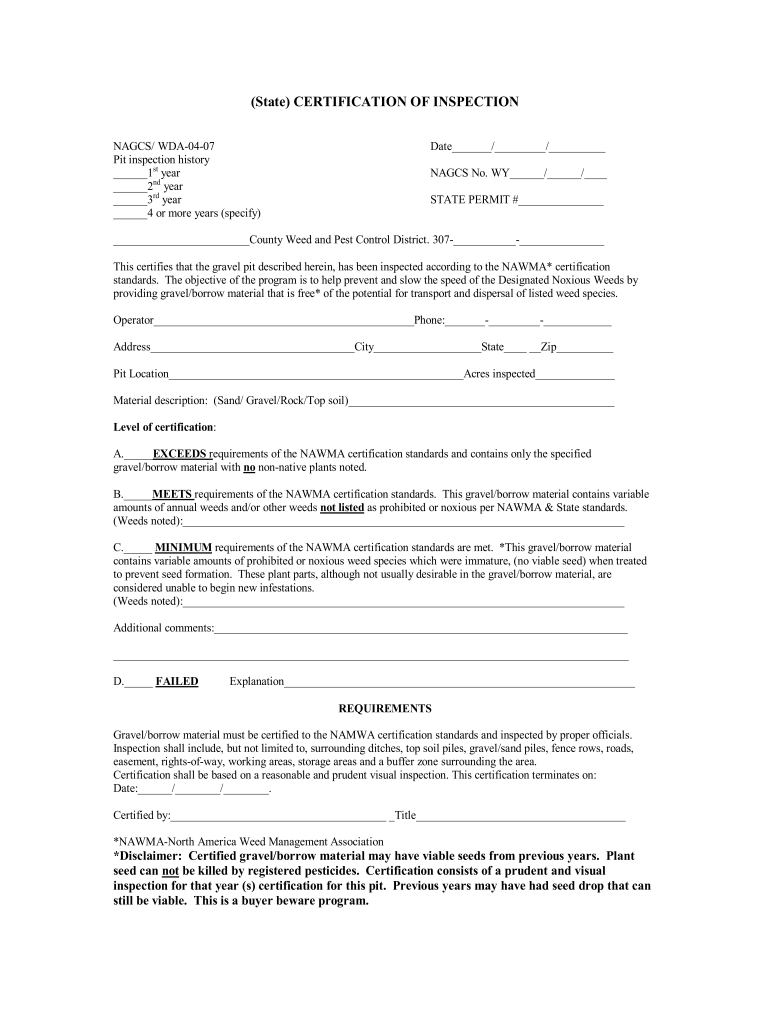
pit inspection checklist Preview on Page 1

Here's how it works

01. Edit your pit inspection checklist online
Type text, add images, blackout confidential details, add comments, highlights and more.
02. Sign it in a few clicks
Draw your signature, type it, upload its image, or use your mobile device as a signature pad.
03. Share your form with others
Send it via email, link, or fax. You can also download it, export it or print it out.

How to use or fill out Gravel Pit Inspection Form - North American Invasive Species with our platform

Form edit decoration
9.5
Ease of Setup
DocHub User Ratings on G2
9.0
Ease of Use
DocHub User Ratings on G2
  1. Click ‘Get Form’ to open the Gravel Pit Inspection Form in the editor.
  2. Begin by filling in the inspection history section, indicating the year of inspection by checking the appropriate box.
  3. Enter the date of inspection and NAGCS number in the designated fields.
  4. Provide your county's Weed and Pest Control District contact information, including phone number.
  5. Fill out the operator's name, address, city, state, and zip code accurately.
  6. Specify the pit location and acres inspected in their respective fields.
  7. Describe the material type (e.g., Sand/Gravel/Rock/Top soil) being inspected.
  8. Select the level of certification that applies to your gravel/borrow material by checking one of the options provided.
  9. If applicable, note any weeds observed during inspection in the designated area.
  10. Add any additional comments or explanations as necessary before finalizing your form.

Start using our platform today for free to streamline your form completion process!

be ready to get more

Complete this form in 5 minutes or less

Get form

Got questions?

We have answers to the most popular questions from our customers. If you can't find an answer to your question, please contact us.
Contact us
Gravel pits often lie in river valleys where the water table is high, so they may naturally fill with water to form ponds or lakes.
Gravel occurs naturally on Earth as a result of sedimentary and erosive geological processes; it is also produced in large quantities commercially as crushed stone. Gravel is classified by particle size range and includes size classes from granule- to boulder-sized fragments.
A gravel pit is a location where gravel is extracted from natural deposits like streambeds or beach deposits, often leading to the formation of artificial lakes when excavated below the water table.
Old, abandoned gravel pits are normally used either as nature reserves, or as amenity areas for water sports, landfills and walking. In Germany former gravel or sand pits that have filled up with water are known as Baggersee (power dug lake) and popular for recreational use.
Gravel pits are often formed by digging into areas where loose materials have accumulated due to natural processes like erosion and deposition.

People also ask

Dirt and sand are the eventual results of all this weathering and erosion as rock breaks down to particles. Wind, water and ice eventually deposit gravel in places such as beaches and calmer areas of rivers or lakes, where these forces no longer have enough strength to carry the gravel further.

Related links