Medical intake for paraarchery form 2026

Get Form
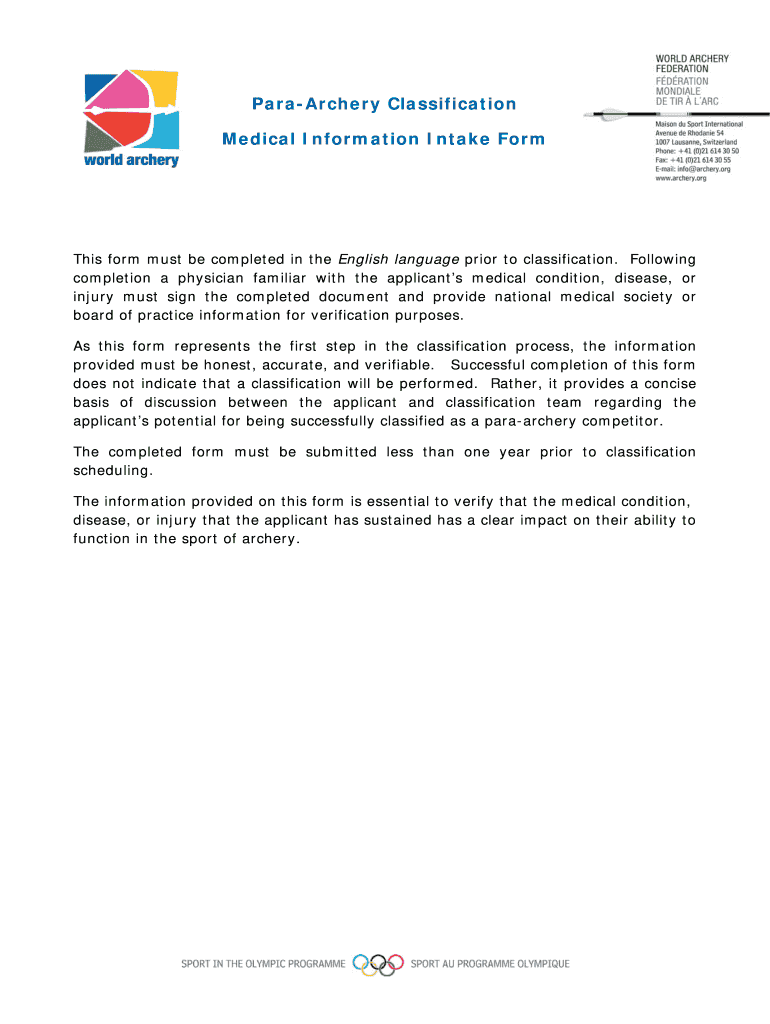
medical intake for paraarchery form Preview on Page 1

Here's how it works

01. Edit your form online
Type text, add images, blackout confidential details, add comments, highlights and more.
02. Sign it in a few clicks
Draw your signature, type it, upload its image, or use your mobile device as a signature pad.
03. Share your form with others
Send it via email, link, or fax. You can also download it, export it or print it out.

How to use or fill out medical intake for paraarchery form with our platform

Form edit decoration
9.5
Ease of Setup
DocHub User Ratings on G2
9.0
Ease of Use
DocHub User Ratings on G2
  1. Click ‘Get Form’ to open the medical intake for paraarchery form in the editor.
  2. Begin by filling out the 'Applicant Information' section. Enter your surname, first name, date and place of birth, and your National Governing Body.
  3. Provide details about your primary diagnosis, including the date of diagnosis and any significant functional limitations associated with it.
  4. Summarize any special tests that confirm your primary diagnosis, such as X-rays or MRIs.
  5. If applicable, fill in the secondary diagnosis section with similar details as above, including significant limitations and test summaries.
  6. List any other medical conditions or circumstances that may impact your ability to perform archery.
  7. Sign and date the document to confirm that all information is honest and accurate before submitting it for physician review.
  8. Finally, ensure a physician completes their information section, including their signature and registration details.

Start using our platform today to complete your medical intake for paraarchery form easily and efficiently!

See more medical intake for paraarchery form versions

We've got more versions of the medical intake for paraarchery form form. Select the right medical intake for paraarchery form version from the list and start editing it straight away!
Versions Form popularity Fillable & printable
2019 4.8 Satisfied (60 Votes)
2013 4.3 Satisfied (33 Votes)
be ready to get more

Complete this form in 5 minutes or less

Get form

Got questions?

We have answers to the most popular questions from our customers. If you can't find an answer to your question, please contact us.
Contact us
about para archery Archers can compete with a recurve or compound bow, shoot standing or seated in a stool or wheelchair. The recurve bow is the modern evolution of traditional bows while the compound bow features mechanical pulleys, telescopic sights and release aids to assist accuracy.
Results RankNPCScore 1 TUR 704 2 IND 703 3 IRI 696 4 GBR 69324 more rows
Assistive devices for para archers Disabled archers may use assistive devices in their shooting, including release aids, mouth tabs, stools and wheelchairs, to level the playing field. Classified athletes may also compete with non-disabled athletes in target archery events using their assistive devices.
The W1 category is for athletes with more severe impairments affecting at least three limbs, the torso, and both upper and lower body function. W1 archers can use either recurve or compound bows with restrictions, such as a 45lb draw weight limit and no magnified or peep sights.
Para archery is a sport that is open to individuals with a range of disabilities, including those with physical impairments or visual impairments. The sport involves using a bow and arrow to hit a target meters away.

Security and compliance

At DocHub, your data security is our priority. We follow HIPAA, SOC2, GDPR, and other standards, so you can work on your documents with confidence.

Learn more
ccpa2
pci-dss
gdpr-compliance
hipaa
soc-compliance
be ready to get more

Complete this form in 5 minutes or less

Get form

People also ask

6 assistive devices on the Paralympic archery field Release brace. Wheelchair. Stool. Prosthetic. Mouth tab. elbow strap.
Classification of Paralympic Sports Assistive Devices I. Wheelchairs. Wheelchairs, generally speaking, are chairs equipped with wheels that can help replace walking. II. Prostheses. III. Hearing Aids. IV. Throwing Stool. V. Swimming Tapping Stick. VI. Swimming Goggles for the Blind.

Related links