




01. Edit your employee information update form online
Type text, add images, blackout confidential details, add comments, highlights and more.

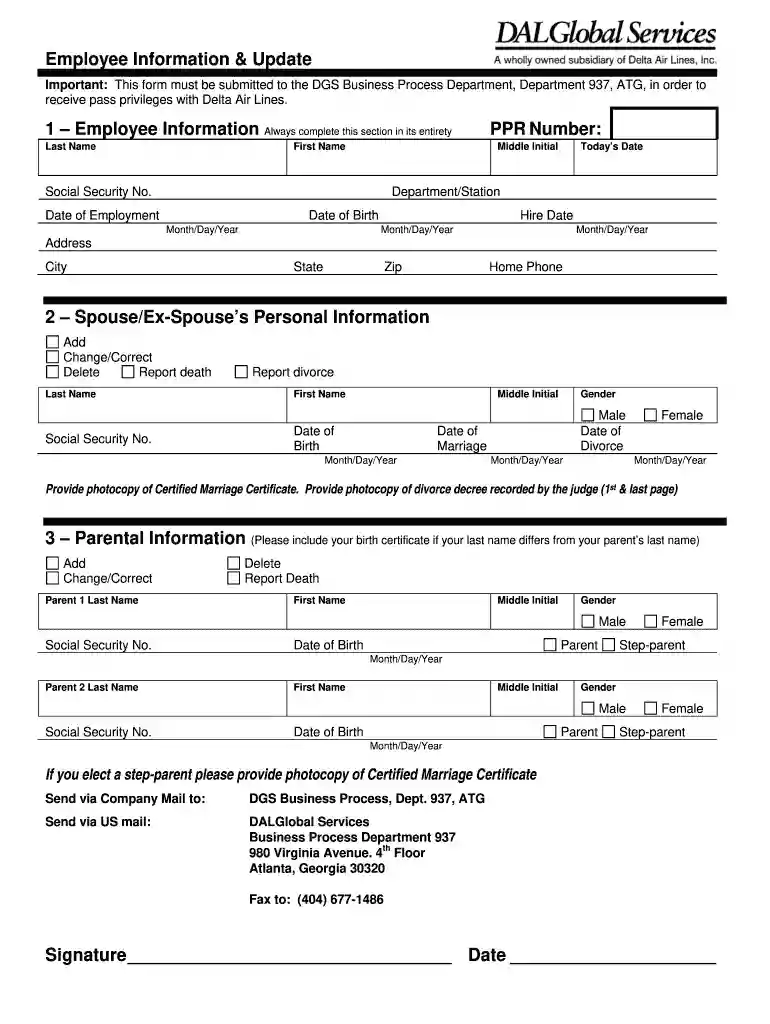
Type text, add images, blackout confidential details, add comments, highlights and more.

Draw your signature, type it, upload its image, or use your mobile device as a signature pad.

Send employee information update form pdf via email, link, or fax. You can also download it, export it or print it out.
An employee information update form is a crucial document used by employers to gather and maintain accurate records of their employees. This form allows employees to provide necessary updates regarding their personal information, such as address changes, marital status updates, and the addition of dependents. Proper documentation of this information is essential for compliance with tax laws, benefits administration, and effective communication within the organization.
By completing the employee information update form, employees ensure that their data is up to date, which is vital for payroll processing, tax withholdings, and eligibility for various employee benefits. Employers use this information to keep employee files accurate, aiding in administrative tasks and in fulfilling legal requirements related to workplace compliance.
Using the employee information update form is generally straightforward. Here are the key steps to effectively use this form:
Completing the employee information update form involves several important steps to ensure accuracy and completeness. Here’s a step-by-step guide:
Download or Request the Form:
Fill in Personal Details:
Update Address or Personal Information:
Provide Marital Status:
List Dependents:
Attach Relevant Documents:
Review and Sign:
Submit:
The legal use of the employee information update form is significant, as precise record-keeping is essential for compliance with various labor and tax laws. Employers must collect and update personal information in accordance with the Fair Labor Standards Act (FLSA) and Internal Revenue Service (IRS) regulations.
Using the employee information update form encompasses a variety of scenarios that necessitate updates to an employee’s records. Here are some common examples:
Change of Address: An employee moves to a new home and needs to update their address to ensure they receive important company communications.
Marriage or Divorce: An individual marries and wants to add their spouse as a dependent on their health insurance or needs to denote a change in marital status following divorce.
Birth of a Child: Employees reporting the birth of a child will use the form to add the child to their health insurance and update beneficiary information.
Change in Emergency Contacts: An employee may wish to change their designated emergency contact due to personal updates or to account for a change in relationships.
Through these examples, it is evident how the employee information update form serves as an essential tool for both employees and employers in maintaining accurate and up-to-date records.
At DocHub, your data security is our priority. We follow HIPAA, SOC2, GDPR, and other standards, so you can work on your documents with confidence.
EMPLOYEE INFORMATION UPDATE FORM. Annual update as requested by HR. Employee Update effective. Employee NameRead more
Please complete this form in blue or black ink and submit to your employer when complete. Hours worked by employee per week. Date of hire (mm/dd/yyyy). LeftRead more
This form is to be used only for name changes, address changes, phone number changes, and emergency contact changes. Tax withholding changes must be completedRead more


