
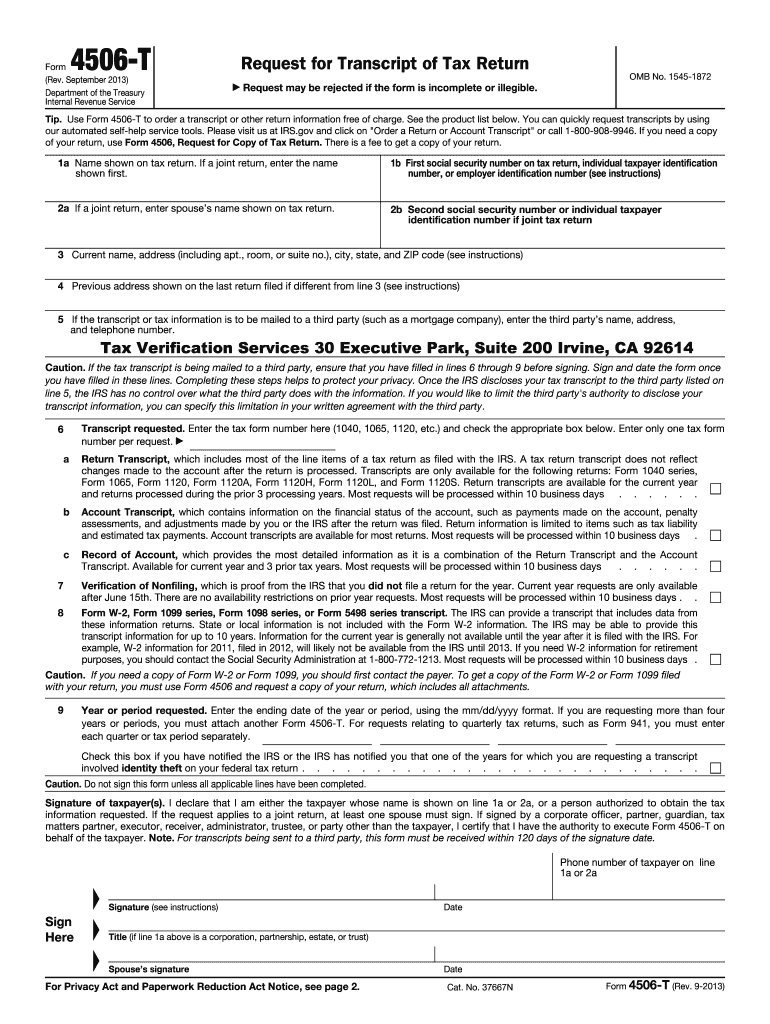







Definition and Purpose of the Veri-Tax Individual Transcript Form
The Veri-Tax Individual Transcript Form is designed to facilitate the request for a transcript of an individual's tax return information from the Internal Revenue Service (IRS). This form is often used to verify income and tax-related data for various financial or legal purposes. The form plays a critical role in ensuring accurate and reliable communication of tax information between different parties.
Common Uses and Applications
- Verifying income for mortgage applications or refinancing.
- Confirming tax return details for student financial aid.
- Supporting tax settlements or legal disputes involving tax information.
Benefits and Importance
Utilizing the Veri-Tax Individual Transcript Form can simplify processes that require validation of financial or taxpayer data, ensuring consistency and credibility in transactions or applications.
How to Obtain the Veri-Tax Individual Transcript Form
Acquiring the Veri-Tax Individual Transcript Form can be done through multiple channels for ease and accessibility, aligning with the needs of U.S.-based taxpayers.
Online Access
- IRS Website: The form can be directly downloaded from the IRS official site. This ensures you have the most up-to-date version.
- Third-Party Services: Platforms like DocHub provide easy access and digital filling processes.
Physical Copy Requests
- Request via Mail: Taxpayers can request a physical copy by sending a letter to the IRS, specifying the need for the form.
Local Tax Centers
Some local IRS offices provide copies of the form, allowing in-person pick-up for those who prefer physical interactions.
Steps to Complete the Veri-Tax Individual Transcript Form
Gathering Necessary Information
- Personal Details: Social Security Number (SSN), name, and address.
- Tax Information: Details about the tax year(s) for which transcripts are needed.
Filling Out the Form
- Section-by-Section Entry: Follow the form's instructions carefully to fill out each section, ensuring all applicable lines are completed.
- Signature and Date: Sign and date the form as required to validate your submission.
Designating a Third Party
- Authorization: If allowing a third party to receive your transcripts, provide complete information and authorization for them in the designated section.
Legal Use of the Veri-Tax Individual Transcript Form
The legal frameworks surrounding the use of this form ensure protection and compliance with tax laws.
Regulatory Compliance
- Federal Laws: Adheres to IRS rules and federal requirements for tax disclosure.
- Privacy Protections: Ensures that sensitive taxpayer information is managed following applicable privacy laws.
Penalties for Misuse
- Potential legal repercussions for improper or unauthorized use of the form could arise, emphasizing the importance of compliance.
Key Elements of the Veri-Tax Individual Transcript Form
Essential Sections
- Taxpayer Information: Includes identifying details for accuracy.
- Transcript Request Details: Specifies the type of transcript and tax years, ensuring precise processing.
Additional Considerations
- Instructions for Accuracy: Provides guidelines to avoid common errors, like incorrect SSN entries or year specifications.
Important Terms Related to Veri-Tax Individual Transcript Form
Transcript Types
- Return Transcript: Summarizes original filings.
- Account Transcript: Provides account activity and changes.
- Verification of Nonfiling: Confirms that no filing was submitted, if applicable.
Terminology Clarification
- Nonfiling: Situations where a tax return is not mandatory can still be formally recognized with this verification.
Examples of Using the Veri-Tax Individual Transcript Form
Real-World Scenarios
- Residential Loan Verification: Utilized by financial institutions to confirm applicant income.
- Educational Grants: Required for verifying need-based aid applications at academic institutions.
Diverse Applications
The form is versatile, used by various entities, from universities to mortgage brokers, highlighting its wide-ranging applicability.
IRS Guidelines and Compliance
Process and Requirements
- Submission Protocols: Follow detailed steps to ensure timely and correct processing.
- Deadline Awareness: Consideration for submission windows to align with financial or legal timelines.
Staying Current
Keep abreast of any changes to the IRS procedures or requirements, especially adjustments that may arise in response to new tax codes or regulatory shifts.




