




01. Edit your form online
Type text, add images, blackout confidential details, add comments, highlights and more.

Type text, add images, blackout confidential details, add comments, highlights and more.

Draw your signature, type it, upload its image, or use your mobile device as a signature pad.

Send it via email, link, or fax. You can also download it, export it or print it out.
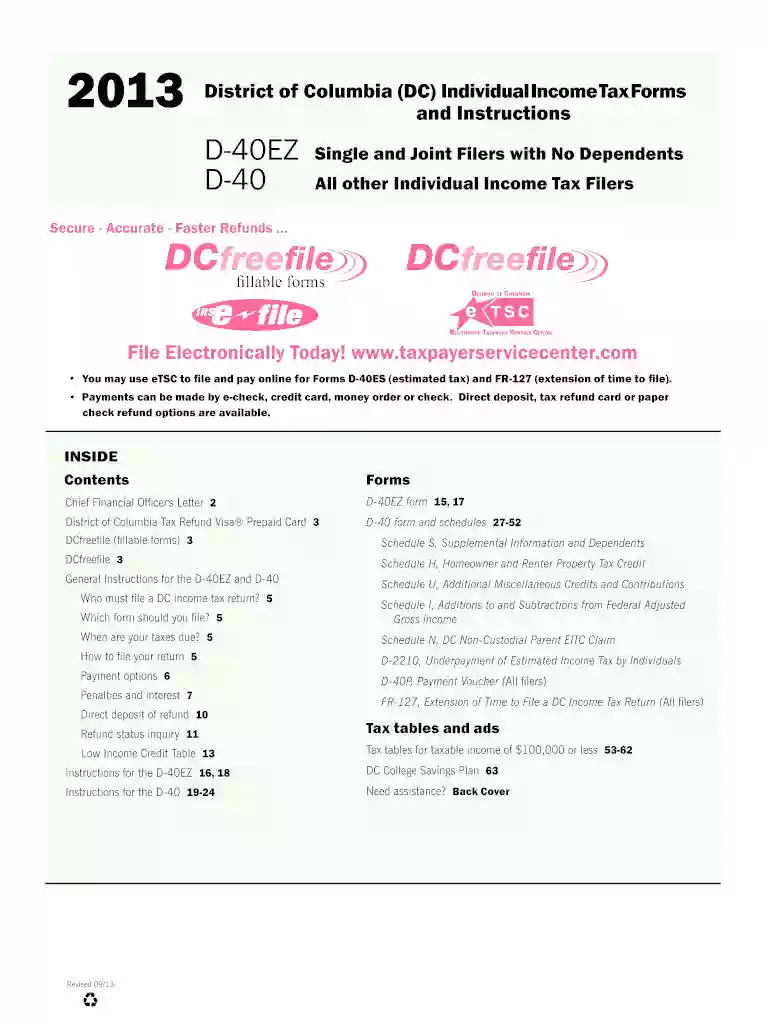
The 2013 D-40 form is an essential document used for filing individual income tax returns in the District of Columbia. It includes the necessary instructions and forms required for individuals to report their taxable income and calculate their tax liabilities for the year 2013. This form is applicable to residents of the District of Columbia, nonresidents, and part-year residents, ensuring they meet their tax obligations comprehensively.
For the 2013 D-40 form, the due date for filing without incurring penalties was typically April 15, 2014. Extensions might be available under certain circumstances but often require pre-arranged applications and explicit permissions from tax authorities.
Residents, non-residents, and part-year residents of the District of Columbia who earned income in 2013 must file the D-40 form. Special eligibility applies to those claiming credits like the Low Income Credit, which is based on specific income thresholds.


Non-compliance with the filing requirements of the 2013 D-40 form can result in significant penalties, including fines and interest on unpaid taxes. The District of Columbia imposes late filing and late payment penalties, emphasizing the importance of accurate and timely submission.
Consider a DC-based taxpayer with multiple income sources, including salary and freelance work. They would use the 2013 D-40 form to report total earnings, claim eligible deductions such as business expenses, and potentially reduce their tax liability through credits. Another example includes a part-year resident who needs to report income earned both in and outside the district, requiring careful attention to detail in filling out the form.
The form is issued by the District of Columbia Office of Tax and Revenue. This governmental body is responsible for managing the collection of local taxes and the dissemination of forms and guidelines applicable for residents filing their taxes in the district.
We've got more versions of the 2013 d 40 form form. Select the right 2013 d 40 form version from the list and start editing it straight away!
Yes, a typed name is accepted as a legitimate electronic signature when you create it on your form utilizing a compliant solution like DocHub. Simply import your 2013 d 40 form to our editor, click Sign in the top tool pane → Create your signature → Type your name in the proper tab, and decide how it will look on your document.
As a comprehensive document editing platform, DocHub is available on smart phones. Open DocHub in your choice of mobile browser and use our intelligent mobile-friendly toolset to complete your 2013 d 40 form.
At DocHub, your data security is our priority. We follow HIPAA, SOC2, GDPR, and other standards, so you can work on your documents with confidence.
Contract for the Research Support Professionals Unit (RX) between the University of California and the University Professional and Technical Employees (UPTE)Read more
2013 D-40 Individual. Income Tax Return. Print in CAPITAL letters using black ink. Leave lines blank that do not apply. 2013 D-40 P1. Individual Income TaxRead more
The Cisco 550X Series (Figure 1) are the next-generation stackable managed Ethernet switches that provide the advanced capabilities and superior performanceRead more


