







Understanding Post 60 Residuals in IATSE
Post 60 residuals refer to the payments made to members of the International Alliance of Theatrical Stage Employees (IATSE) for work done on projects that are released after a certain period post-initial release. These payments are crucial for ensuring fair compensation for the ongoing use of creative work. Typically, they apply to members who worked on productions covered under union agreements that stipulate residual payments.
Significance of Post 60 Residuals
Post 60 residuals serve multiple purposes in the entertainment industry:
- Ensures Fair Compensation: Residuals provide ongoing financial support to artists and crew members, reflecting the continuing value of their work.
- Encourages Quality Production: Knowing that creators will receive ongoing payments can incentivize higher quality performances and productions.
- Supports Economic Stability: For many IATSE members, residuals supplement earnings from the unpredictable nature of freelance work.
Eligibility for Post 60 Residuals
To qualify for post 60 residuals under IATSE:
- Employment on Eligible Projects: Workers must have participated in productions that fall under IATSE's collective agreements, specifically those projects marked for residual payments.
- Duration Requirement: Typically, the project must have initially released a certain number of months or years prior to the residual payment being triggered.
- Submission of Proper Documentation: Members must submit necessary paperwork, often through an IATSE form relevant to residual claims, detailing their role and project information.
Process of Claiming Post 60 Residuals
Claiming post 60 residuals involves several key steps:
- Review Your Involvement: Confirm your employment and ascertain the eligibility of the project for residuals.
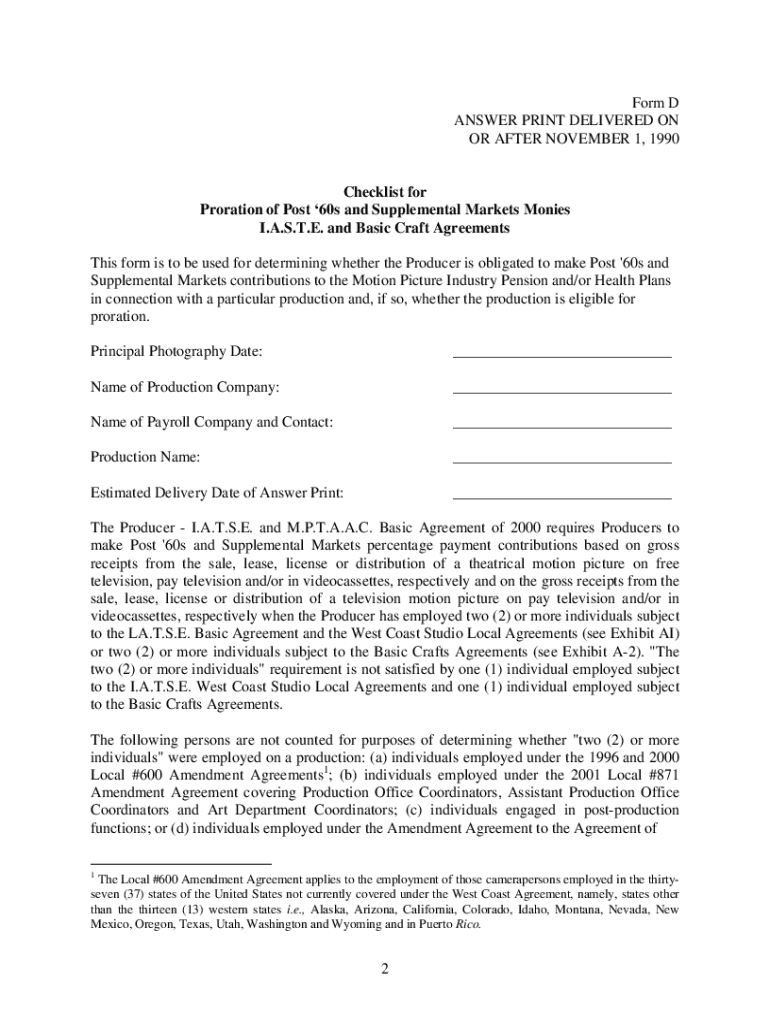
- Complete the Required IATSE Form: Depending on the nature of the project, this may be the IATSE Form D or another specified form.
- Submit Documentation: Provide the completed form along with any necessary documentation, such as call sheets or contracts, to your local IATSE office.
- Await Processing: After submission, residual claims are reviewed by IATSE, which can involve a waiting period for payment.
Key Terms and Conditions
Several important terms frequently arise in discussions about post 60 residuals:
- Residual Payments: These are the payments made for the reuse or rebroadcast of a production.
- IATSE Collective Bargaining Agreements: The negotiated contracts that define terms of employment and compensation, including residuals.
- Proration: In certain circumstances, the amount of residuals may be adjusted based on factors such as the production budget or the number of viewers.
Legal Framework Surrounding Post 60 Residuals
Post 60 residuals are governed by specific legal and contractual obligations:
- ESIGN Act Compliance: Electronic signatures for forms must comply with federal regulations, ensuring they are legally binding.
- Audit Rights: Productions may have auditing practices in place to verify that appropriate residuals are paid, which necessitates accurate record-keeping by producers.
- State Regulations: Different states may have specific laws affecting contracts and payment processes, which can impact the claiming of residuals.
By understanding these components surrounding post 60 residuals, IATSE members can better navigate their rights to these payments and ensure they receive due compensation for their contributions.




