




01. Edit your form online
Type text, add images, blackout confidential details, add comments, highlights and more.

Type text, add images, blackout confidential details, add comments, highlights and more.

Draw your signature, type it, upload its image, or use your mobile device as a signature pad.

Send it via email, link, or fax. You can also download it, export it or print it out.
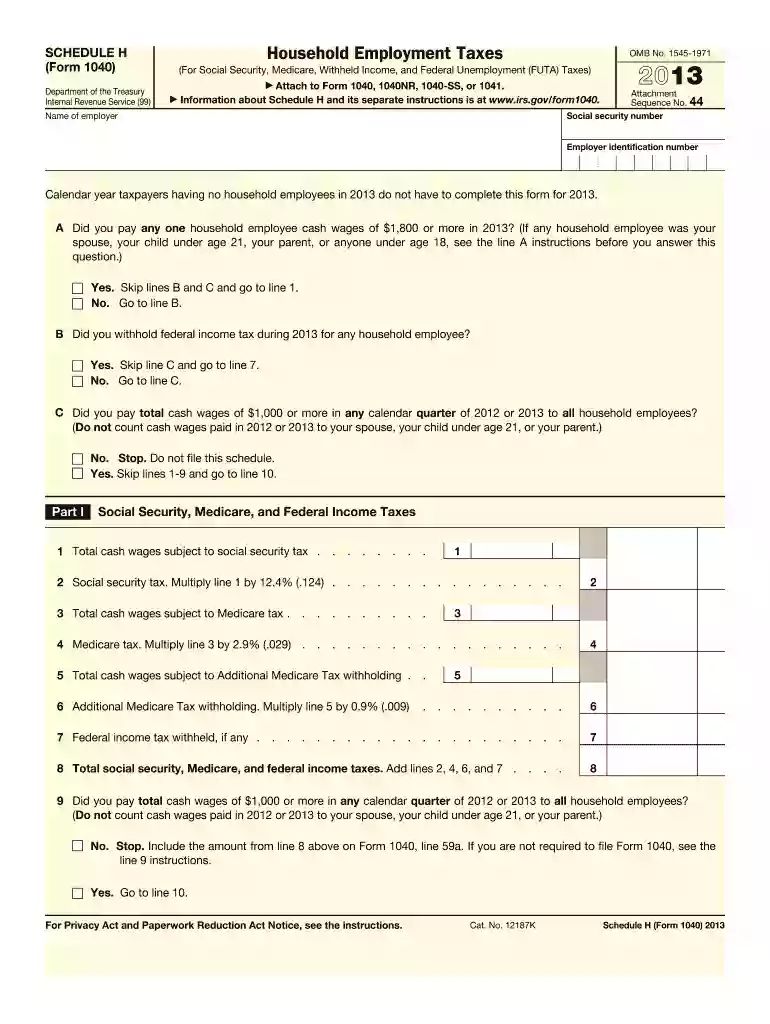
The 2013 Schedule H Form, also known as "Form 1040 Schedule H," is designed for household employers to report Social Security, Medicare, and Federal Unemployment Taxes (FUTA) for their household employees. This form is used when household employers pay cash wages that meet a certain threshold, making them responsible for withholding and paying these taxes. The form is a crucial document for ensuring compliance with the Internal Revenue Service (IRS) regarding household employment taxes.
To effectively utilize the 2013 Schedule H Form, household employers must first determine if they paid total cash wages that require the filing of this form. This typically involves calculating if the wages meet the annual threshold for federal taxes. Employers then fill out the form by providing details on wages paid, calculating the required Social Security and Medicare taxes, and any FUTA taxes due. An accurate completion ensures that all necessary taxes are reported for the household employees.
The 2013 Schedule H Form can be obtained through the IRS website where it is available as a downloadable PDF. Alternatively, it can be picked up at local IRS offices or found in tax preparation software that supports historical tax forms. Ensuring access to the correct version of the form is essential for accurate reporting in compliance with the 2013 tax year requirements.
Filing the 2013 Schedule H Form is crucial for household employers to fulfill their tax obligations regarding employment taxes for household employees. Compliance with this requirement helps avoid potential penalties or interest from the IRS for underreporting or late filing. It ensures that all taxes owed are correctly reported and paid, maintaining good standing with federal tax regulations.
The form is typically used by household employers who pay a specific threshold of cash wages to employees, such as nannies, housekeepers, or gardeners, within a tax year. Employers must evaluate their wage payments against the IRS's defined criteria for taxes to determine their obligation to file this form.
The form consists of several important sections:
The completed 2013 Schedule H Form should be filed along with the employer’s federal income tax return for that year, typically due on April 15 of the following year. It's crucial to adhere to this deadline to avoid late fees or penalties. Extensions may be available under certain circumstances, but they require prompt action and appropriate documentation.
The IRS provides detailed instructions for accurately completing the Schedule H Form. These guidelines help employers understand the complexities involved in fring stipulations, such as meeting threshold amounts for various taxes and the correct procedures for computing and reporting taxes.
While the Schedule H Form relates to federal taxes, employers must also be aware of any state-specific rules that may impact their total tax liability. Some states have additional requirements or varying thresholds for household employment taxes. Employing due diligence to understand these variations helps ensure full compliance with both federal and state tax obligations.
We've got more versions of the 2013 schedule h form form. Select the right 2013 schedule h form version from the list and start editing it straight away!
| Versions | Form popularity | Fillable & printable |
|---|---|---|
| 2025 | 4.2 Satisfied (49 Votes) | |
| 2024 | 4.6 Satisfied (41 Votes) | |
| 2023 | 4.6 Satisfied (40 Votes) | |
| 2022 | 4.5 Satisfied (52 Votes) | |
| 2021 | 4.8 Satisfied (145 Votes) | |
| 2020 | 4.4 Satisfied (225 Votes) | |
| 2019 | 4.3 Satisfied (110 Votes) | |
| 2018 | 4.4 Satisfied (69 Votes) | |
| 2017 | 4.3 Satisfied (80 Votes) | |
| 2016 | 4.4 Satisfied (45 Votes) | |
| 2015 | 4 Satisfied (21 Votes) | |
| 2014 | 4.3 Satisfied (68 Votes) | |
| 2013 | 4 Satisfied (26 Votes) | |
| 2011 | 4.2 Satisfied (33 Votes) | |
| 2010 | 4.2 Satisfied (61 Votes) |
At DocHub, your data security is our priority. We follow HIPAA, SOC2, GDPR, and other standards, so you can work on your documents with confidence.
by S Rosenbaum Cited by 24 Schedule H delineates financial assistance and bad debt, and requires identification of community health improvement and community building. Many states haveRead more
This Reporting and Disclosure Guide for Employee Benefit Plans has been prepared by the U.S. Department of Labors Employee.Read more
Calendar year taxpayers having no household employees in 2013 do not have to complete this form for 2013. A Did you pay any one household employee cash wages ofRead more


