







Definition and Purpose of the ABC Observation Form
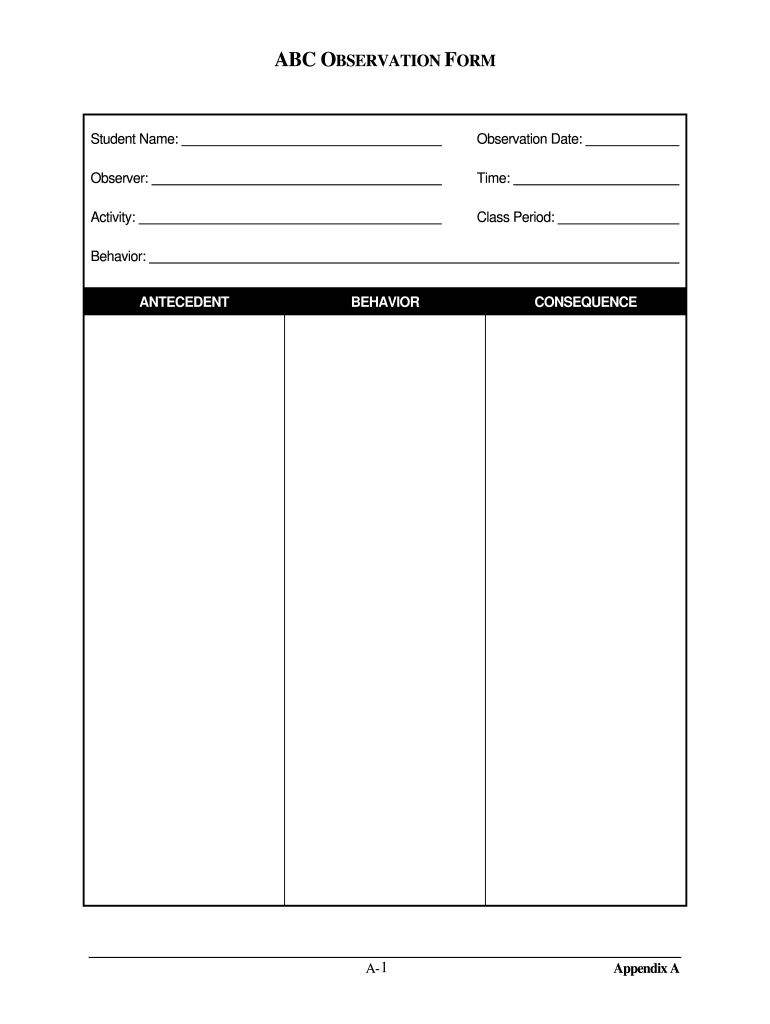
The ABC Observation Form is a structured tool used primarily in educational settings for evaluating student behavior. The form is designed to document specific incidents of behavior, capturing critical information that can inform intervention strategies. Key elements include:
- Student Name: Essential for identifying the individual being observed.
- Observation Date: Provides temporal context for the behavior being recorded.
- Observer: Indicates who is conducting the observation, which is crucial for accountability and follow-up.
- Time: Allows for noting the specific moment an incident occurred, aiding in pattern recognition.
- Activity: Describes the context in which the behavior occurred, such as during a particular lesson or activity.
The ABC framework focuses on three primary aspects of behavior during observation:
- Antecedent: This section captures what happened immediately before the behavior — the events or triggers that may have led to the observed action.
- Behavior: This section provides a detailed account of the behavior itself that was observed, describing it in objective terms.
- Consequence: Here, the observer notes the outcome of the behavior, including any responses from teachers or peers, which helps in assessing the effectiveness of intervention strategies.
Importance of Capturing Context
Understanding the context of an incident is crucial for accurate analysis. The form may include sections such as:
- Class Period: Indicates which part of the school day the behavior occurred, offering insight into patterns related to specific times.
- Context of Incident: This allows for a deeper understanding of the setting, such as whether the behavior occurred in a one-on-one situation or within a larger group.
Steps to Complete the ABC Observation Form
Completing the ABC Observation Form involves several key steps that ensure comprehensive documentation of the observed behavior.
-
Gather Required Information:
- Ensure you have the student's name, the date of observation, your name as the observer, and the time of observation.
-
Document the Activity:
- Clearly write down what the student was doing at the time of the observation. This could include details such as the subject being taught or any specific tasks the student was engaged with.
-
Identify Antecedents:
- Note any triggers or events that occurred prior to the behavior. This could include interactions with peers, teacher instructions, or environmental factors.
-
Describe the Behavior:
- Use factual, specific language to describe the behavior exhibited by the student. Avoid subjective terms and focus on observable actions.
-
Record Consequences:
- Document how others responded to the behavior, including reactions from the teacher or classmates. This section should reflect the immediate results following the student's actions.
-
Review for Accuracy:
- Ensure all sections are filled out correctly and comprehensively. Accurate data is essential for later analysis and intervention.
-
Analyze Patterns:
- After completing several forms, look for recurring themes in behaviors, triggers, and outcomes to inform targeted interventions.
Importance of Consistency
Consistency in filling out the form helps in forming a clear picture of the student’s behavior over time. Observers should aim to use the same criteria for observing and documenting behavior in various contexts, allowing for more reliable comparisons and conclusions.
Key Elements of the ABC Observation Form
The ABC Observation Form consists of essential components that contribute to its effectiveness as a behavioral assessment tool. Understanding these elements can enhance the accuracy and utility of observations.
-
Clear Identification Fields: These include the student's name, the observation date, and the observer's details. This ensures each observation is traceable and linked to the correct individual.
-
Observation Details:
- Activity and Class Period: Defining the setting helps stakeholders understand potential influences on behavior.
- Context of Incident: This section allows for greater nuance by specifying any unique features of the environment.
-
Behavior Section: This section specifies the observed behavior objectively. Descriptive and quantifiable behavior statements guide the observer in maintaining focus on facts rather than interpretations.
-
Antecedent and Consequence Fields: These two sections are crucial for behavioral analysis.
-
Antecedent: Identifies patterns that may suggest triggers for specific behaviors, which can include environmental conditions and peer interactions.
-
Consequence: Helps to assess the effectiveness of responses to behaviors, guiding future decisions on interventions.
-
-
Appendix: Often includes directions or examples to assist in filling out the form accurately, which can serve as a valuable resource during observations.
Examples of Using the ABC Observation Form
Effective use of the ABC Observation Form hinges on real-world applications that highlight its functionalities. Here are specific scenarios:
-
Example 1: Disruptive Behavior in Class
A student frequently interrupts during math lessons. The observer notes the incident on the form, specifying that the antecedent was the teacher asking a question, the behavior was talking out of turn, and the consequence was the teacher's reprimand. This data can help in understanding whether the student is seeking attention or struggling with the material. -
Example 2: Positive Behavior Recognition
During a group project, a student helps peers stay on task when the antecedent was a lack of clear direction from the teacher. The behavior noted is cooperative engagement, with a positive consequence being verbal praise from the teacher. This reinforces the student's role as a supportive peer, an aspect that can be nurtured further. -
Example 3: Tailored Interventions
If the observations of a student transitioning between classes show that crowds trigger anxiety (antecedent), leading to withdrawal (behavior) with staff providing reassurance (consequence), the school can develop tailored strategies, such as a buddy system or staggered transitions to reduce anxiety.
These scenarios demonstrate the versatility of the ABC Observation Form in capturing complex behavioral information while fostering a deeper understanding of student needs and interventions.




