

Slide sign in the protocol

Aug 6th, 2022
forms filled out
0
forms filled out
forms signed
0
forms signed
forms sent
0
forms sent
Service screenshot
01. Upload a document from your computer or cloud storage.
Service screenshot
02. Add text, images, drawings, shapes, and more.
Service screenshot
03. Sign your document online in a few clicks.
Service screenshot
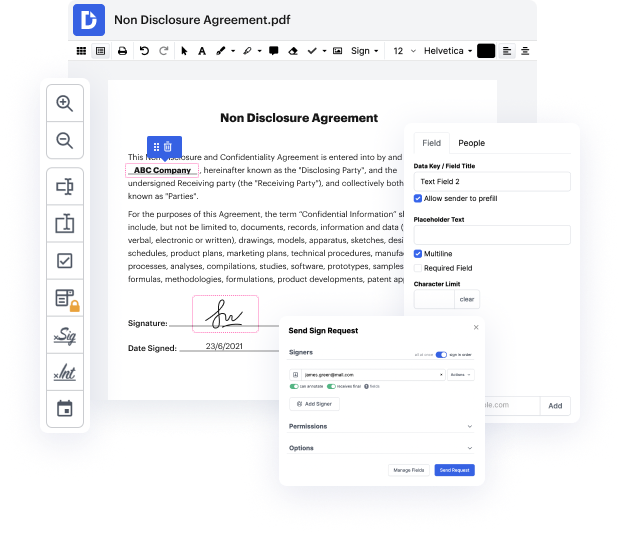
04. Send, export, fax, download, or print out your document.

Slide sign in protocol and cut through the workflow with DocHub

Form edit decoration

The struggle to handle protocol can consume your time and overwhelm you. But no more - DocHub is here to take the hard work out of altering and completing your documents. You can forget about spending hours editing, signing, and organizing paperwork and stressing about data safety. Our platform provides industry-leading data protection measures, so you don’t need to think twice about trusting us with your privat data.

Here is how you can slide sign in protocol on the web:

  1. Create a free DocHub profile or log in to your existing one.
  2. Add a document by clicking the ‘New Document’ button or going to Documents.
  3. Use the top toolbar to slide sign in protocol.
  4. Edit, annotate, and improve your document layout.
  5. Click the right-corner Dropdown icon -> Actions and choose the option of your choice to Make a Copy, Move to Folder, or Convert to Template.
  6. Click the Download/Export to finish.

DocHub supports different data file formats and is available across multiple systems.

PDF editing simplified with DocHub

icon
Seamless PDF editing
Editing a PDF is as simple as working in a Word document. You can add text, drawings, highlights, and redact or annotate your document without affecting its quality. No rasterized text or removed fields. Use an online PDF editor to get your perfect document in minutes.
icon
Smooth teamwork
Collaborate on documents with your team using a desktop or mobile device. Let others view, edit, comment on, and sign your documents online. You can also make your form public and share its URL anywhere.
icon
Automatic saving
Every change you make in a document is automatically saved to the cloud and synchronized across all devices in real-time. No need to send new versions of a document or worry about losing information.
icon
Google integrations
DocHub integrates with Google Workspace so you can import, edit, and sign your documents directly from your Gmail, Google Drive, and Dropbox. When finished, export documents to Google Drive or import your Google Address Book and share the document with your contacts.
icon
Powerful PDF tools on your mobile device
Keep your work flowing even when you're away from your computer. DocHub works on mobile just as easily as it does on desktop. Edit, annotate, and sign documents from the convenience of your smartphone or tablet. No need to install the app.
icon
Secure document sharing and storage
Instantly share, email, and fax documents in a secure and compliant way. Set a password, place your documents in encrypted folders, and enable recipient authentication to control who accesses your documents. When completed, keep your documents secure in the cloud.

Drive efficiency with the DocHub add-on for Google Workspace

Access documents and edit, sign, and share them straight from your favorite Google Apps.
Install now

How to slide sign in the protocol

5 out of 5
11 votes

in the last lecture we have seen the stop-and-wait protocol and the stop-and-wait a RQ protocol in todays lecture we will see the sliding window protocol lets start the session with the outcomes in todays session we have three outcomes lets see what are they upon the completion of this session the learner will be able to outcome number one understand the drawbacks of stop and wait a RQ protocol outcome number two we will know the need for sliding window protocol and outcome number three we will understand the working of sliding window protocol before we go into the sliding window protocol lets see the stop-and-wait arq u protocol again but briefly we know the flow control protocols are for noiseless channel and noisy channels and we have already seen the stop-and-wait protocol and the stop-and-wait AR q protocol you may be wondering where is sliding window protocol in the hierarchy go back in AR q and the selective-repeat here q are the sliding window protocols lets see the stop-

video background

Got questions?

Here are some common questions from our customers that may provide you with the answer you're looking for. If you can't find an answer to your question, please don't hesitate to reach out to us.
Contact us
The sliding sac sign is the movement of a gestational sac against the endocervical canal and can be seen in a miscarriage in progress but not a cervical ectopic pregnancy [11].
The lung sliding sign refers to the movement between the two pleural layers (at the pleural line, Fig. 5A) that occurs during respiration. Its presence indicates that the two pleural layers are in apposition to each other, and sliding with respiration(4).
The Pouch of Douglas is an area within the pelvis behind your uterus where the ovaries and fallopian tubes sit. Endometriosis can cause adhesions and scar tissue in this area which can also cause fertility problems as well as pain with intercourse and opening your bowels.
The designation of lung sliding refers to a to-and-fro movement of the visceral pleura in contact with the parietal pleura and has been variably described as a shimmering/glimmering (or twinkling) of the pleural line on 2-Dimensional ultrasound5.
The sliding‐sign diagnostic test, which involves determining whether the anterior rectum glides freely across the posterior aspect of the cervix, posterior vaginal wall (for an anteverted uterus) or uterine fundus (for a retroverted uterus) 7 , has been associated with bowel involvement, namely rectal or sigmoid
The jellyfish sign refers to the sonographic appearance of atelectatic lung swimming within a large pleural effusion. The mobility of the lung within pleural fluid implies an absence of lung consolidation and the absence of pleural adhesions 1.
This technique involves using gentle probe pressure to assess whether the anterior rectum and sigmoid colon glides freely across the posterior aspect of the upper uterus, cervix and vaginal wall. Normal sliding motion of the uterus is regarded as a positive sliding sign.

See why our customers choose DocHub

Great solution for PDF docs with very little pre-knowledge required.
"Simplicity, familiarity with the menu and user-friendly. It's easy to navigate, make changes and edit whatever you may need. Because it's used alongside Google, the document is always saved, so you don't have to worry about it."
Pam Driscoll F
Teacher
A Valuable Document Signer for Small Businesses.
"I love that DocHub is incredibly affordable and customizable. It truly does everything I need it to do, without a large price tag like some of its more well known competitors. I am able to send secure documents directly to me clients emails and via in real time when they are viewing and making alterations to a document."
Jiovany A
Small-Business
I can create refillable copies for the templates that I select and then I can publish those.
"I like to work and organize my work in the appropriate way to meet and even exceed the demands that are made daily in the office, so I enjoy working with PDF files, I think they are more professional and versatile, they allow..."
Victoria G
Small-Business
be ready to get more

Edit and sign PDFfor free

Get started now