
Set URL in the certificate


Use our all-in-one document editor to set URL in certificate in minutes.
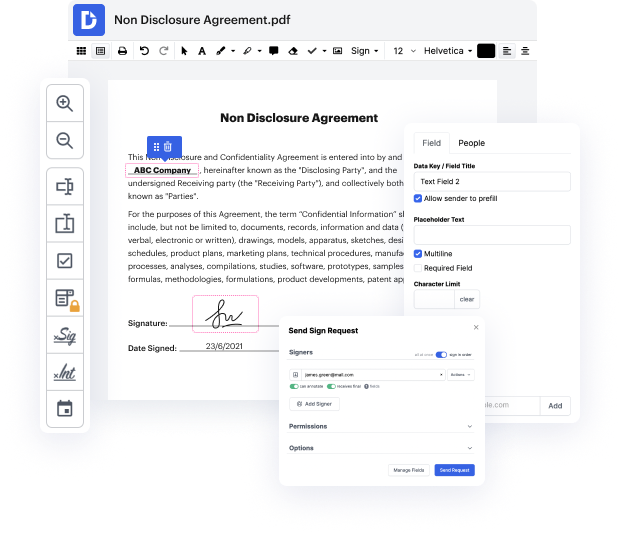
DocHub allows you to set URL in certificate swiftly and quickly. Whether your document is PDF or any other format, you can effortlessly alter it utilizing DocHub's user-friendly interface and powerful editing tools. With online editing, you can change your certificate without the need of downloading or installing any software.
DocHub's drag and drop editor makes customizing your certificate simple and streamlined. We safely store all your edited paperwork in the cloud, enabling you to access them from anywhere, anytime. Moreover, it's straightforward to share your paperwork with parties who need to review them or add an eSignature. And our native integrations with Google products let you transfer, export and alter and endorse paperwork directly from Google apps, all within a single, user-friendly platform. Plus, you can quickly convert your edited certificate into a template for repeated use.
How do you set URL in certificate with DocHub?
- First, import your certificate to DocHub.
- Next, select ADD NEW > Select from Device or transfer your document yourself from the cloud.
- Once opened, you can start making tweaks utilizing tools in the top and right-hand tabs. In these tabs, you can find the option to set URL in your certificate.
- Choose Done at the top and then pick one of the options in the right-hand menu of the DocHub dashboard to save your document: download, combine and divide, reorder pages, change formats, etc.
All processed paperwork are safely stored in your DocHub account, are easily handled and shifted to other folders.
DocHub simplifies the process of completing document workflows from day one!
PDF editing simplified with DocHub






Drive efficiency with the DocHub add-on for Google Workspace
How to set URL in the certificate
Learn how to use Azure App Service managed certificates in this episode of Azure Tips and Tricks. Here I have a website with a custom domain that runs in an Azure web app, and its not protected with an SSL certificate. That is why I see this warning. Lets fix this. Here is the Azure portal, and Im in the web app. In here, I can go to the SSL/TLS settings. This is it. I have nothing configured yet. There are no bindings yet and no certificates. By the way, in order to use custom domains and SSL, your web app needs to run in the B1 service tier or higher. This doesnt work for the free or shared tiers. Lets go to the private key blade. Here we go. This is where my certificates would show up. I dont have any yet. I have lots of options to create ones though. I can buy a certificate from here, for instance. That is the app server certificate which you can use when you need to have a wildcard certificate, and when you need to be able to export it, or protect naked domains. So withou

Got questions?
How to add URL to SSL certificate?
How do I find the URL of a certificate?
How do I get a certificate URL?
How do I link my domain to SSL certificate?
What is a certificate URL?
How do I get a URL certificate?
How do I copy a certificate URL?
See why our customers choose DocHub


Security and compliance
At DocHub, your data security is our priority. We follow HIPAA, SOC2, GDPR, and other standards, so you can work on your documents with confidence.
Learn more


