
*Powered by ChatGPT
Explore DocHub’s ChatGPT-assisted features to Improve Register with AI in IT industry
Coming soon
Aug 6th, 2022

0
forms filled out

0
forms signed

0
forms sent
01. Upload a document from your computer or cloud storage service.
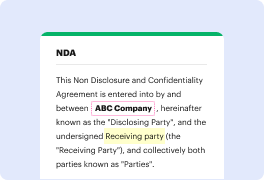
02. Modify your document or let the ai PDF editor summarize, rewrite, or proofread your PDF.
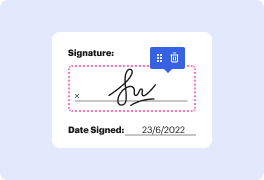
03. Sign your document online in a few clicks.

04. Send, export, fax, download, or print out your document.
How to use DocHub’s capabilities to Improve Register using AI in IT industry
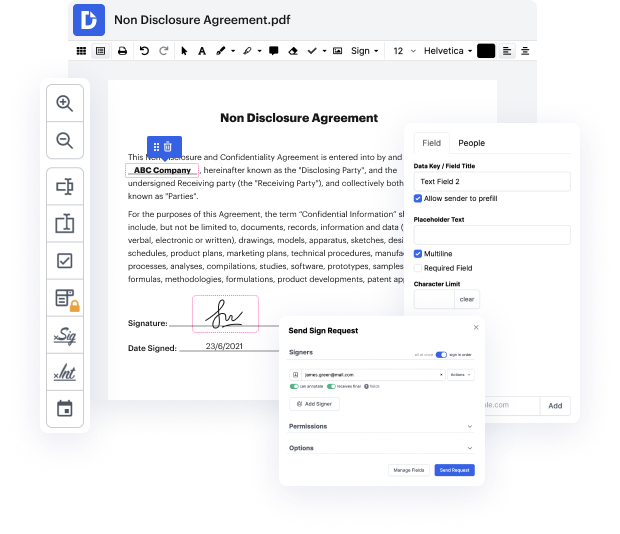
Regular online editors can help specialists in IT industry with simple document management tasks. However, an up-to-date AI-driven solution like DocHub provides more capabilities and helps complete your work faster. Select our ChatGPT-powered tool to Improve Register and other business paperwork - you’ll get the results you need within minutes!
Check out the quick guide below to Improve Register with AI in IT sector:
- Register an account in DocHub and log in after its verification.
- Add the Register to the editor using one of the available upload methods.
- Launch the ChatGPT assistant and select the tool that lets you Improve your document.
- Look through the updates proposed by Artificial Intelligence.
- Make edits where needed, and check at least once more before submitting.
- Create your signature and request it from others if your form needs approval.
- Click on Menu to download, export, or share your professional paperwork.
Whatever your document management needs, you can rely on our progressive solution and complete your tasks in clicks. Try it today!
A single solution for all your PDF needs

Lossless PDF editing
Edit a PDF as easily as you would a Word document. Add text, images, drawings, and highlight or white out information without affecting document quality. No rasterized text or removed fields.

Secure collaboration and document sharing
Improve teamwork with comments and document permissions that allow others to view, edit, and sign your documents online. Securely send your document via email, fax, public or private link, and export the finalized PDF to the cloud or download it to your device.

Quick data collection
Create and fill out PDF forms online on any device. Turn your form or document into a reusable template and share it via URL or email so anyone can fill out their own copy.

Legally-binding eSignatures
Instantly sign any document — type or draw your signature, or upload an image of it. Request eSignatures from others and track them every step of the way. No need to print and scan.

Google integrations
DocHub extends its PDF editing, form creation, and eSignature capabilities to Google Workspace so you can easily import, export, edit, fill out, and sign your documents directly from your favorite Google Apps.

AI PDF functionality
Improve productivity with DocHub's ai tools. Get quick summaries with the ai PDF summarizer, enhance document readability with an ai that reads PDF, and use the ai PDF editor to ensure the quality of your document’s content.






Drive efficiency with the DocHub add-on for Google Workspace
Access documents and edit, sign, and share them straight from your favorite Google Apps.
Install now
Got questions?
Here are some common questions from our customers that may provide you with the answer you're looking for. If you can't find an answer to your question, please don't hesitate to reach out to us.
Contact us
How does AI help information technology?
An AI system uses a series of algorithms that can help programmers in writing better code or overcome software bugs. AI system suggests a pre-designed set of algorithms for developers based on their performance to optimize the development time by detecting and eliminating software bugs.
How does AI affect information technology?
One of the most docHub ways AI has affected the IT industry is through automation. Companies can automate many of their more complicated processes using AI-powered tools and software. This not only saves time and resources but also decreases the possibility of human error.
Why is AI important in information technology?
It is widely used to monitor, research different types of cases, and analyze past cases and their outcomes. It also seeks to improve their models and assistants efficiency by predicting what could be improved and making themselves smarter.
How has AI improved technology?
In the last five years, the field of AI has made major progress in almost all its standard sub-areas, including vision, speech recognition and generation, natural language processing (understanding and generation), image and video generation, multi-agent systems, planning, decision-making, and integration of vision and
What is a register in AI?
A register is an official record of information. In its simplest form, it can provide visibility over algorithmic systems in use, which is the most basic form of transparency. It can also be designed to enable meaningful transparency that meets stakeholder information needs.
How is AI used in information technology?
Artificial intelligence (AI) for IT operations refers to the application of AI to manage Information Technology based on a multi-based platform. Big Data and machine learning are the two primary technologies employed in AIOps. Using data from the past and present, these automate data processing and decision making.
How to use AI to improve data quality?
AI can use machine learning and natural language processing techniques to detect and correct data errors, such as typos, duplicates, missing values, outliers, and inconsistencies. For example, AI can identify and standardize different formats of dates, names, addresses, and currencies across different data sources.
See why our customers choose DocHub
Great solution for PDF docs with very little pre-knowledge required.

A Valuable Document Signer for Small Businesses.

I can create refillable copies for the templates that I select and then I can publish those.

Security and compliance
At DocHub, your data security is our priority. We follow HIPAA, SOC2, GDPR, and other standards, so you can work on your documents with confidence.
Learn more