
Compile currency charter easily




How to rapidly Compile currency charter and improve your workflow
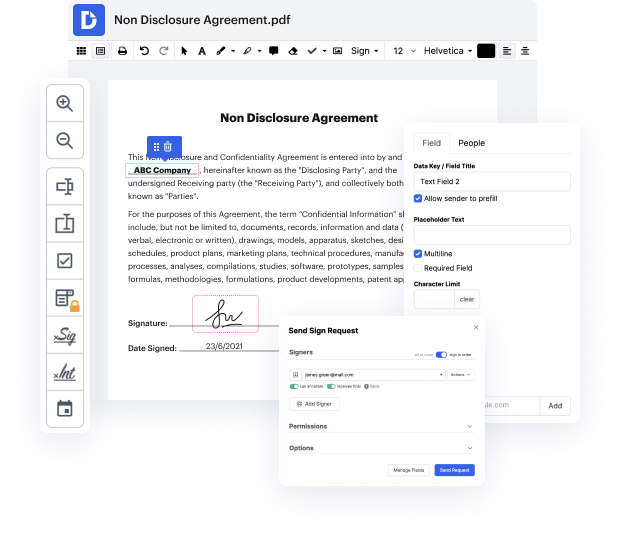
Document editing comes as an element of many professions and careers, which is why instruments for it must be accessible and unambiguous in their use. An advanced online editor can spare you plenty of headaches and save a considerable amount of time if you need to Compile currency charter.
DocHub is an excellent demonstration of an instrument you can master in no time with all the useful features at hand. Start editing immediately after creating your account. The user-friendly interface of the editor will allow you to locate and make use of any feature right away. Notice the difference using the DocHub editor as soon as you open it to Compile currency charter.
Simply follow these steps to start editing your documents:
- Visit the DocHub page and click on Sign up to make an account.
- Give your current email address and set up a security password to finish the registration.
- Once done with the signup, you will be directed to your dashboard. Click the New Document option to add the file you need to edit.
- Pull and drop the document from your device or link it from your cloud storage.
- Open the document in the editor and use its toolbar to Compile currency charter.
- All the alterations in the document will be saved automatically. After finishing the editing, just go to your Dashboard or download the file on your device.
Being an integral part of workflows, file editing must stay straightforward. Using DocHub, you can quickly find your way around the editor making the required adjustments to your document without a minute lost.
PDF editing simplified with DocHub






Drive efficiency with the DocHub add-on for Google Workspace
How to compile currency charter
For more on 19th century banking and monetary debates, lets now consider Peels Act of 1844 and the currency school. This Act, of course, has to do with regulating the Bank of England. Formerly, Peels Act was called the Bank Charter Act of 1844 and just as an introductory overview it did the following: First, it tried to centralize exclusive note-issuing powers in the Bank of England Second, it stipulated 100% gold reserves for new notes above a certain level. It treated more generally banking and control of the currency as separate functions. It also stipulated defacto that the Bank of England would contract credit in case of a drain. Thats what the act actually meant in practice And it tried to create what was then called a Self-Regulating monetary order. Thats all quite a mouthful, a lot of it will become clearer as we go back and revisit the context. For historical background, recall that in 1821 England returns to the Gold Standard. We explain this in more detail in o

See why our customers choose DocHub


Security and compliance
At DocHub, your data security is our priority. We follow HIPAA, SOC2, GDPR, and other standards, so you can work on your documents with confidence.
Learn more