

Bind margin in PAGES

Aug 6th, 2022
forms filled out
0
forms filled out
forms signed
0
forms signed
forms sent
0
forms sent
Service screenshot
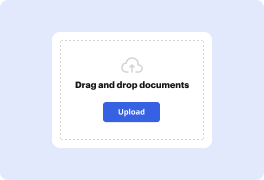
01. Upload a document from your computer or cloud storage.
Service screenshot
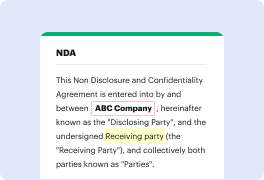
02. Add text, images, drawings, shapes, and more.
Service screenshot
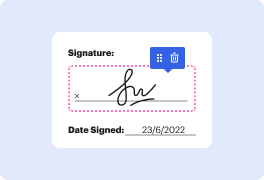
03. Sign your document online in a few clicks.
Service screenshot
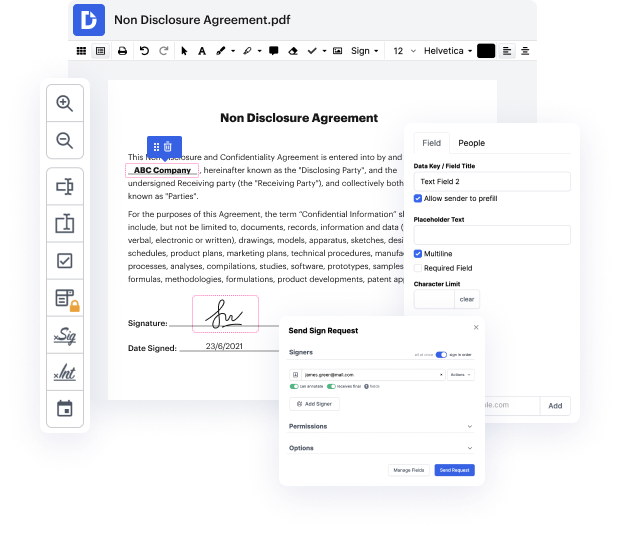
04. Send, export, fax, download, or print out your document.

Explore how to bind margin in PAGES effortlessly with DocHub

Form edit decoration

Editing PAGES is fast and straightforward using DocHub. Skip downloading software to your PC and make adjustments using our drag and drop document editor in a few easy steps. DocHub is more than just a PDF editor. Users praise it for its convenience and robust features that you can use on desktop and mobile devices. You can annotate documents, generate fillable forms, use eSignatures, and email records for completion to other people. All of this, combined with a competing cost, makes DocHub the perfect choice to bind margin in PAGES files effortlessly.

Your quick guide to bind margin in PAGES with DocHub:

  1. Add your PAGES file into your DocHub profile.
  2. After you select your document, click it to view it in our editor.
  3. Use intuitive editing tools to make any adjustments to your record.
  4. Once completed, click Download/Export and save your PAGES to your device or cloud storage.
  5. Store your files in your Documents folder for quick access from any device.

Make your next tasks even easier by converting your documents into reusable templates. Don't worry about the safety of your data, as we securely store them in the DocHub cloud.

PDF editing simplified with DocHub

icon
Seamless PDF editing
Editing a PDF is as simple as working in a Word document. You can add text, drawings, highlights, and redact or annotate your document without affecting its quality. No rasterized text or removed fields. Use an online PDF editor to get your perfect document in minutes.
icon
Smooth teamwork
Collaborate on documents with your team using a desktop or mobile device. Let others view, edit, comment on, and sign your documents online. You can also make your form public and share its URL anywhere.
icon
Automatic saving
Every change you make in a document is automatically saved to the cloud and synchronized across all devices in real-time. No need to send new versions of a document or worry about losing information.
icon
Google integrations
DocHub integrates with Google Workspace so you can import, edit, and sign your documents directly from your Gmail, Google Drive, and Dropbox. When finished, export documents to Google Drive or import your Google Address Book and share the document with your contacts.
icon
Powerful PDF tools on your mobile device
Keep your work flowing even when you're away from your computer. DocHub works on mobile just as easily as it does on desktop. Edit, annotate, and sign documents from the convenience of your smartphone or tablet. No need to install the app.
icon
Secure document sharing and storage
Instantly share, email, and fax documents in a secure and compliant way. Set a password, place your documents in encrypted folders, and enable recipient authentication to control who accesses your documents. When completed, keep your documents secure in the cloud.

Drive efficiency with the DocHub add-on for Google Workspace

Access documents and edit, sign, and share them straight from your favorite Google Apps.
Install now

How to bind margin in PAGES

4.6 out of 5
49 votes

all right so this is a video about wire o and coil binding designing and facing pages but also getting the bleed you need so whatamp;#39;s the problem the problem is facing pages in InDesign are very normal looks like this itamp;#39;s all part of the program and it works for a lot of things it works for books that you staple it works for books that you perfect bind but this kind of layout actually could cause problems if youamp;#39;re trying to do a wire o or coil bind why is it a problem there well if you look at this document this is an export and youamp;#39;ll see on this page um weamp;#39;re getting this green from this side of the spread and on this side weamp;#39;re getting the white because thatamp;#39;s whatamp;#39;s here so basically the indesigns creating bleed thatamp;#39;s really not helpful and it doesnamp;#39;t matter for most things that we do but it does matter for a coil because if we cut it you could see this thin white line instead of it looking beautiful y

video background

Got questions?

Here are some common questions from our customers that may provide you with the answer you're looking for. If you can't find an answer to your question, please don't hesitate to reach out to us.
Contact us
The inside edge margin sizes differ depending on your binding type: Paperback Book Printing: 18mm on the binding edge. 15mm on the other edges. Hardback Book Printing: 19mm on the top and bottom edge, 18mm for the binding edge and 15mm for the outside edge.
The following are the steps to be followed: Open MS word document. Click the layout tab. Select margins. Click on custom margins. Set the required margins. Click Apply from the drop-down menu. Select how to apply the margins. Click OK.
Gutter margin is the margin that is added to the binding side of the page when printing.
Number of Pages Accepted To help avoid this, we recommend you have a 3/8 (0.375) margin on the binding side of all pages, including inside cover pages. Smaller books may need less margin while larger books may need more.
in the toolbar, then click the Document tab at the top of the sidebar. In the Document Margins section, click the arrows or enter values in the fields next to Top, Bottom, Left, and Right. For documents that use facing pages, the document margins are Top, Bottom, Inside, and Outside.
Margins are very important when it comes to binding. No margins = Text/images cut off in the binding process. For single-sided printing, we recommend a margin of 3cm on the left side and 2.5 cm on the other three sides. For double-sided printing, we recommend a margin of 2.5 cm on all four sides.
The binding edge is the Inside, and the free edge is the Outside. Often you will want the Inside margin to be larger, to allow for binding. This larger margin will alternate from left (Inside on a Recto page) to right (Inside on a Verso page).
In general, for spiral or wire-o bound products we recommend 1/2 margins to be safe. However, if space is an issue, you can follow these specific guides: Holes for spiral binding are smaller and only require 1/4 of the binding edge. Wire-o holes are larger and require 1/2 margins.

See why our customers choose DocHub

Great solution for PDF docs with very little pre-knowledge required.
"Simplicity, familiarity with the menu and user-friendly. It's easy to navigate, make changes and edit whatever you may need. Because it's used alongside Google, the document is always saved, so you don't have to worry about it."
Pam Driscoll F
Teacher
A Valuable Document Signer for Small Businesses.
"I love that DocHub is incredibly affordable and customizable. It truly does everything I need it to do, without a large price tag like some of its more well known competitors. I am able to send secure documents directly to me clients emails and via in real time when they are viewing and making alterations to a document."
Jiovany A
Small-Business
I can create refillable copies for the templates that I select and then I can publish those.
"I like to work and organize my work in the appropriate way to meet and even exceed the demands that are made daily in the office, so I enjoy working with PDF files, I think they are more professional and versatile, they allow..."
Victoria G
Small-Business
be ready to get more

Edit and sign PDFfor free

Get started now